ChatGPT, Perplexity & Google AI: 32 Platform Optimization Tips
Design

Tanuj Sarva
04/05/2026
How do optimization strategies differ across ChatGPT, Perplexity, and Google AI Overview in 2026? Each AI platform uses distinct algorithms, citation criteria, and content evaluation methods requiring platform-specific tactics. These 32 proven optimization tips from Web of Picasso's work with 150+ brands reveal exactly how to maximize visibility across all three major answer engines simultaneously.
Why Generic AEO Strategies Fail Across Platforms
Most businesses approach Answer Engine Optimization as if ChatGPT, Perplexity, and Google AI Overview operate identically. This fundamental mistake wastes resources on tactics working well for one platform while delivering minimal results on others.
According to Gartner's 2026 AI platform analysis, different answer engines prioritize dramatically different signals when selecting sources to cite. ChatGPT emphasizes conversational relevance and semantic depth, Perplexity prioritizes source credibility and citation quality, while Google AI Overview leverages traditional SEO signals plus AI-specific factors.
From my 5+ years building Web of Picasso, brands optimizing uniformly across platforms achieve 40-60% lower citation rates than those implementing platform-specific strategies. The companies dominating all three answer engines understand each platform's unique approach to earning AI citations and mentions and tailor content accordingly.
Understanding Platform Differences at Algorithm Level
ChatGPT's Conversational Preference Signals
ChatGPT operates as conversational AI optimizing for natural dialogue and follow-up question handling. Its training emphasizes understanding context, maintaining conversation threads, and providing answers matching how humans actually communicate.
This conversational focus means ChatGPT favors content written in natural language with clear question-answer structures, comprehensive explanations, and practical examples over keyword-dense text optimized for traditional search engines. Our ChatGPT AEO service builds content around exactly these conversational signals.
Perplexity's Research-Quality Requirements
Perplexity positions as research tool prioritizing source credibility, citation transparency, and factual accuracy. It evaluates domain authority, content creator credentials, and citation networks before determining which sources to recommend.
This research orientation means Perplexity demands higher standards for source quality, proper attribution, and verifiable claims than conversational AI platforms accepting broader content quality ranges. Our Perplexity AEO service is built to meet those research-grade standards.
Google AI Overview's SEO Foundation Integration
Google AI Overview builds on traditional search ranking factors while adding AI-specific evaluation criteria. It leverages Google's existing understanding of content quality, domain authority, and user engagement combined with generative AI capabilities.
This hybrid approach means Google AI Overview optimization requires solid traditional SEO foundations plus AI-specific enhancements rather than completely new strategies independent of existing search ranking factors. Start from our guide on how to optimize your website for AI search to get that technical setup right.
ChatGPT Optimization: 11 Platform-Specific Tips
Tip 1: Write in Natural, Conversational Language
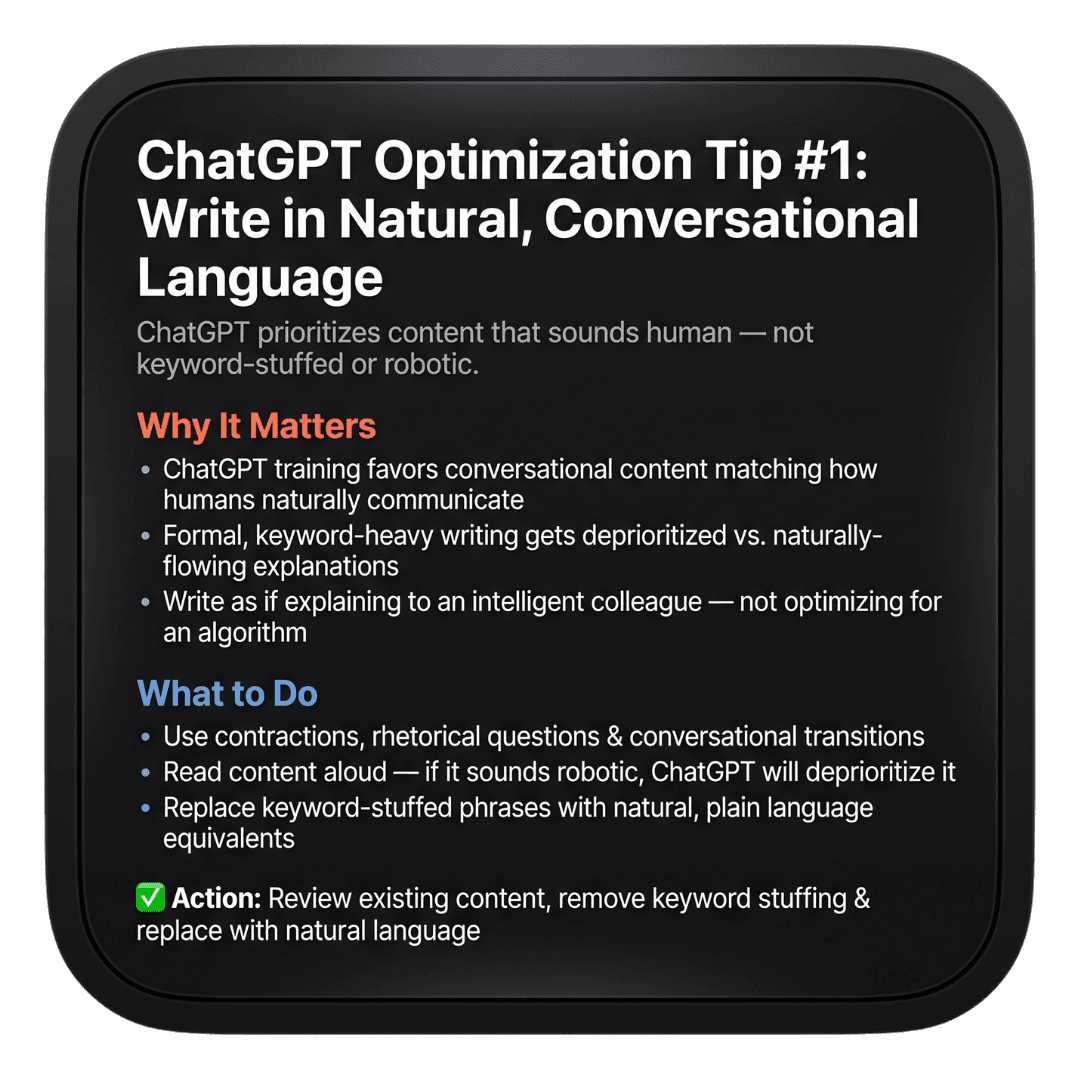
ChatGPT's training prioritizes conversational content matching how humans naturally communicate. Content written formally or stuffed with keywords performs poorly compared to naturally-flowing explanations.
Write as if explaining concepts to intelligent colleagues rather than optimizing for search algorithms. Use contractions, ask rhetorical questions, and employ conversational transitions ChatGPT recognizes as high-quality communication patterns.
Action: Review existing content removing keyword-stuffed phrases and replacing with natural language. Read content aloud - if it sounds robotic, ChatGPT will deprioritize it.
Tip 2: Lead With Direct Answers in First 40 Words
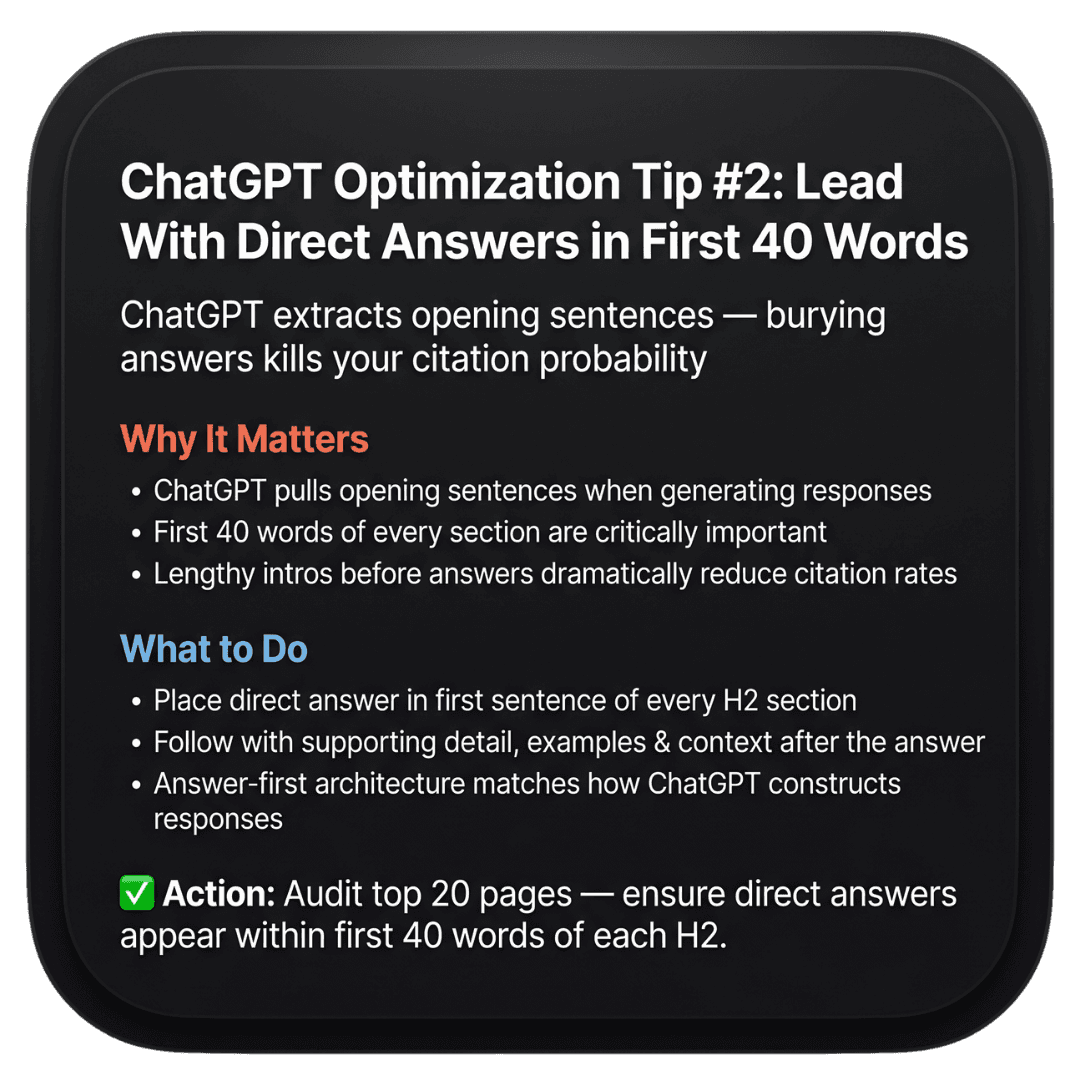
ChatGPT extracts opening sentences when generating responses, making the first 40 words of each section critically important. Burying answers after lengthy introductions reduces citation probability dramatically.
Structure every section with direct answer statements in opening sentences followed by supporting detail, examples, and context. This answer-first architecture matches how ChatGPT constructs responses.
Action: Audit top 20 pages placing direct answers within first 40 words of each H2 section. Test with "Does this sentence directly answer the heading question?" - if no, rewrite opening.
Tip 3: Use Question-Based H2 Headers
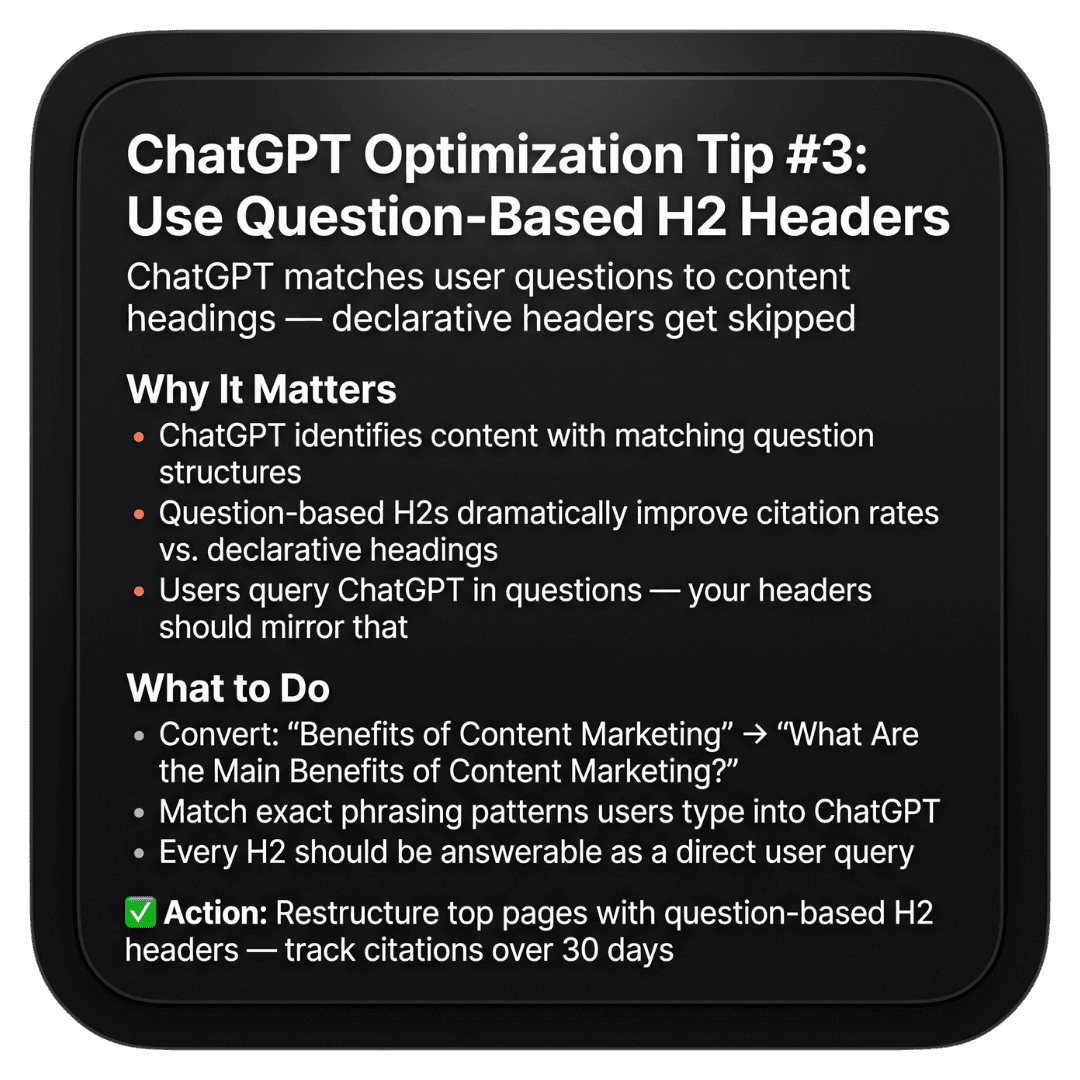
ChatGPT's conversational model responds to user questions by identifying content with matching question structures. H2 headers phrased as questions dramatically improve citation rates compared to declarative headings.
Convert headings from statements to questions matching how users actually query ChatGPT. "Benefits of Content Marketing" becomes "What Are the Main Benefits of Content Marketing?" to align with conversational search patterns.
Action: Restructure top-performing pages using question-based H2 headers. Track citation improvements over 30 days after implementation.
Tip 4: Emphasize Recency Through Date References
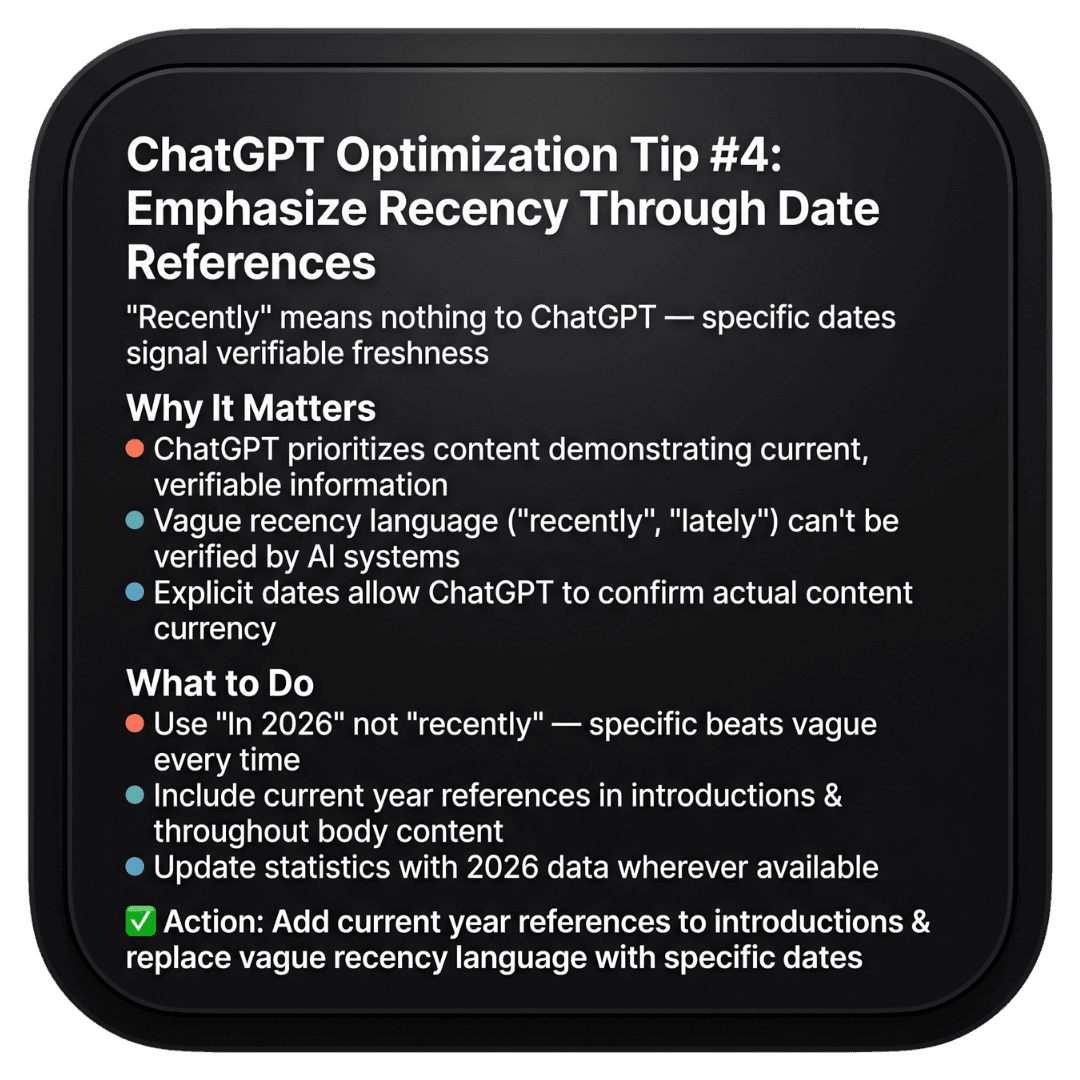
ChatGPT's training cuts off at specific dates, making it prioritize content demonstrating current information. Explicit date references signal freshness that generic "recently" language doesn't convey effectively.
Include specific dates, current year references, and temporal markers throughout content. "In 2026" performs better than "recently" because ChatGPT can verify actual currency rather than trusting vague recency claims.
Action: Add current year references to introductions and update statistics with 2026 data where available. Monitor citation improvements for pages with explicit temporal markers.
Tip 5: Build Dense Semantic Relationship Networks
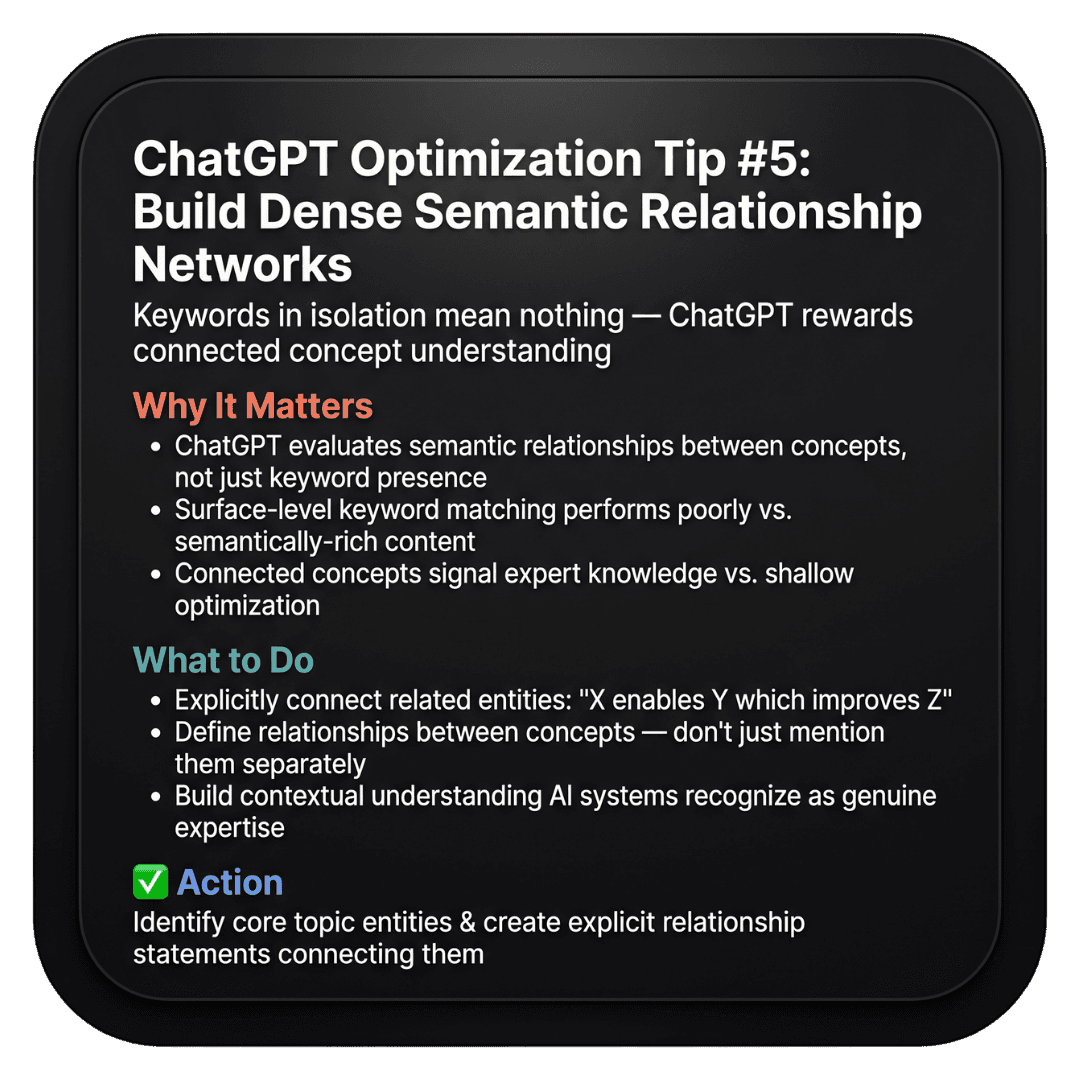
ChatGPT evaluates semantic relationships between concepts, rewarding content demonstrating deep understanding through comprehensive entity connections. Surface-level keyword matching performs poorly versus semantically-rich content.
Connect related concepts explicitly, define relationships between entities, and build contextual understanding AI systems recognize as expert knowledge rather than keyword optimization.
Action: Identify core topic entities and create relationship statements: "X enables Y which improves Z" rather than mentioning X, Y, Z independently without connecting them.
Tip 6: Include Authoritative External Citations
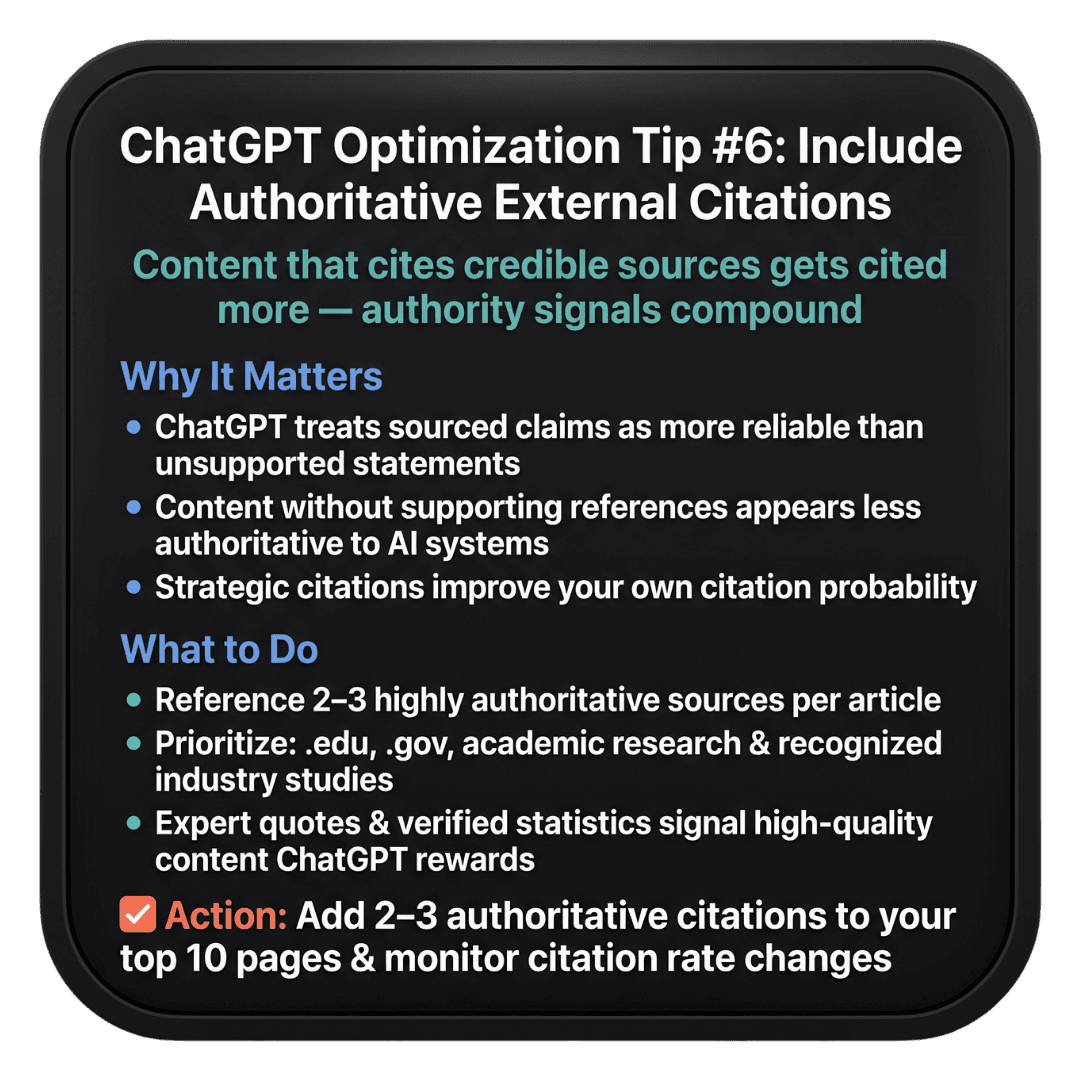
ChatGPT's training includes understanding citation patterns, recognizing content citing authoritative sources as more reliable than claims without supporting references. Strategic citations improve your own citation probability.
Reference 2-3 highly authoritative sources per article, particularly academic research, industry studies, or recognized expert statements. This citation behavior signals content quality ChatGPT rewards.
Action: Add 2-3 authoritative citations to top 10 pages, preferably to .edu, .gov, or recognized industry research organizations. Monitor citation rate changes.
Tip 7: Create Comprehensive 2000+ Word Content
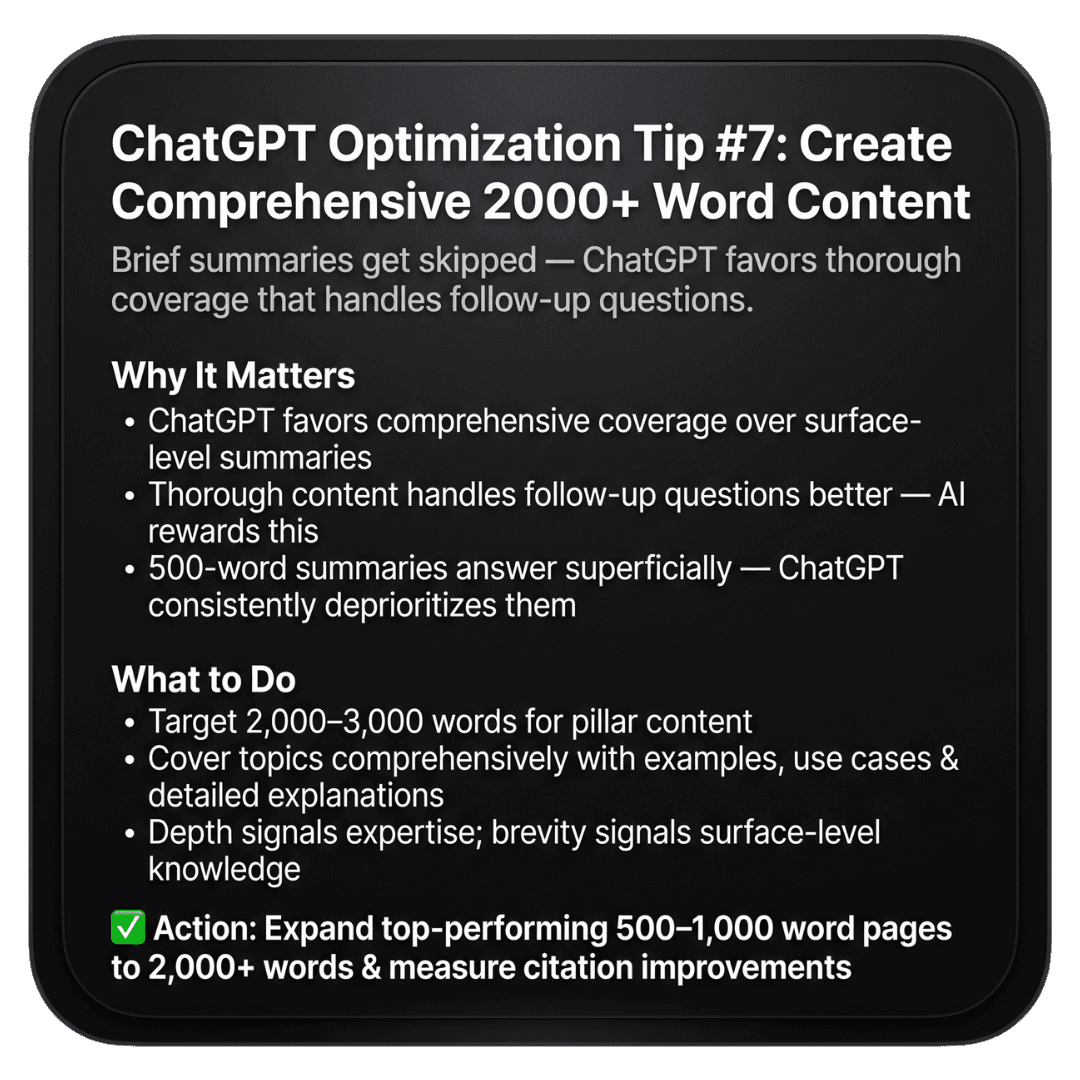
ChatGPT favors comprehensive coverage over surface-level summaries because thorough content provides more useful responses to follow-up questions. Longer, detailed content outperforms brief summaries consistently.
Target 2000-3000 words for pillar content covering topics comprehensively rather than 500-word summaries that answer questions superficially without providing depth ChatGPT prioritizes.
Action: Expand top-performing 500-1000 word pages to 2000+ words with additional examples, use cases, and detailed explanations. Measure citation improvements on expanded content.
Tip 8: Incorporate Practical Examples and Use Cases
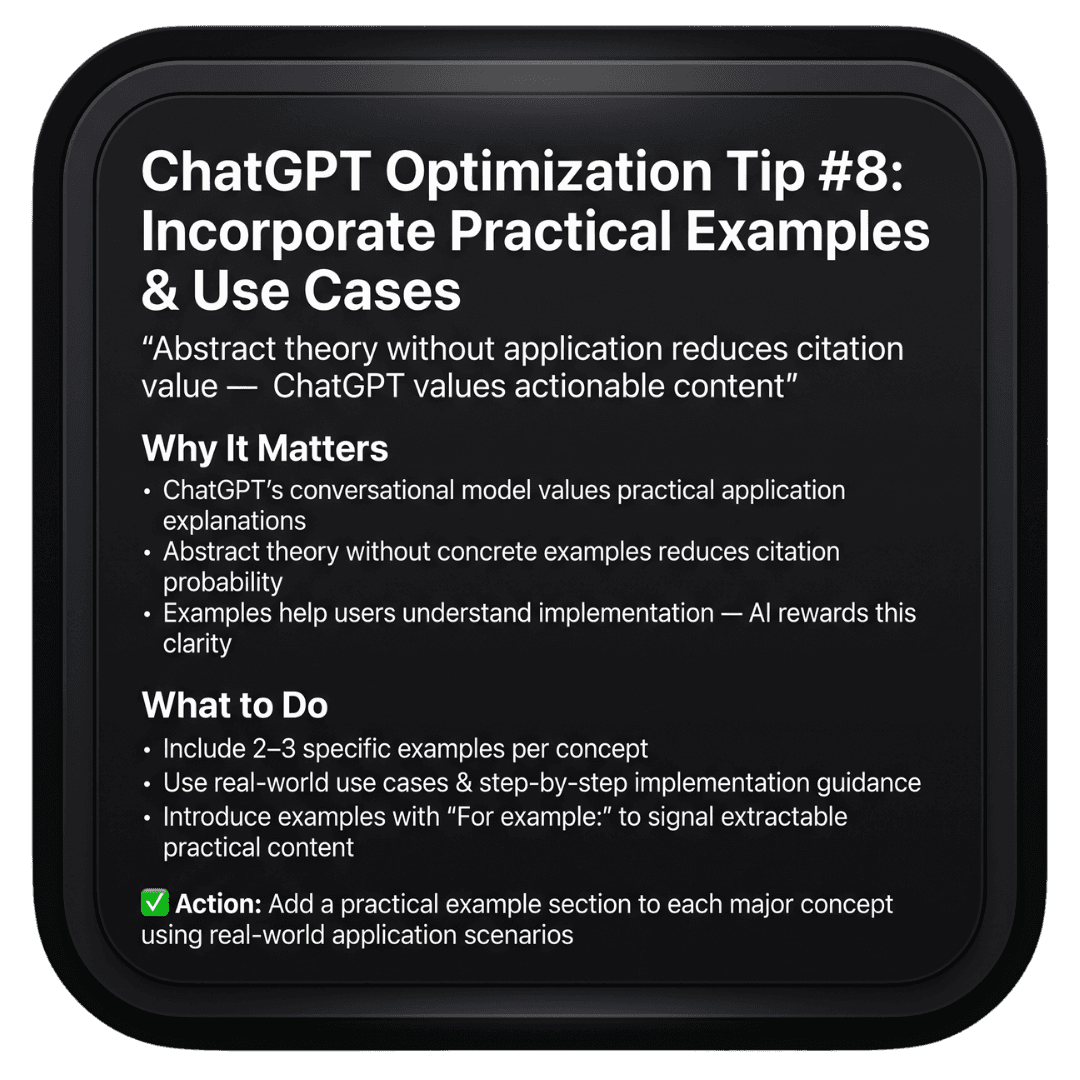
ChatGPT's conversational model values practical application explanations helping users understand implementation. Abstract theory without concrete examples reduces citation value compared to application-focused content.
Include 2-3 specific examples per concept, real-world use cases, and step-by-step implementation guidance making concepts immediately actionable rather than purely theoretical.
Action: Add practical example section to each major concept with "For example:" introducing real-world application scenarios. Track user engagement and citation improvements.
Tip 9: Optimize for Follow-Up Query Paths
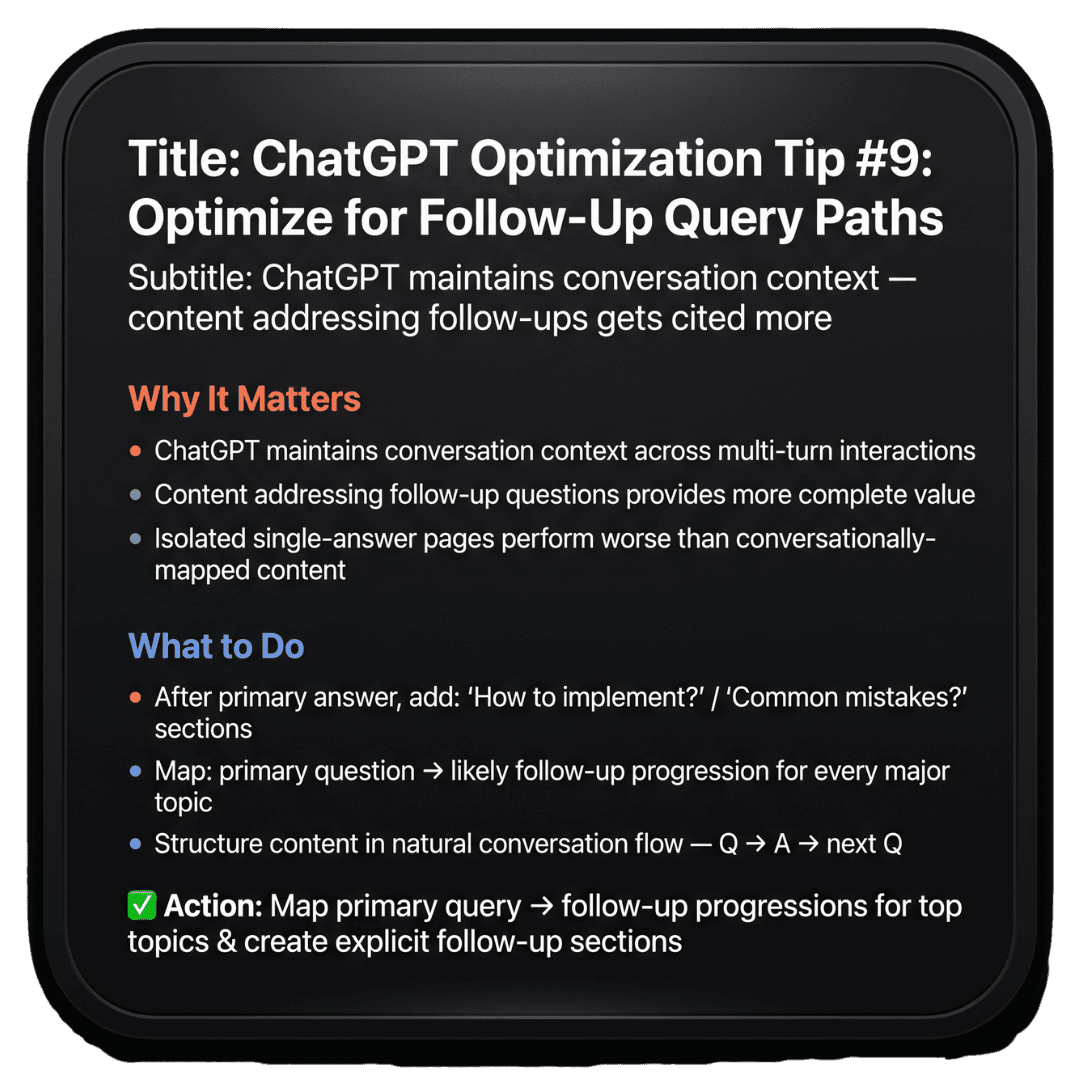
ChatGPT maintains conversation context, making content addressing likely follow-up questions more valuable than isolated answers. Anticipate natural question progressions and address them proactively.
After answering primary questions, include sections addressing obvious follow-ups: "How to implement this?" or "What are common mistakes?" that conversational users naturally ask next.
Action: Map primary question → likely follow-up progression for top topics. Create content sections explicitly addressing each follow-up question in natural conversation flow.
Tip 10: Structure Content for Easy Sentence Extraction
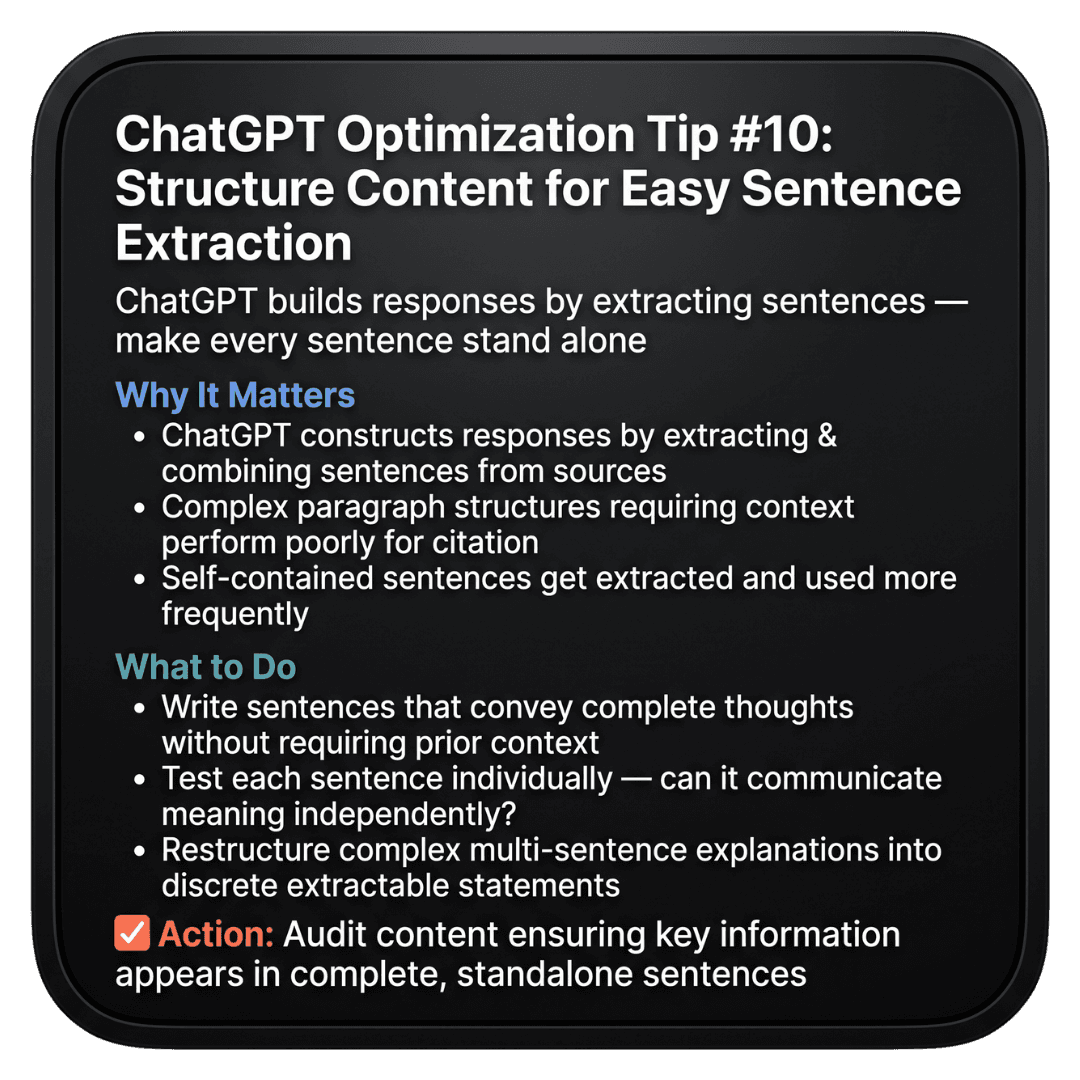
ChatGPT constructs responses by extracting and combining sentences from sources. Content with self-contained, complete sentences citing easily performs better than complex paragraph structures requiring context.
Write sentences that stand alone conveying complete thoughts without requiring previous sentence context. Test by reading sentences individually - can each communicate independently?
Action: Audit content ensuring key information appears in complete, standalone sentences. Restructure complex multi-sentence explanations into discrete extractable statements.
Tip 11: Build Topical Authority Through Cluster Content
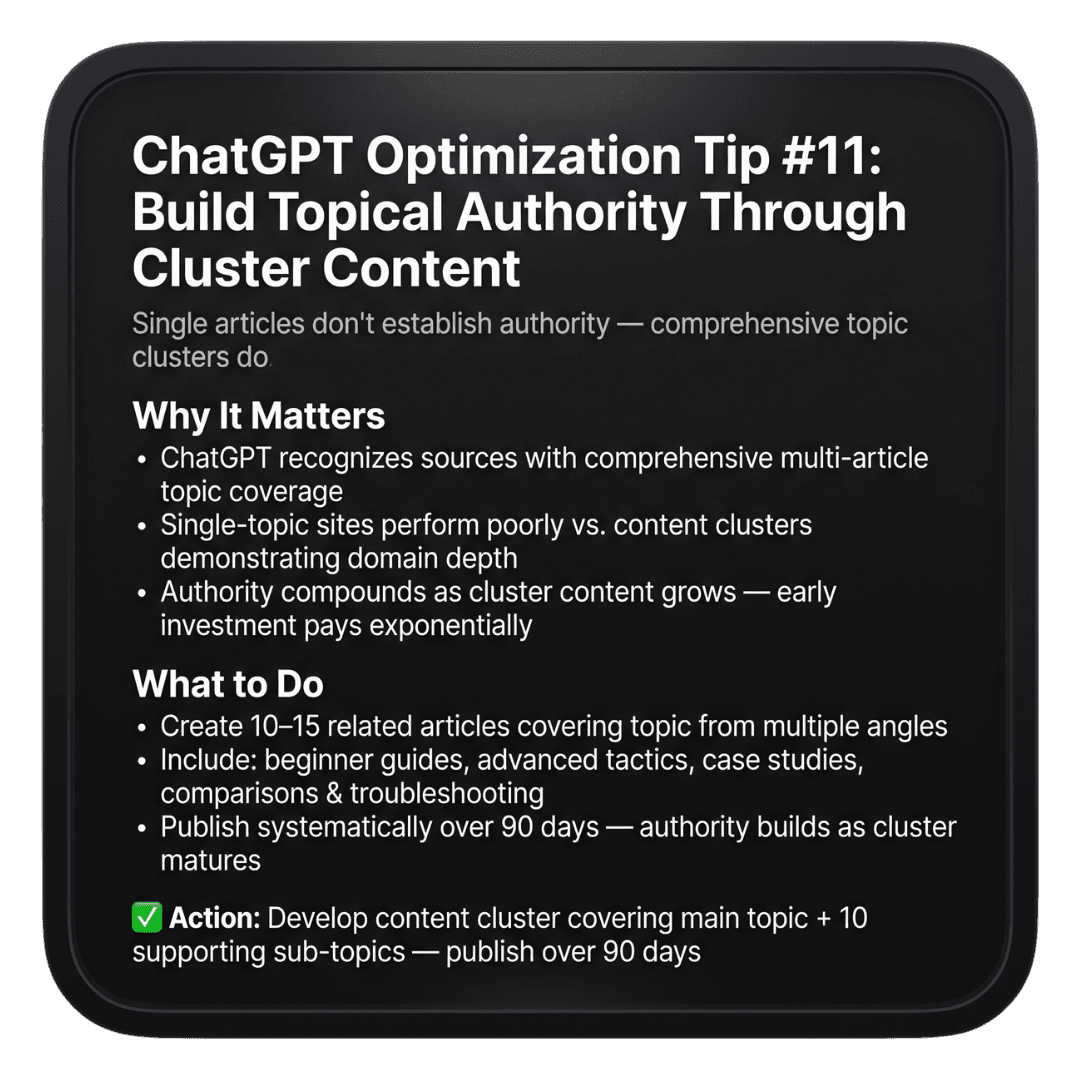
ChatGPT recognizes sources demonstrating comprehensive topic coverage through multiple related articles. Single-topic sites perform poorly versus content clusters establishing deep domain expertise.
Create 10-15 related articles covering topic from multiple angles: beginner guides, advanced tactics, case studies, comparison content, and troubleshooting building comprehensive authority ChatGPT rewards.
Action: Develop content cluster strategy covering main topic plus 10 supporting sub-topics. Publish systematically over 90 days while monitoring citation improvements as authority builds.
Perplexity Optimization: 11 Research-Quality Tips
Tip 12: Prioritize Exceptional Source Credibility
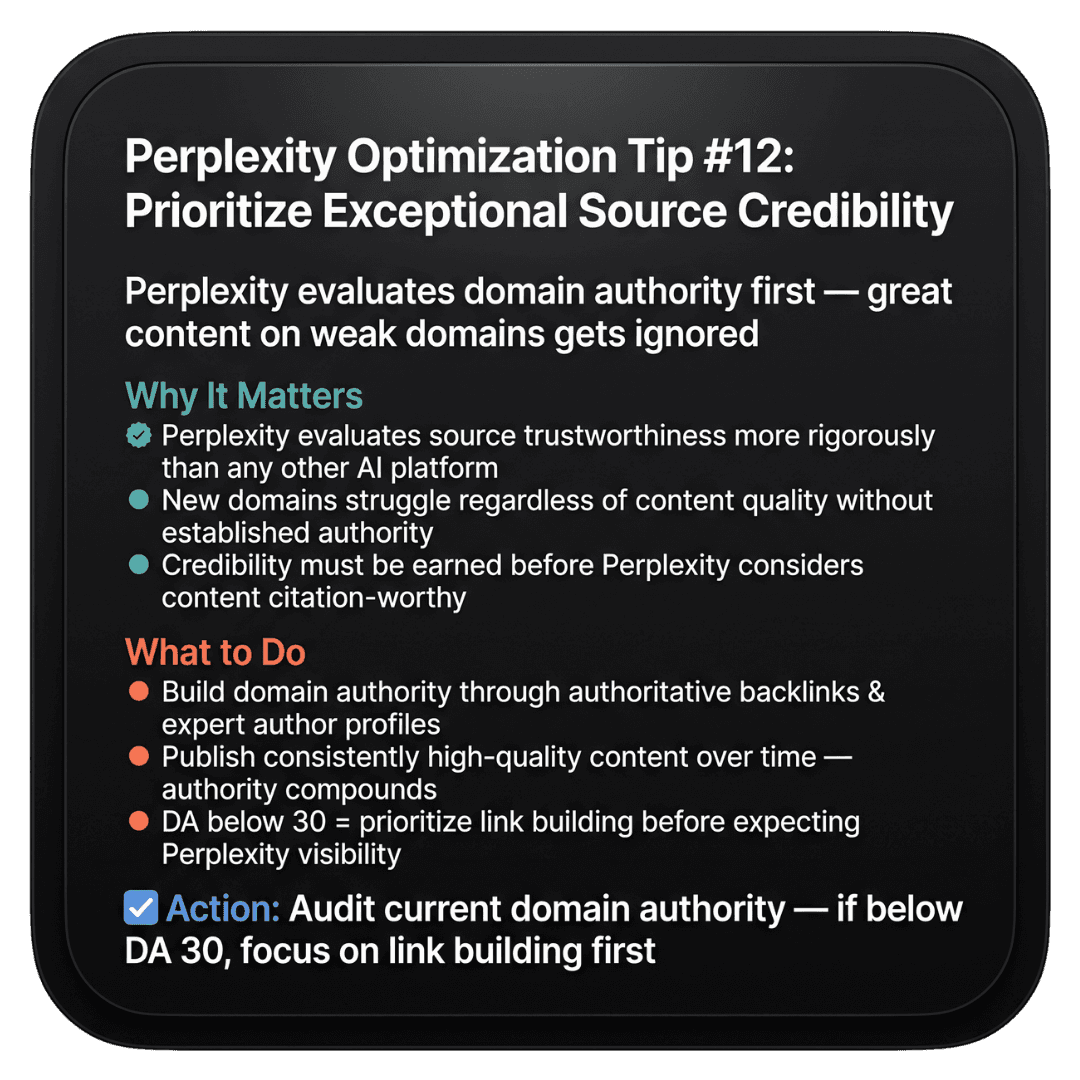
Perplexity evaluates source trustworthiness more rigorously than other platforms, requiring established domain authority before considering content citation-worthy. New domains struggle regardless of content quality without authority building.
Focus on building domain authority through authoritative backlinks, expert author profiles, and consistent quality publication before expecting Perplexity citations. This platform demands earned credibility.
Action: Audit current domain authority metrics. If below DA 30, prioritize link building and authority establishment before expecting significant Perplexity visibility.
Tip 13: Include Proper Citations and References
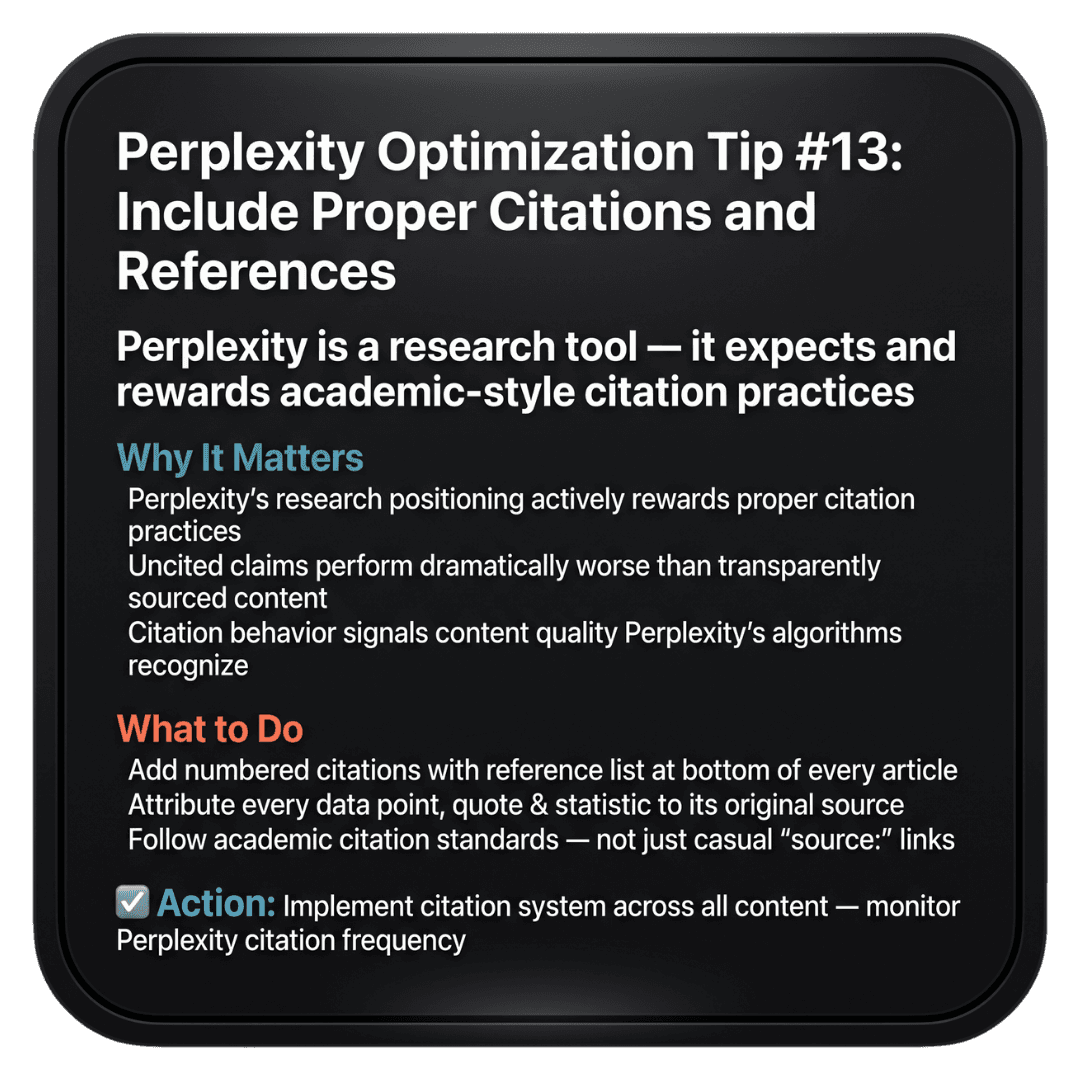
Perplexity's research tool positioning means it expects and rewards proper citation practices. Content citing sources transparently performs dramatically better than uncited claims regardless of accuracy.
Add numbered citations, reference lists, and proper attribution for data, quotes, and claims following academic citation standards that Perplexity's algorithms recognize as quality signals.
Action: Implement citation system on all content with numbered references [1], [2] linking to source list. Monitor whether Perplexity begins citing content more frequently.
Tip 14: Create Research-Quality Structured Content
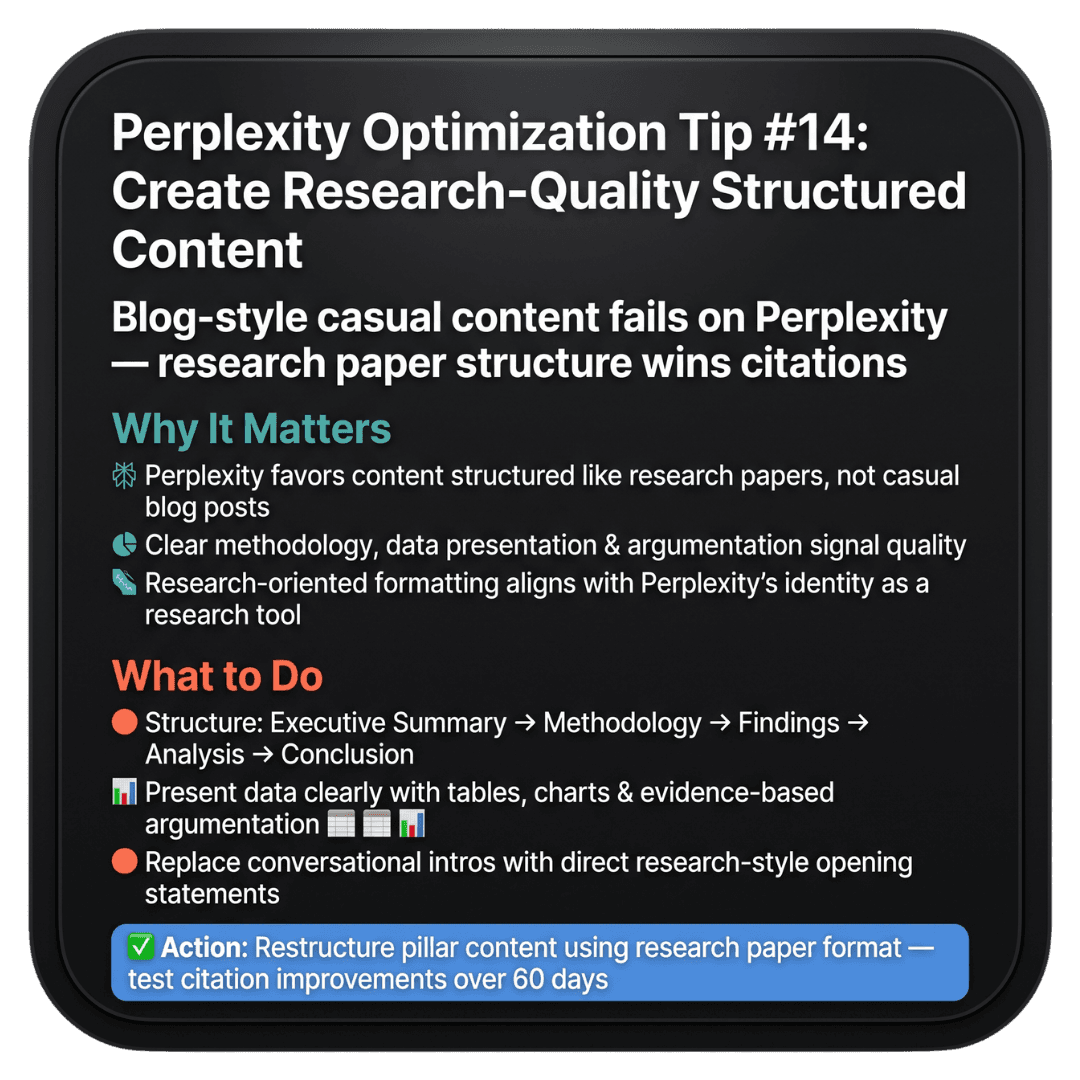
Perplexity favors content structured like research papers with clear methodology, data presentation, and logical argumentation. Blog-style casual content performs poorly compared to research-oriented formatting.
Structure content with: executive summary, methodology/approach, findings/data, analysis, and conclusion matching research paper organization that Perplexity prioritizes for citations.
Action: Restructure pillar content using research paper format. Test whether more formal structure improves Perplexity citation rates over 60 days.
Tip 15: Build Measurable Domain Authority
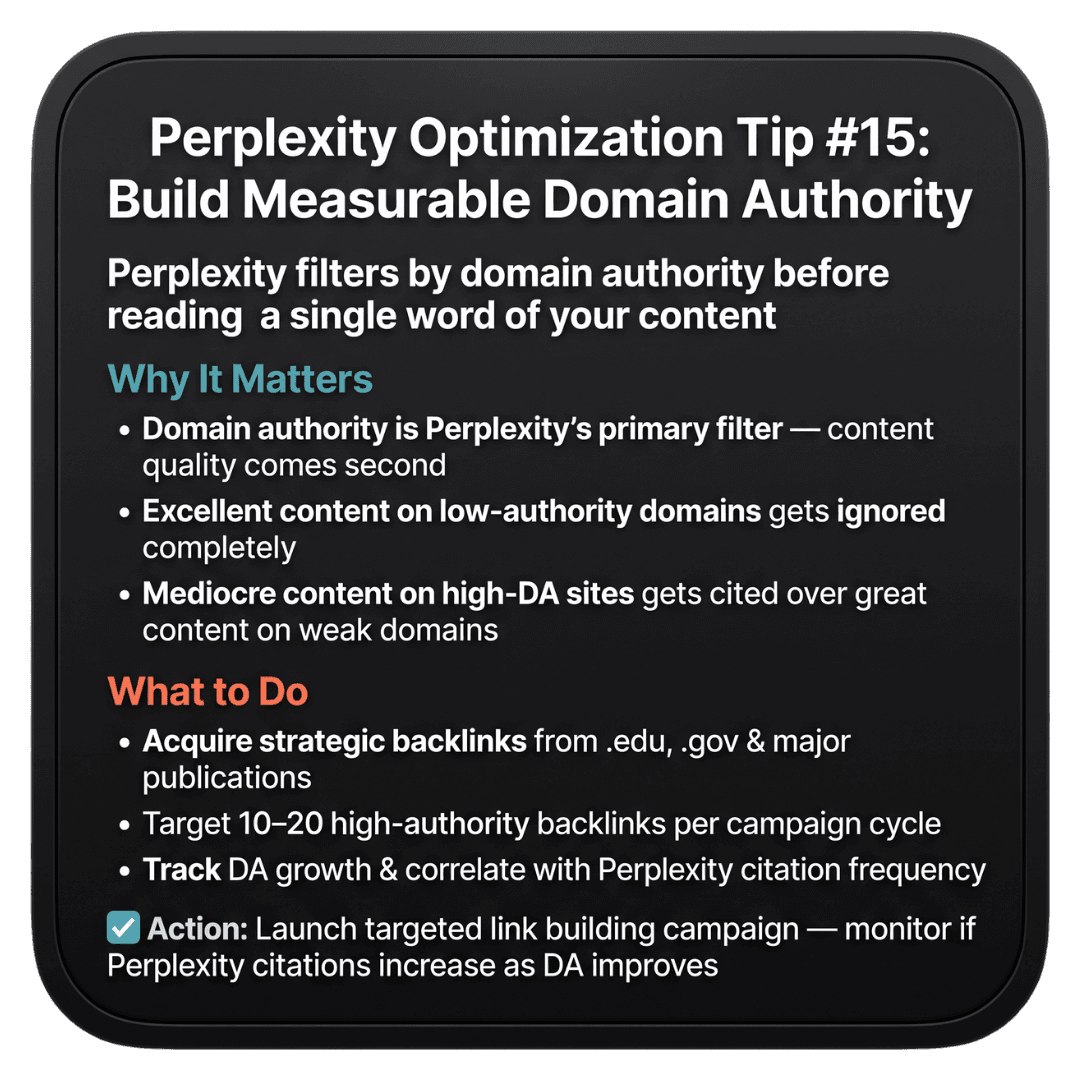
Perplexity uses domain authority as primary filter before evaluating content quality. Excellent content on low-authority domains gets ignored while mediocre content on high-authority sites gets cited frequently.
Invest in strategic link building from high-authority domains (.edu, .gov, major publications) specifically improving domain authority that Perplexity measures before considering your content.
Action: Launch targeted link building campaign acquiring 10-20 high-authority backlinks. Monitor whether Perplexity citation frequency improves as domain authority increases.
Tip 16: Include Original Data and Statistics
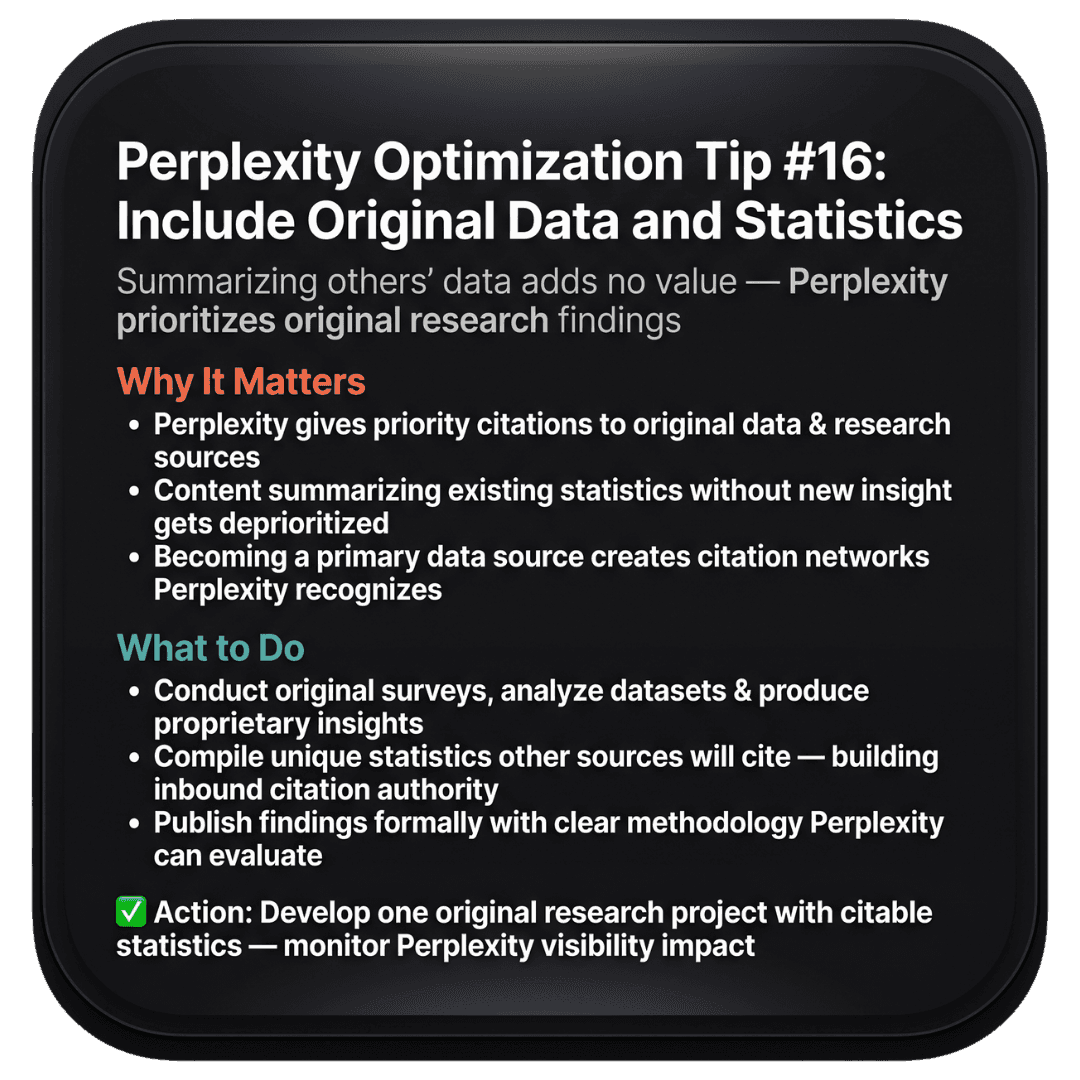
Perplexity's research orientation means original data, proprietary statistics, and unique research findings receive priority citations over content summarizing others' data without adding new information.
Conduct original surveys, analyze datasets producing new insights, or compile statistics that other sources will cite creating citation networks Perplexity recognizes as authority signals.
Action: Develop one original research project producing citable statistics. Publish findings and monitor whether becoming data source improves overall Perplexity visibility.
Tip 17: Create Comparative Analysis Content
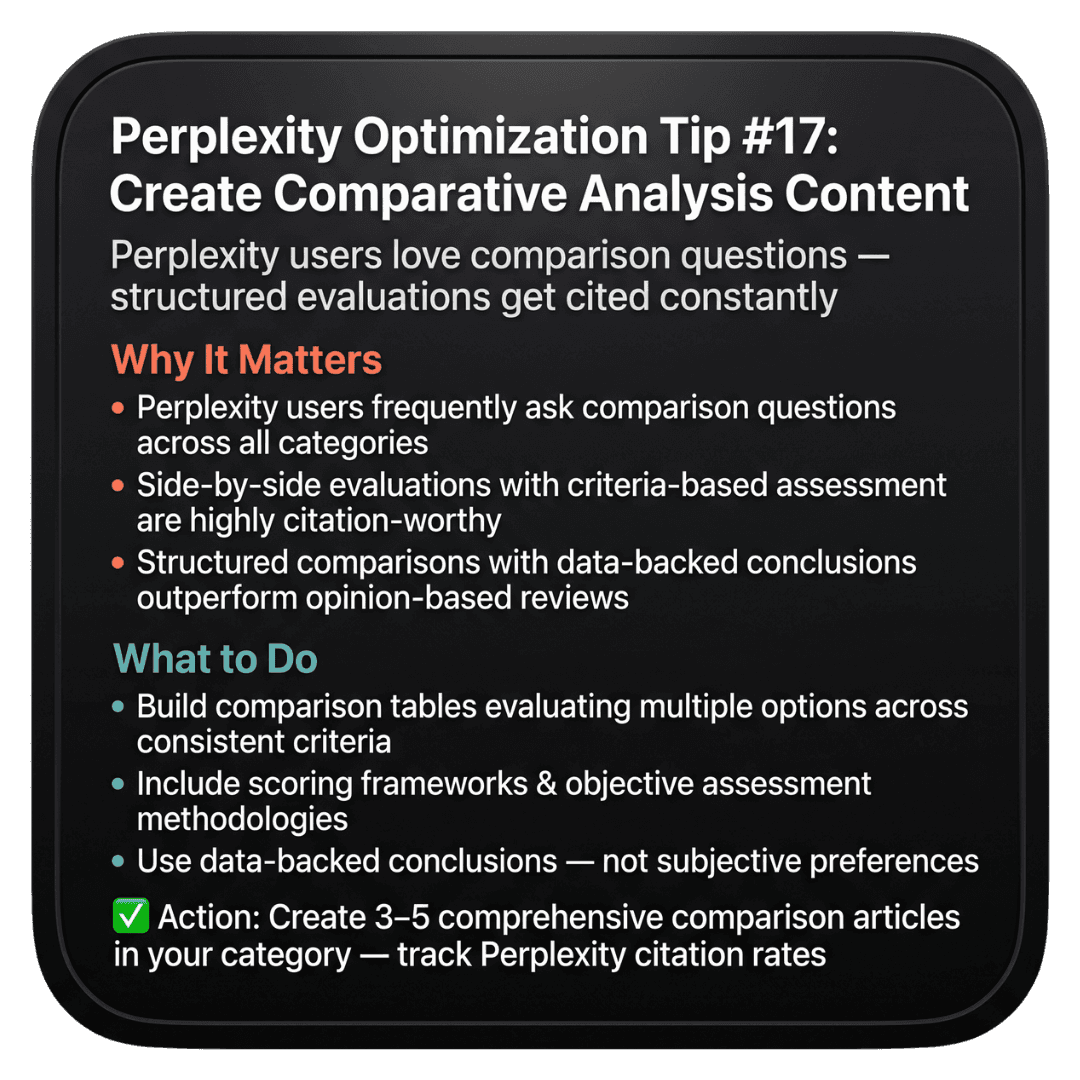
Perplexity users frequently ask comparison questions, making comparative analysis content highly citation-worthy. Side-by-side evaluations with criteria-based assessment perform exceptionally well.
Build comparison content evaluating multiple options across consistent criteria with data-backed conclusions. Include comparison tables, scoring frameworks, and objective assessment methodologies.
Action: Create 3-5 comprehensive comparison articles in your category with structured evaluation criteria. Track Perplexity citation rates for comparison content versus other types.
Tip 18: Use Proper Attribution for All Claims
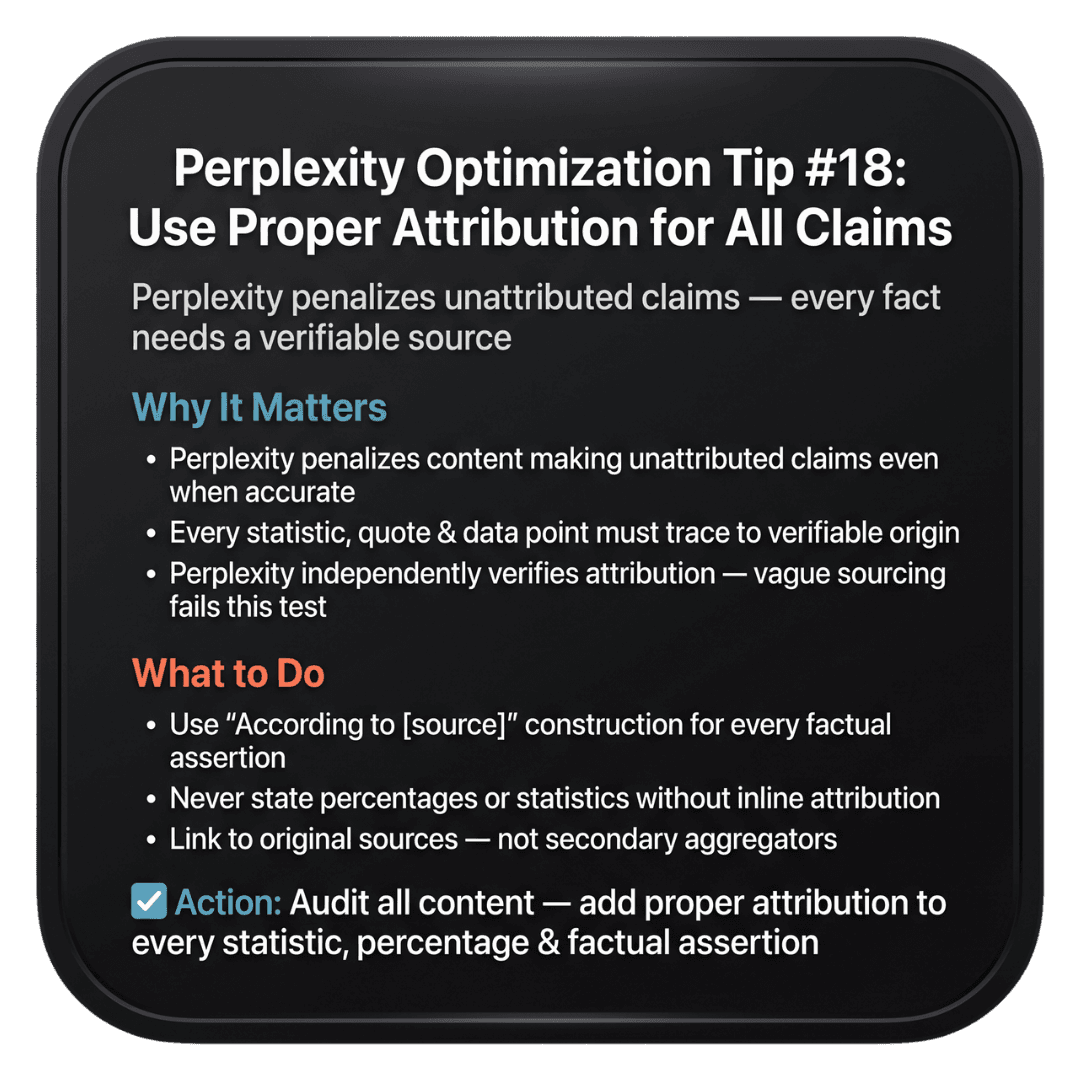
Perplexity penalizes content making unattributed claims even when accurate. Every statistic, quote, or data point requires clear source attribution that Perplexity can verify independently.
Never make claims without attribution. Use "According to [source]" construction ensuring every factual assertion traces to verifiable origin that Perplexity can validate.
Action: Audit content identifying unattributed claims. Add proper attribution to every statistic, percentage, or factual assertion with inline citations.
Tip 19: Optimize Author Bio and Credentials
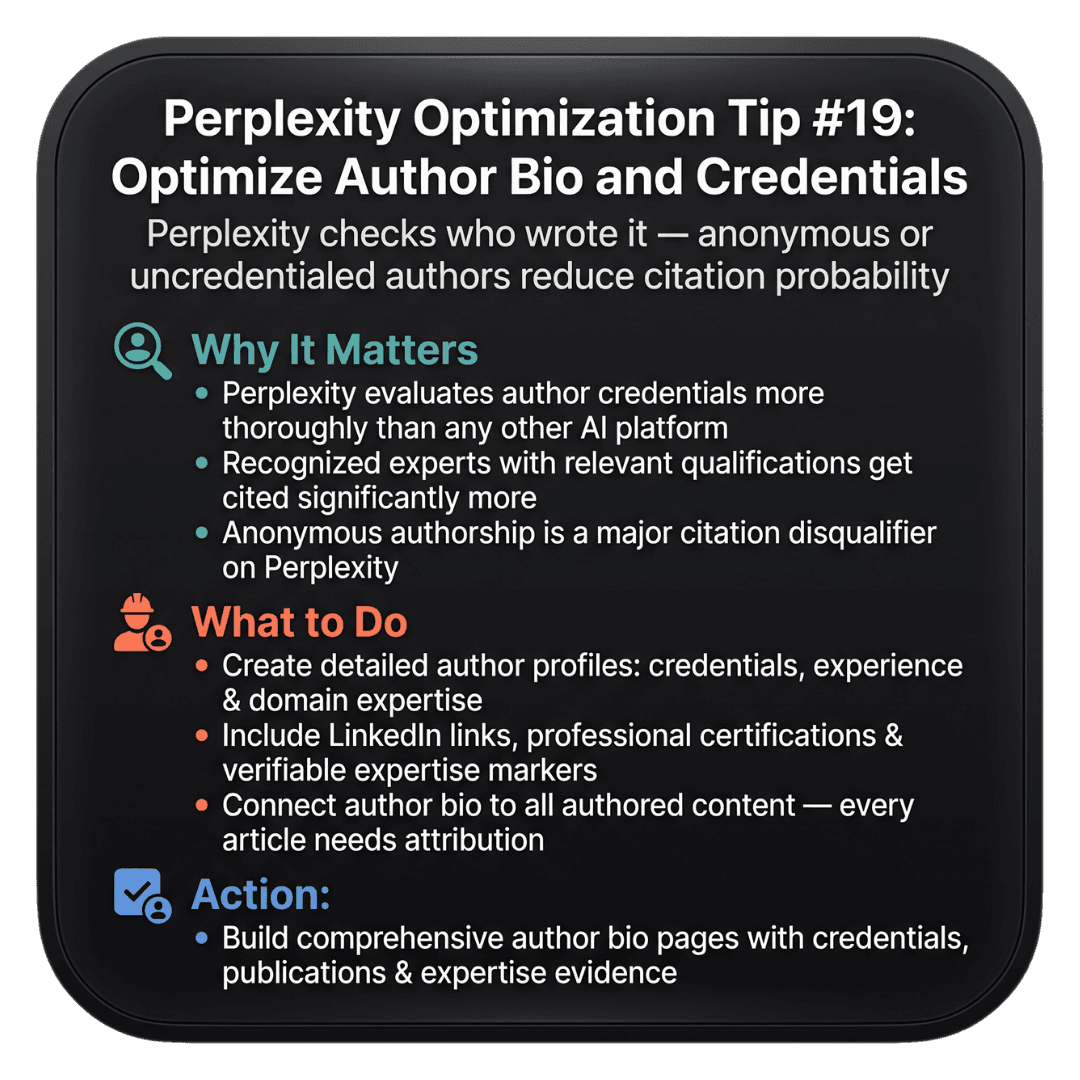
Perplexity evaluates author credentials more thoroughly than other platforms, rewarding content from recognized experts with relevant qualifications. Anonymous or uncredentialed authors reduce citation probability.
Create detailed author profiles highlighting relevant credentials, experience, and expertise. Include links to LinkedIn, professional certifications, and other credibility markers Perplexity can verify.
Action: Develop comprehensive author bio pages with credentials, publications, speaking engagements, and expertise evidence. Link from all authored content.
Tip 20: Implement Comprehensive Metadata
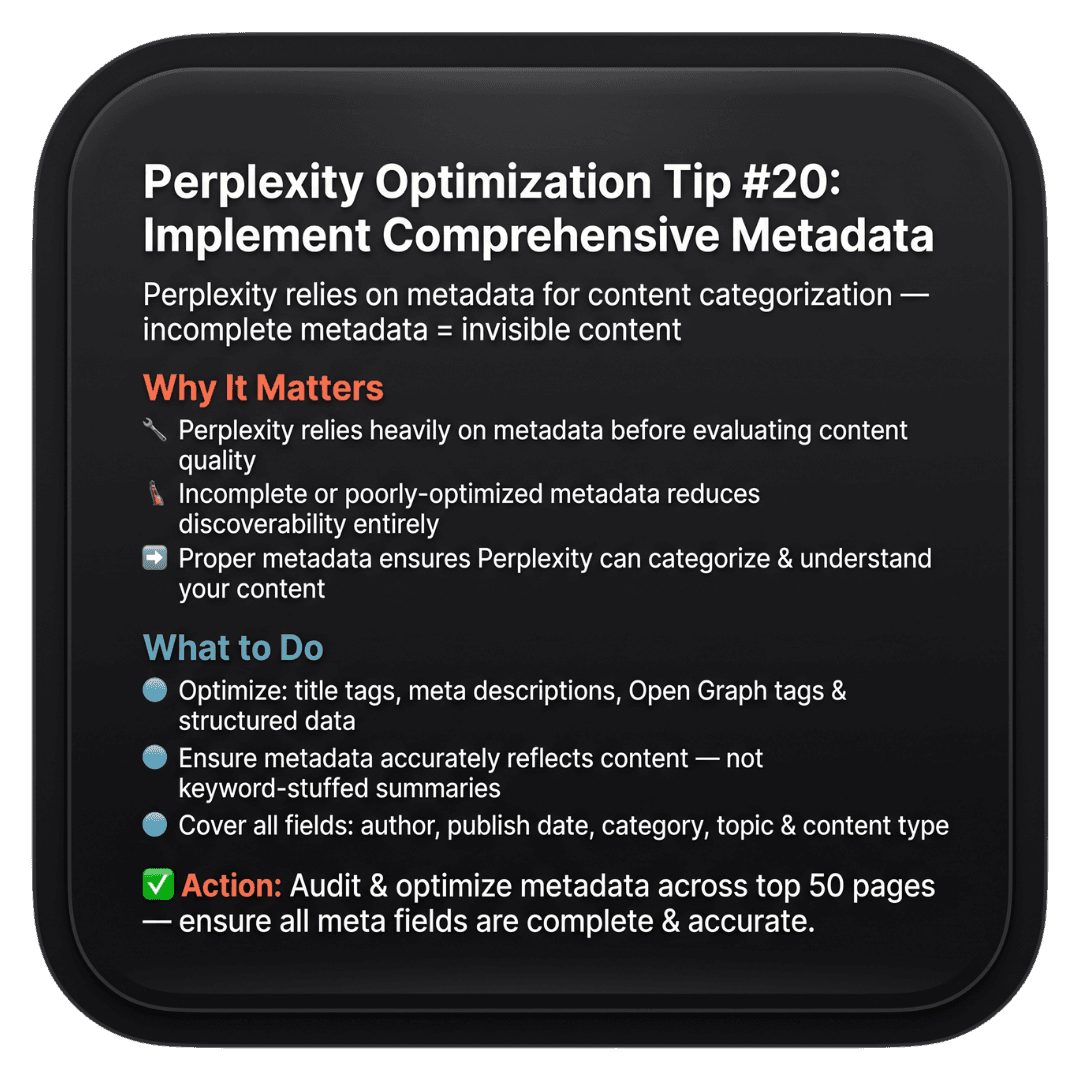
Perplexity relies heavily on metadata for content categorization and relevance determination. Incomplete or poorly-optimized metadata reduces discoverability regardless of content quality.
Optimize title tags, meta descriptions, Open Graph tags, and structured data ensuring Perplexity can properly categorize and understand content before evaluating citation worthiness.
Action: Audit and optimize metadata across top 50 pages ensuring complete, accurate information in all meta fields Perplexity evaluates.
Tip 21: Include Expert Quotes and Perspectives
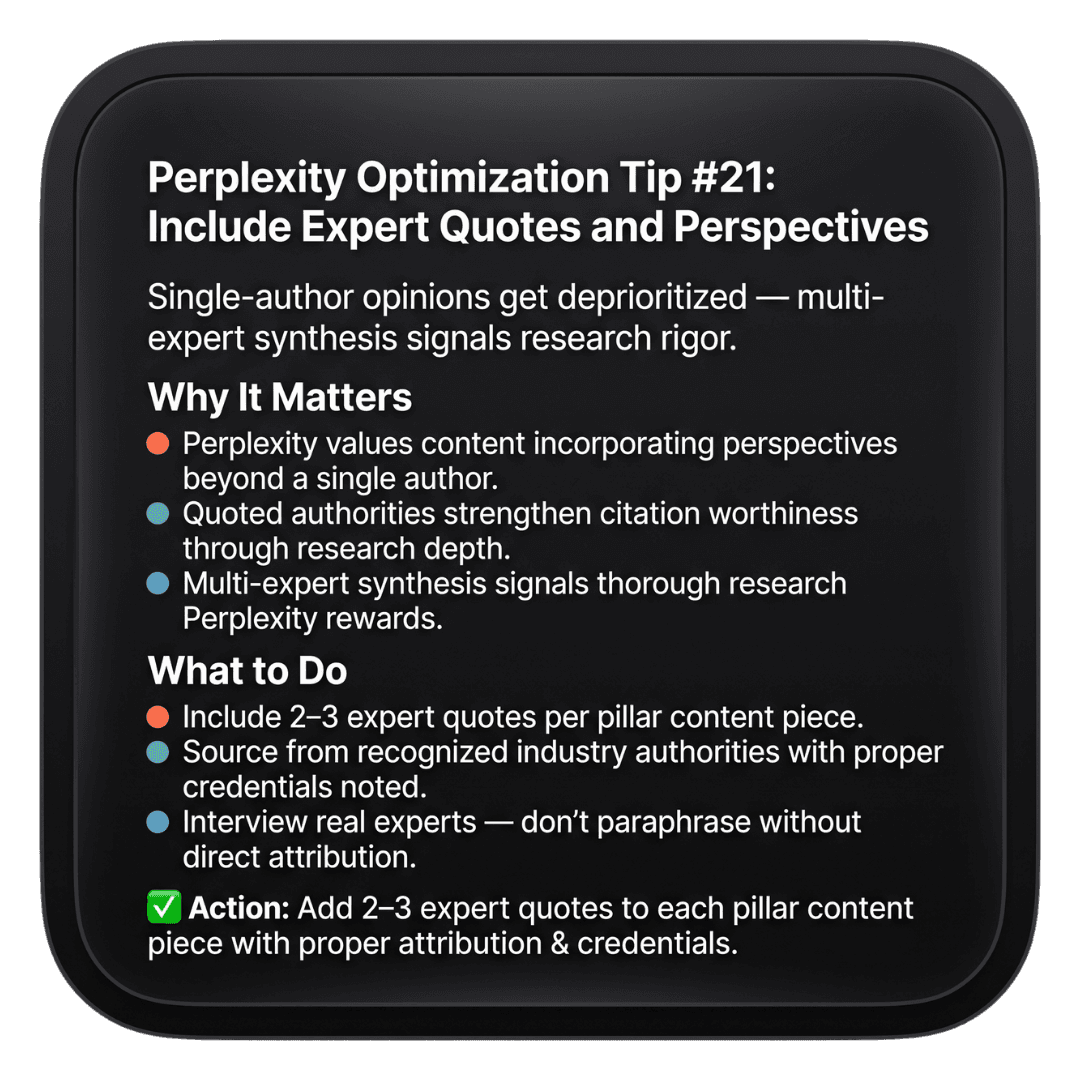
Perplexity values content incorporating expert perspectives beyond single-author viewpoints. Including quotes from recognized authorities strengthens citation worthiness through demonstrated research rigor.
Interview industry experts, include quoted perspectives from recognized authorities, and demonstrate content synthesis across multiple expert viewpoints rather than single-perspective analysis.
Action: Add 2-3 expert quotes to each pillar content piece. Source from recognized industry authorities with proper attribution and credentials noted.
Tip 22: Maintain Exceptional Factual Accuracy
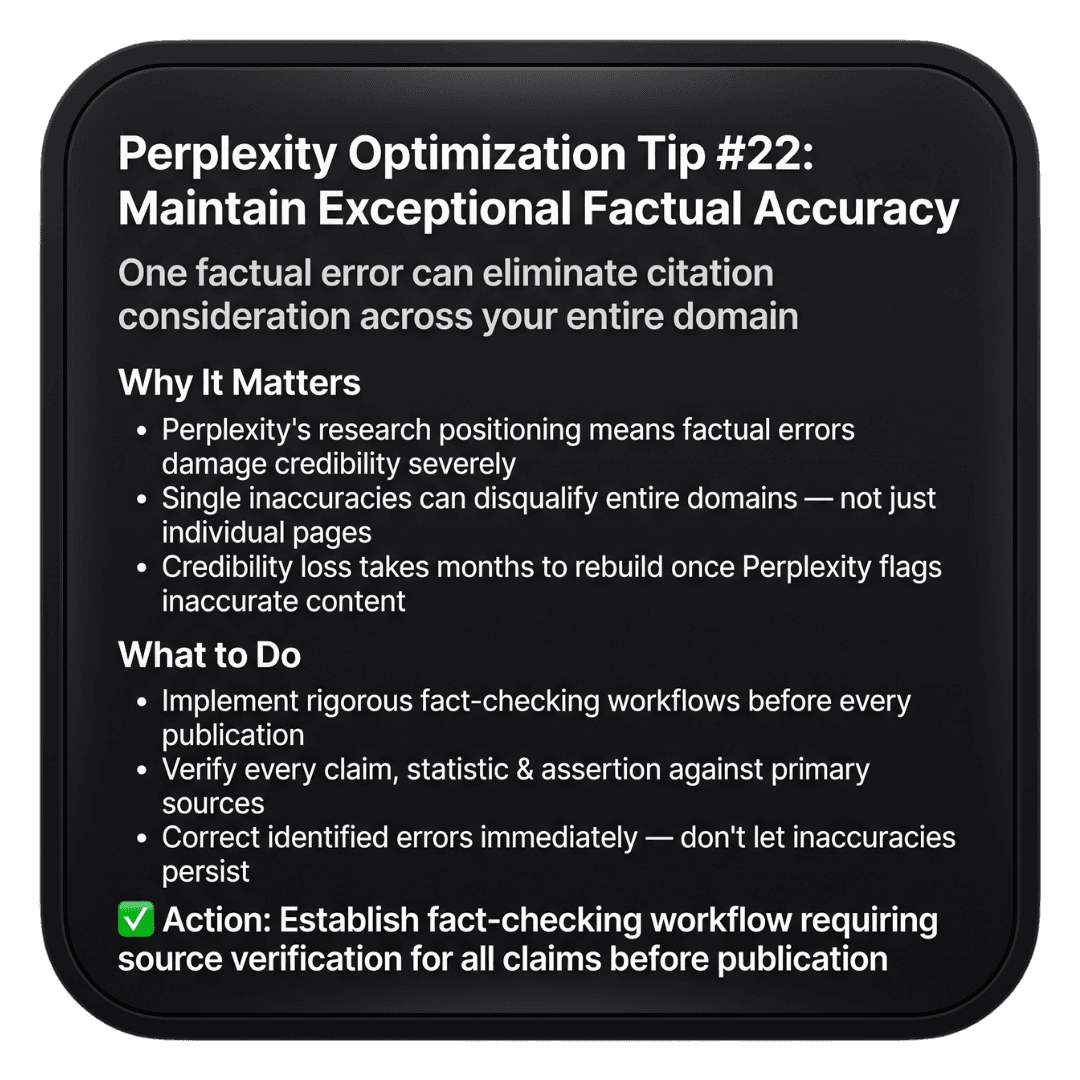
Perplexity's research tool positioning means factual errors damage credibility more severely than on conversational platforms. Single inaccuracies can eliminate citation consideration across entire domains.
Implement rigorous fact-checking processes verifying every claim, statistic, and assertion before publication. One error undermines credibility that takes months to rebuild with Perplexity.
Action: Establish fact-checking workflow requiring source verification for all claims. Monitor content accuracy and correct any identified errors immediately.
Google AI Overview Optimization: 10 SEO-Foundation Tips
Tip 23: Leverage Strong Traditional SEO Foundations
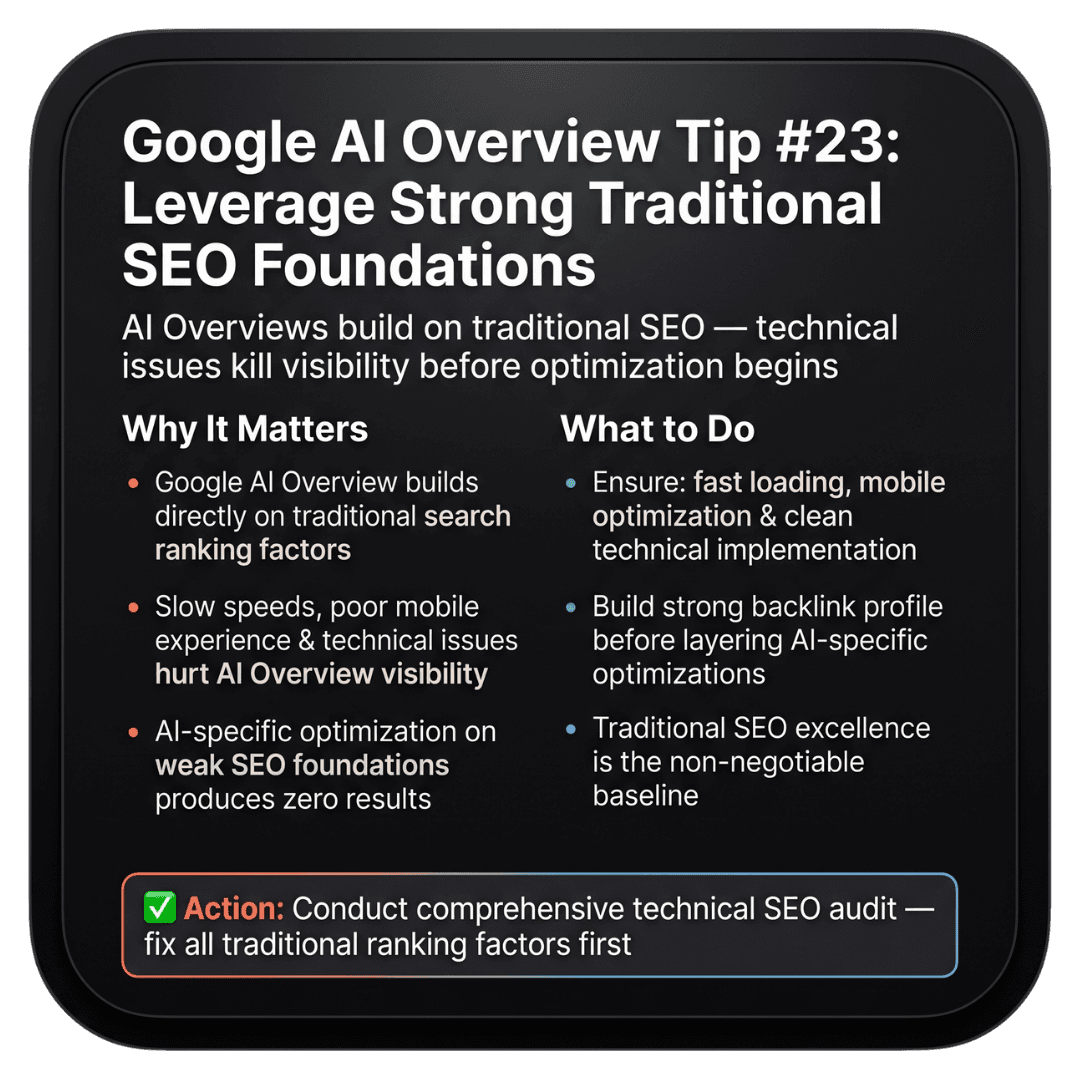
Google AI Overview builds on traditional search ranking factors, meaning solid SEO foundations remain critically important. Technical issues, slow speeds, or poor mobile experience hurt AI Overview visibility.
Ensure excellent traditional SEO: fast loading, mobile optimization, clean technical implementation, and strong backlink profiles before layering AI-specific optimizations on top.
Action: Conduct comprehensive technical SEO audit addressing all traditional ranking factors. AI Overview success requires traditional SEO excellence as baseline.
Tip 24: Implement Comprehensive Structured Data
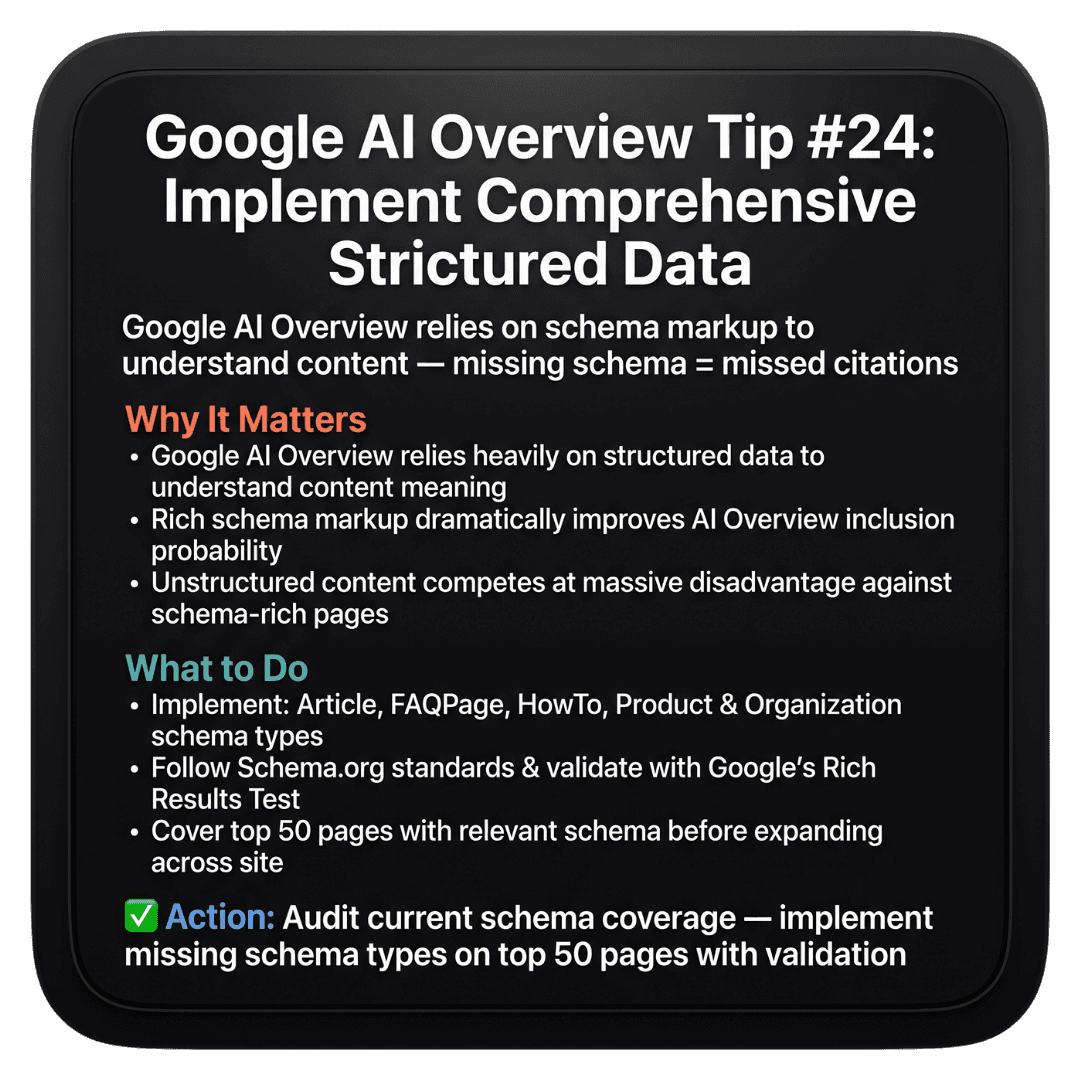
Google AI Overview relies heavily on structured data understanding content meaning and relationships. Rich schema markup dramatically improves AI Overview inclusion probability.
Implement Article, FAQPage, HowTo, Product, Organization, and other relevant schema types following Schema.org standards. Validate with Google's Rich Results Test ensuring proper implementation.
Action: Audit current schema coverage. Implement missing schema types on top 50 pages with validation confirming Google recognizes structured data properly.
Tip 25: Create Featured Snippet-Optimized Content
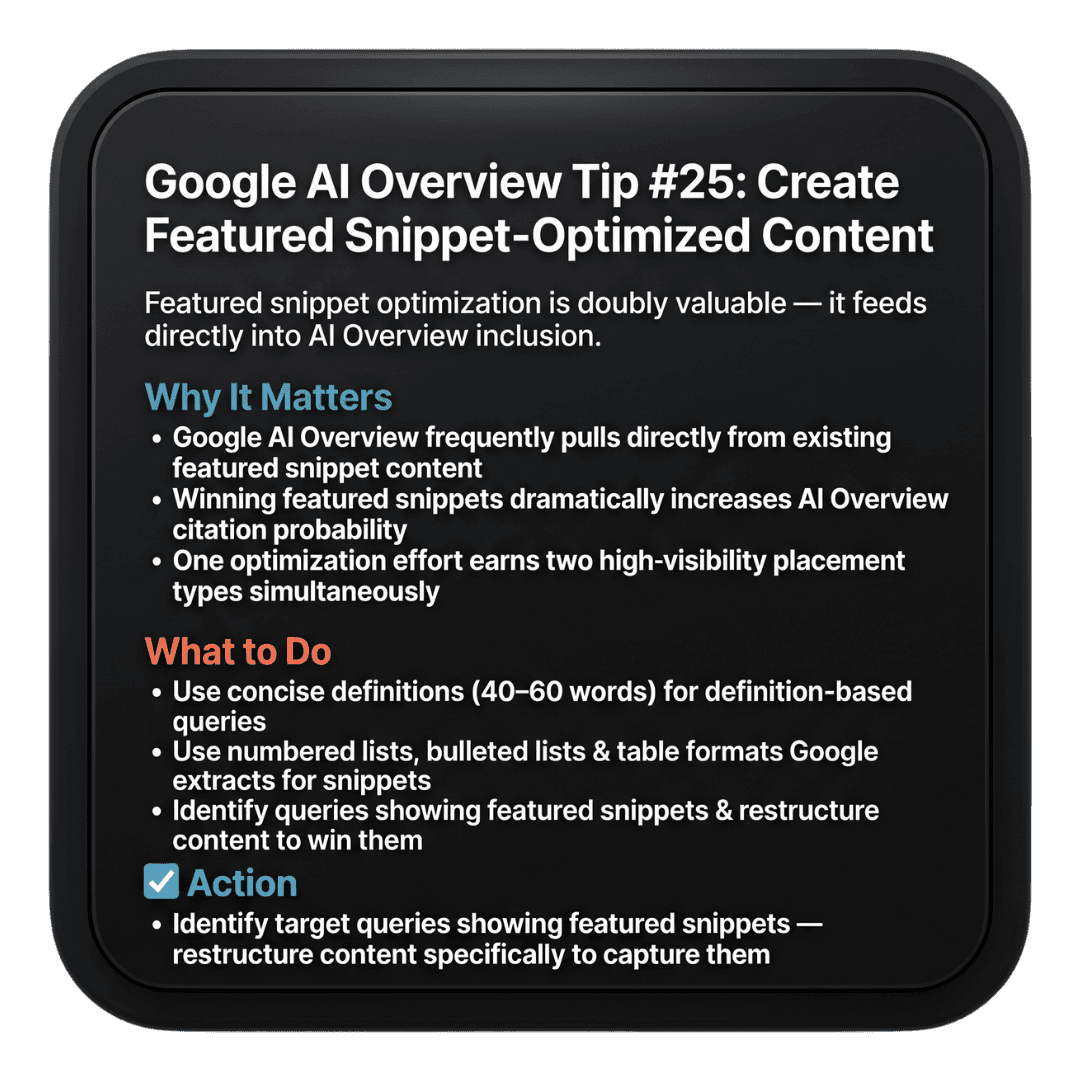
Google AI Overview frequently pulls from existing featured snippet content, making featured snippet optimization doubly valuable. Content structured for snippets performs well in AI Overviews.
Use concise definitions (40-60 words), numbered lists, bulleted lists, and table formats that Google extracts for featured snippets and repurposes in AI Overview responses.
Action: Identify target queries showing featured snippets. Restructure content specifically targeting snippet capture which feeds AI Overview inclusion.
Tip 26: Optimize for E-E-A-T Signals
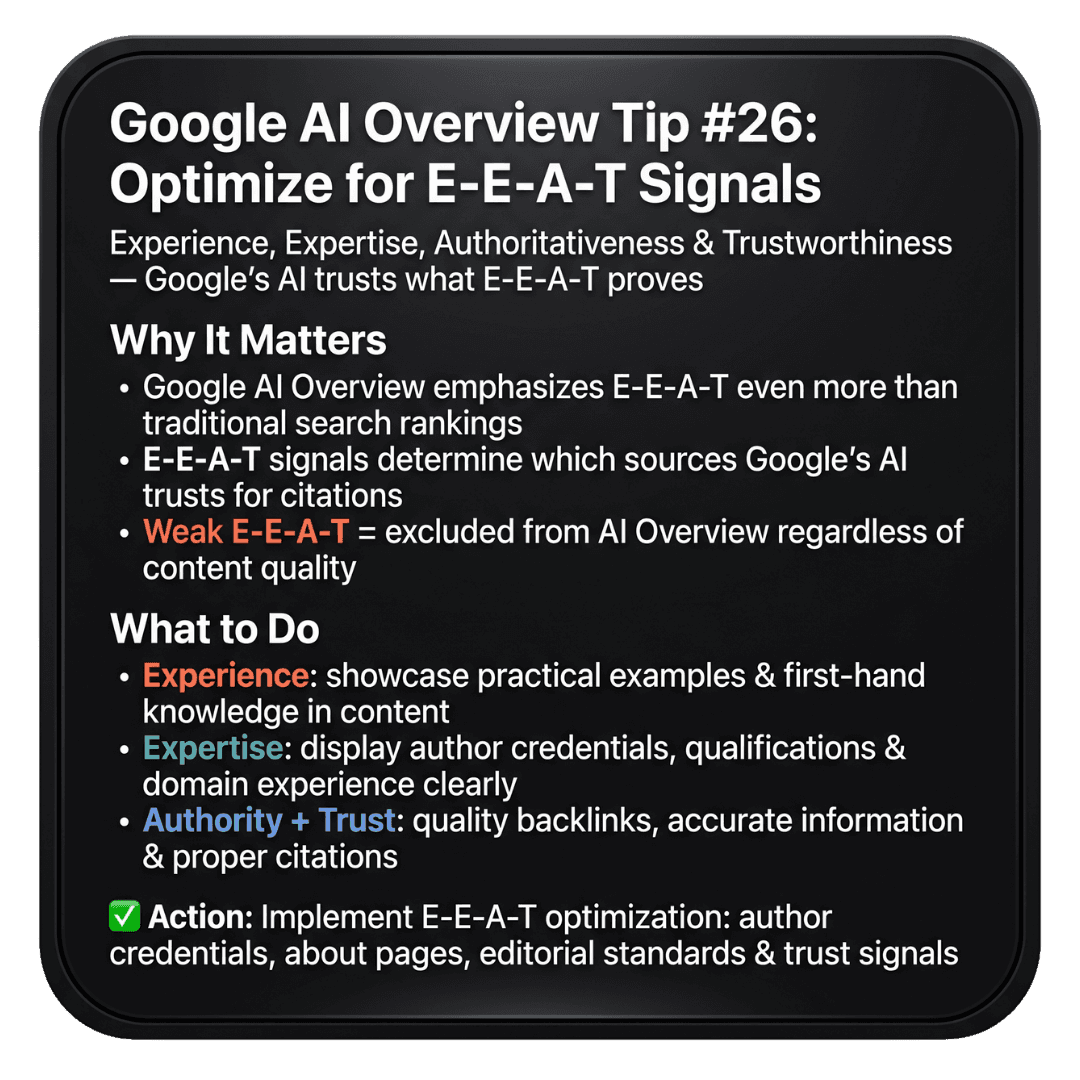
Google AI Overview emphasizes Experience, Expertise, Authoritativeness, and Trustworthiness even more than traditional search. E-E-A-T signals determine which sources Google's AI trusts for citations.
Demonstrate expertise through credentials, build authority via quality backlinks, establish trustworthiness with accurate information and proper citations, and showcase experience through practical examples.
Action: Implement comprehensive E-E-A-T optimization: author credentials, about pages, editorial standards, citations, and trust signals Google's AI evaluates.
Tip 27: Use Clear Heading Hierarchies
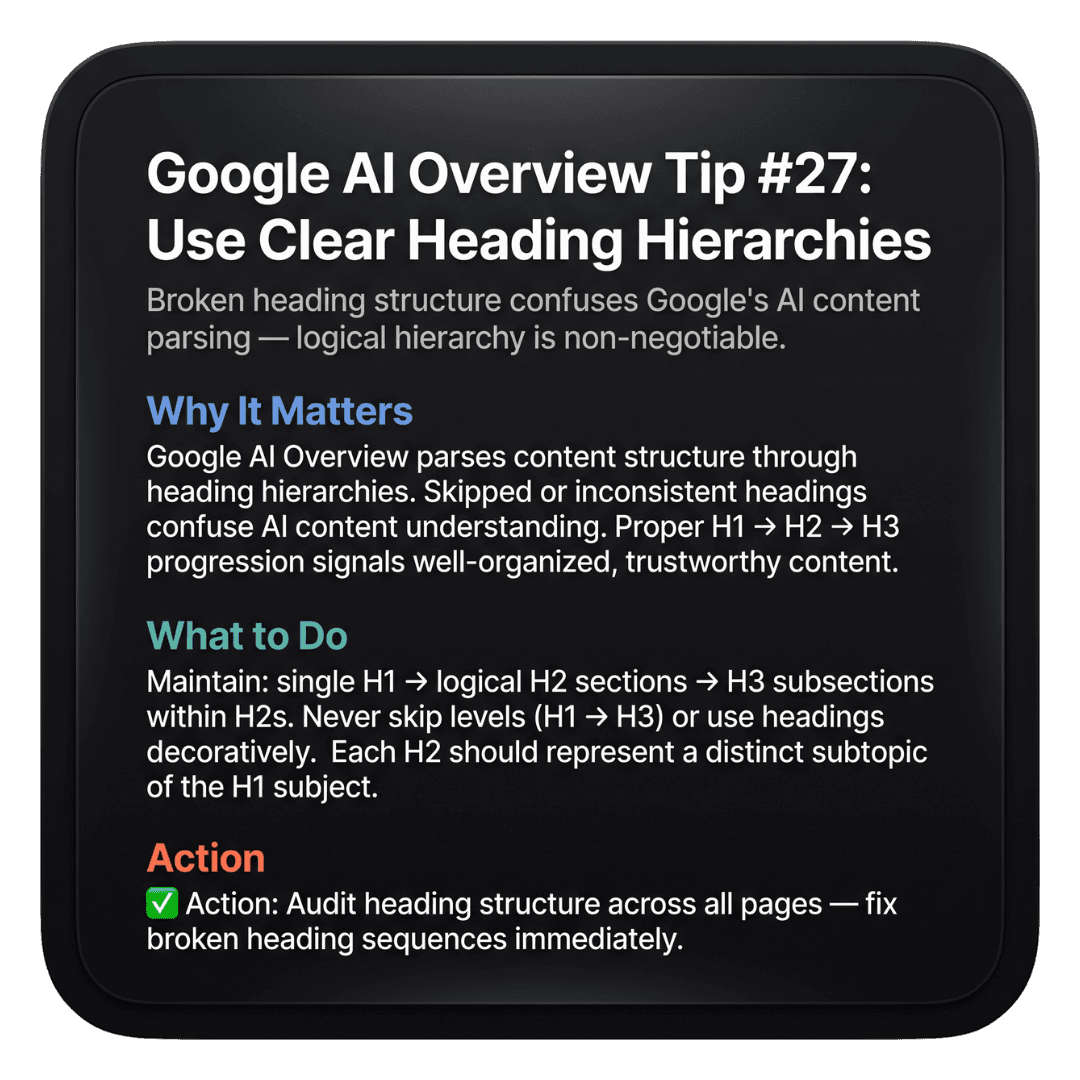
Google AI Overview parses content structure through heading hierarchies, requiring logical H1 → H2 → H3 progression. Broken hierarchies confuse AI content understanding reducing citation probability.
Maintain strict heading hierarchy: single H1, logical H2 sections, and H3 subsections within H2s. Never skip levels (H1 → H3) or use headings inconsistently.
Action: Audit heading structure across all pages ensuring proper hierarchy. Fix broken heading sequences that confuse Google's AI content parsing.
Tip 28: Include High-Quality Multimedia
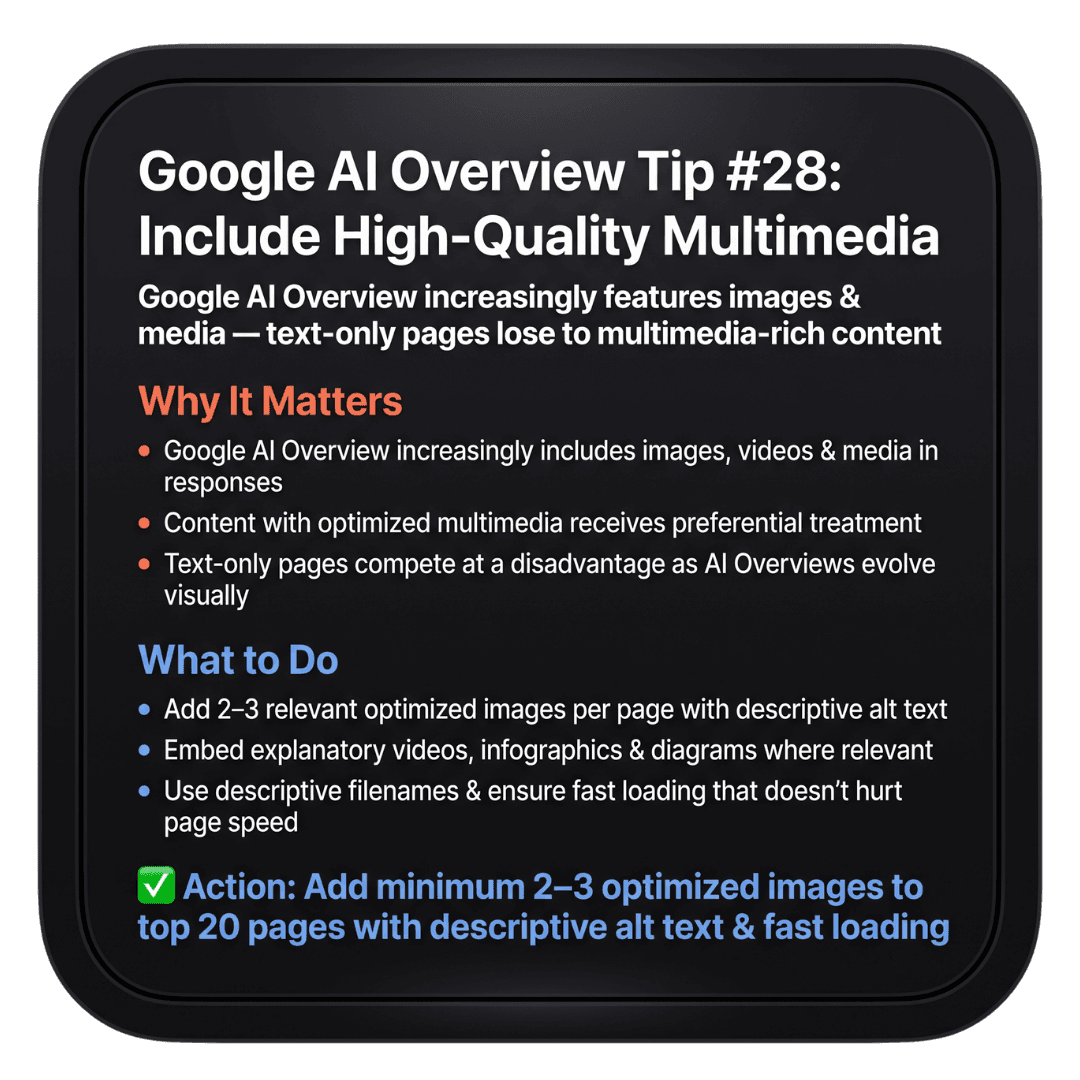
Google AI Overview increasingly includes images, videos, and other media in responses. Content with optimized multimedia receives preferential treatment over text-only pages.
Add relevant images with proper alt text, embed explanatory videos, create infographics, and include diagrams that Google can feature in AI Overview responses alongside text.
Action: Add minimum 2-3 optimized images to top 20 pages. Include descriptive alt text, proper filenames, and ensure fast loading that doesn't hurt page speed.
Tip 29: Create List and Table Formats
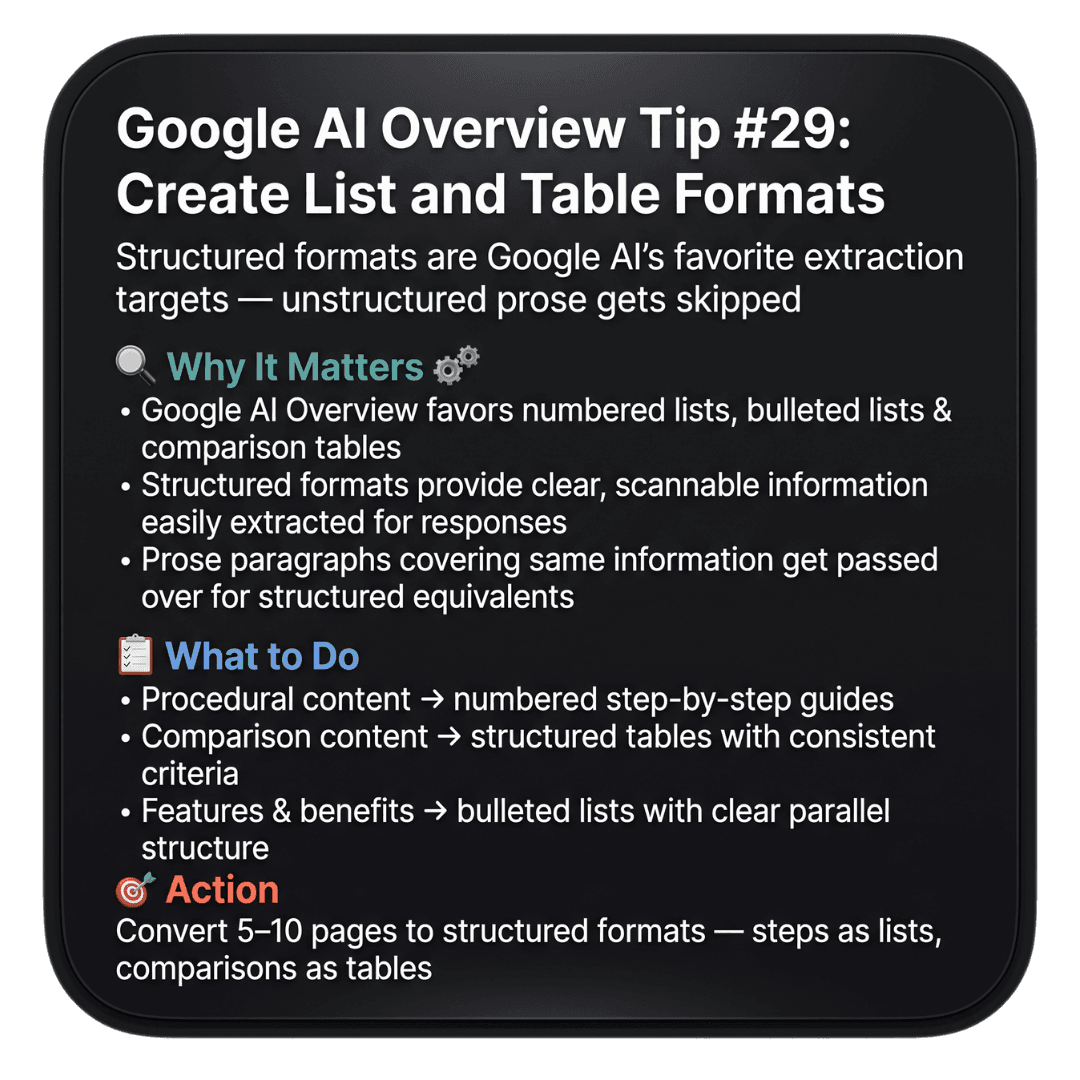
Google AI Overview favors structured formats like numbered lists, bulleted lists, and comparison tables because they provide clear, scannable information easily extracted for responses.
Restructure procedural content as numbered steps, create comparison tables for evaluations, and use bulleted lists for feature/benefit descriptions matching formats Google's AI prioritizes.
Action: Convert 5-10 pages to structured formats: step-by-step guides use numbered lists, comparison content uses tables, features use bulleted lists.
Tip 30: Optimize for Local Search Signals
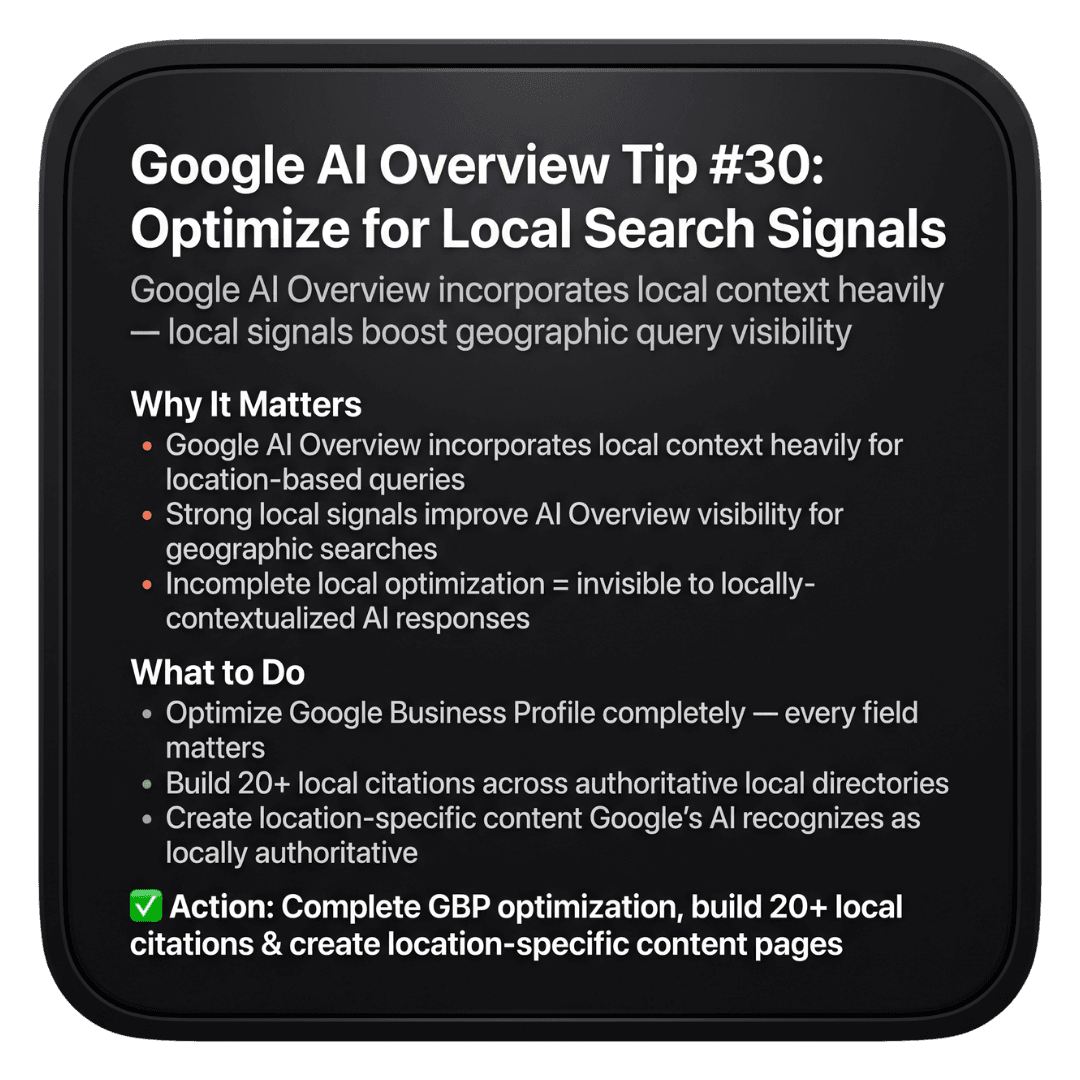
Google AI Overview incorporates local context heavily when relevant, making local optimization critical for location-based queries. Strong local signals improve AI Overview visibility for geographic searches.
Optimize Google Business Profile completely, build local citations, earn local backlinks, and create location-specific content that Google's AI recognizes as locally authoritative.
Action: Audit local SEO signals: complete GBP optimization, build 20+ local citations, create location-specific content if serving local markets.
Tip 31: Build Comprehensive Pillar Content
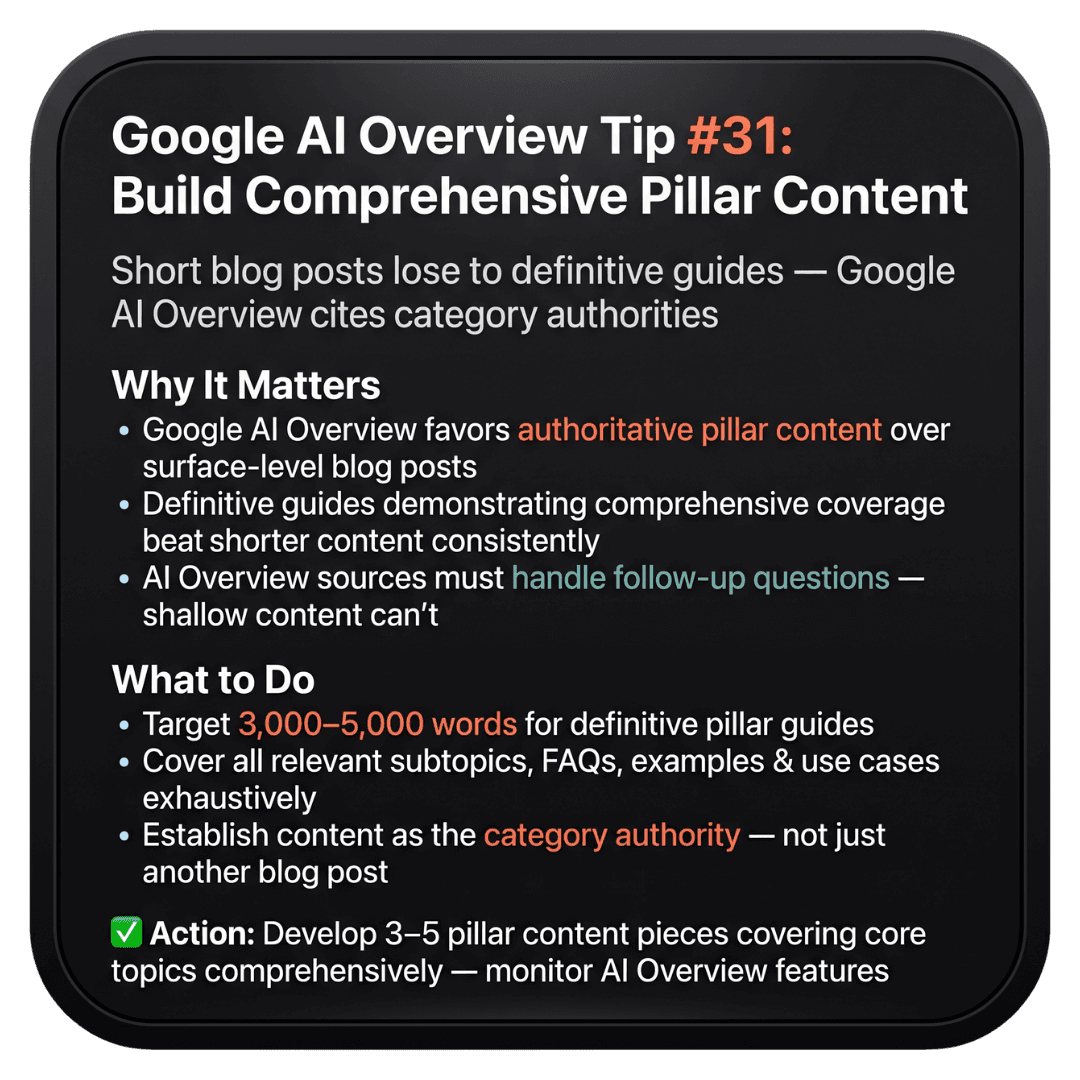
Google AI Overview favors authoritative pillar content demonstrating comprehensive topic coverage. Surface-level blog posts lose to definitive guides when Google selects AI Overview sources.
Create 3000-5000 word definitive guides covering topics exhaustively with all relevant subtopics, FAQs, examples, and use cases establishing content as category authority.
Action: Develop 3-5 pillar content pieces covering core topics comprehensively. Monitor whether definitive guides capture more AI Overview features than shorter content.
Tip 32: Implement FAQ Schema Strategically
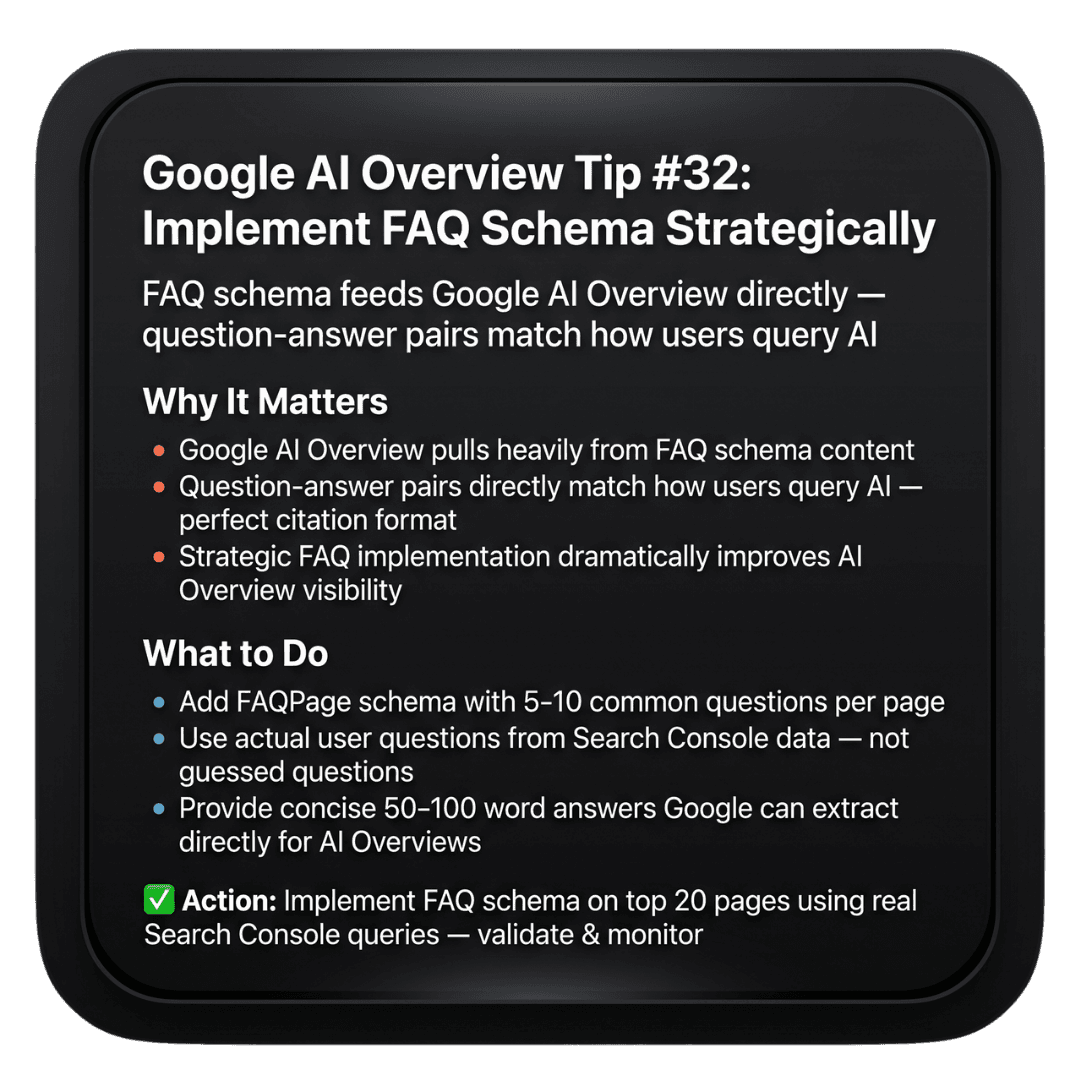
Google AI Overview pulls heavily from FAQ schema content because question-answer pairs directly match how users query AI. Strategic FAQ implementation dramatically improves visibility.
Add FAQPage schema answering 5-10 common questions per page. Use actual user questions and provide concise 50-100 word answers that Google can extract for AI Overviews.
Action: Implement FAQ schema on top 20 pages with questions matching real user queries from search console data. Validate schema and monitor AI Overview improvements.
How Web of Picasso Implements Platform-Specific Optimization
At Web of Picasso, we don't apply generic AEO tactics uniformly. Our methodology implements platform-specific optimization strategies delivering 400% average citation increases by recognizing each platform's unique algorithm requirements.
Multi-Platform Testing and Measurement
We test content variations across all three platforms measuring which optimizations drive results on each. This empirical approach reveals that conversational tone improves ChatGPT citations 60% while having minimal Perplexity impact, while citation practices boost Perplexity 80% with smaller ChatGPT effects.
Our proprietary tracking shows exactly which optimizations work for which platforms, enabling strategic resource allocation focusing efforts where they drive maximum business impact.
Prioritized Implementation Roadmaps
Rather than implementing all 32 tips simultaneously overwhelming teams, we create prioritized roadmaps starting with highest-impact optimizations for each client's target platforms.
B2B SaaS companies targeting technical decision-makers might prioritize Perplexity optimizations first while consumer brands focusing on conversational discovery emphasize ChatGPT tactics, with Google AI Overview as foundation for both.
Continuous Platform Evolution Adaptation
AI platforms evolve rapidly with algorithm updates changing citation criteria frequently. Our monitoring systems track platform changes enabling rapid strategy adjustments before clients experience citation declines.
This adaptive approach means optimization strategies stay current with platform evolution rather than becoming outdated as algorithms shift and new ranking factors emerge.
Implementation Priority: Where to Start
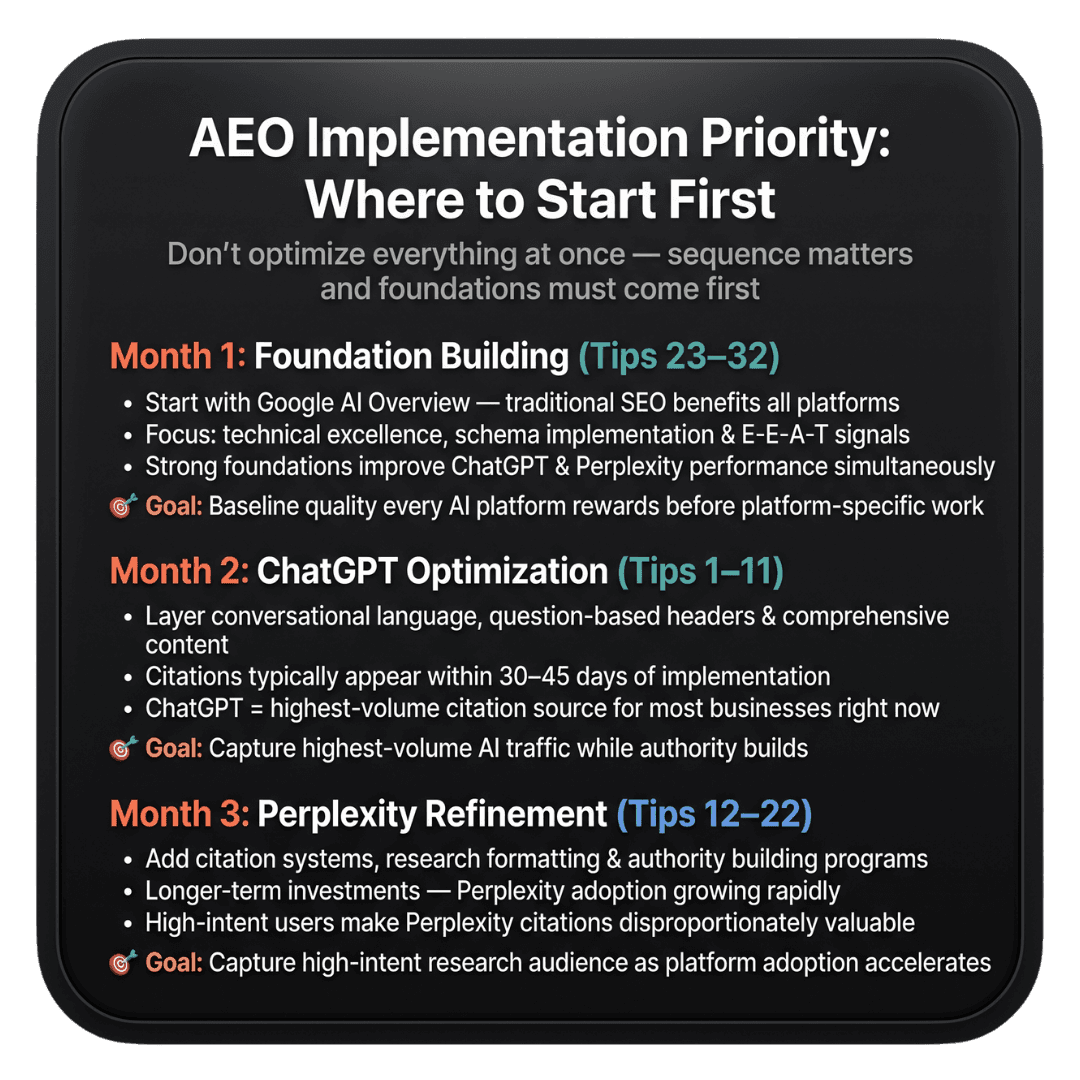
Month 1: Foundation Building
Start with Google AI Overview optimization (Tips 23-32) because traditional SEO foundations benefit all platforms. Strong technical SEO, structured data, and content quality improve ChatGPT and Perplexity performance while establishing Google visibility.
Focus on technical excellence, schema implementation, and E-E-A-T signals creating baseline quality all platforms reward before adding platform-specific enhancements.
Month 2: ChatGPT Optimization
Layer ChatGPT tactics (Tips 1-11) focusing on conversational language, question-based headers, and comprehensive content. These changes typically show fastest results with citations appearing within 30-45 days.
ChatGPT's rapid adoption and conversational nature make it highest-volume citation source for most businesses, justifying early optimization priority after foundations establish. For specialist help, compare the leading ChatGPT SEO agencies.
Month 3: Perplexity Refinement
Add Perplexity optimizations (Tips 12-22) requiring more substantial changes like citation systems, research formatting, and authority building. These longer-term investments pay off as Perplexity adoption grows.
Perplexity's research tool positioning attracts high-intent users making it valuable despite lower current volume than ChatGPT or Google AI Overview. If you want outside expertise, review the best Perplexity SEO agencies.
Measuring Platform-Specific Success
Track citation performance separately by platform rather than aggregate "AI visibility" that obscures where strategies work versus fail. The right AEO tracking tools make this per-platform measurement possible. Web of Picasso clients monitor: ChatGPT citation frequency across 100 test queries, Perplexity brand mentions in research results, Google AI Overview feature appearances, and conversion rates by platform source.
This granular measurement reveals which platforms drive business outcomes justifying continued optimization investment versus which require strategy adjustments improving performance.
Ready to Dominate All Three Platforms?
Implementing these 32 platform-specific optimization tips requires systematic approaches tailoring content to each AI platform's unique requirements. Web of Picasso provides comprehensive implementation frameworks ensuring your optimization efforts drive maximum citations across ChatGPT, Perplexity, and Google AI Overview simultaneously.
Our experience optimizing 150+ brands reveals exactly which tactics work for which platforms, enabling strategic prioritization focusing resources where they generate highest ROI for your specific business and target audience.
Contact Web of Picasso
Website: Visit Web of Picasso
Email: info@webofpicasso.net
Get Started: Book your platform-specific AEO assessment and implementation roadmap