AEO Pricing Models: 19 Ways Agencies Structure Costs
Results & ROI

Tanuj Sarva
02/09/2026
Which Answer Engine Optimization pricing model works best for your business in 2026: monthly retainers, performance-based pricing, project-based fees, or hybrid models? This comprehensive guide explains 19 different AEO pricing structures agencies use, helping you understand cost models, evaluate fairness, and negotiate optimal pricing. Understanding these 19 models reveals which provide best value and alignment with your business goals.
Why AEO Pricing Varies So Dramatically
AEO services pricing ranges from $1,500-$50,000+ monthly depending on pricing model, service scope, and provider expertise. This dramatic variance confuses businesses trying to evaluate whether proposed pricing is fair or excessive.
Pricing variation reflects fundamental differences in how agencies structure costs, share risk, and align incentives. Understanding these 19 models helps you evaluate proposals based on value rather than absolute price.
From my 5+ years pricing AEO services at Web of Picasso, I've learned that transparent pricing model explanation helps clients make informed decisions. Most agencies never explain their pricing structure philosophy, leaving clients confused about value received.
19 AEO Pricing Models Explained
Model 1: Fixed Monthly Retainer
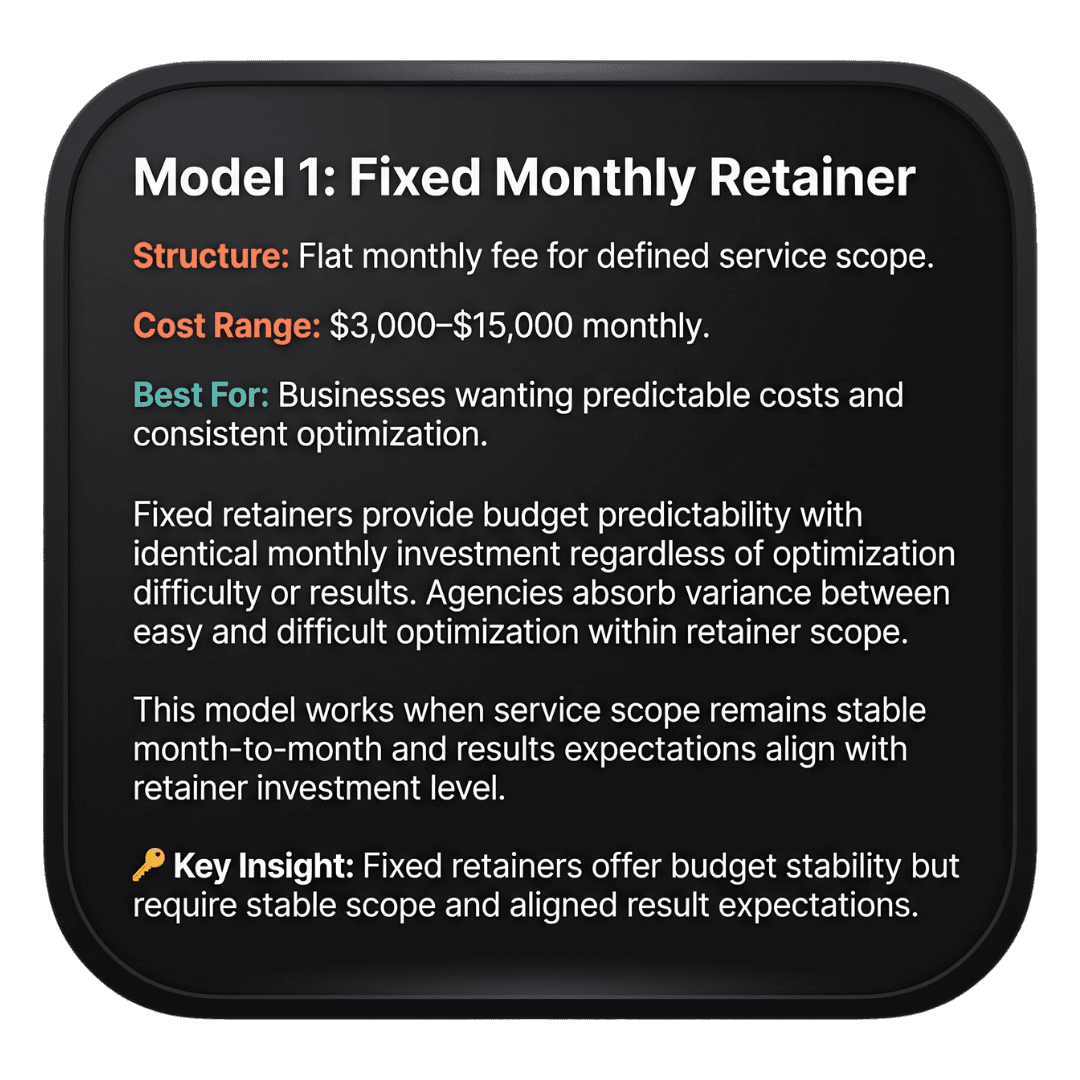
Structure: Flat monthly fee for defined service scope
Cost Range: $3,000-$15,000 monthly
Best For: Businesses wanting predictable costs and consistent optimization
Fixed retainers provide budget predictability with identical monthly investment regardless of optimization difficulty or results. Agencies absorb variance between easy and difficult optimization within retainer scope.
This model works when service scope remains stable month-to-month and results expectations align with retainer investment level.
Model 2: Performance-Based Pricing
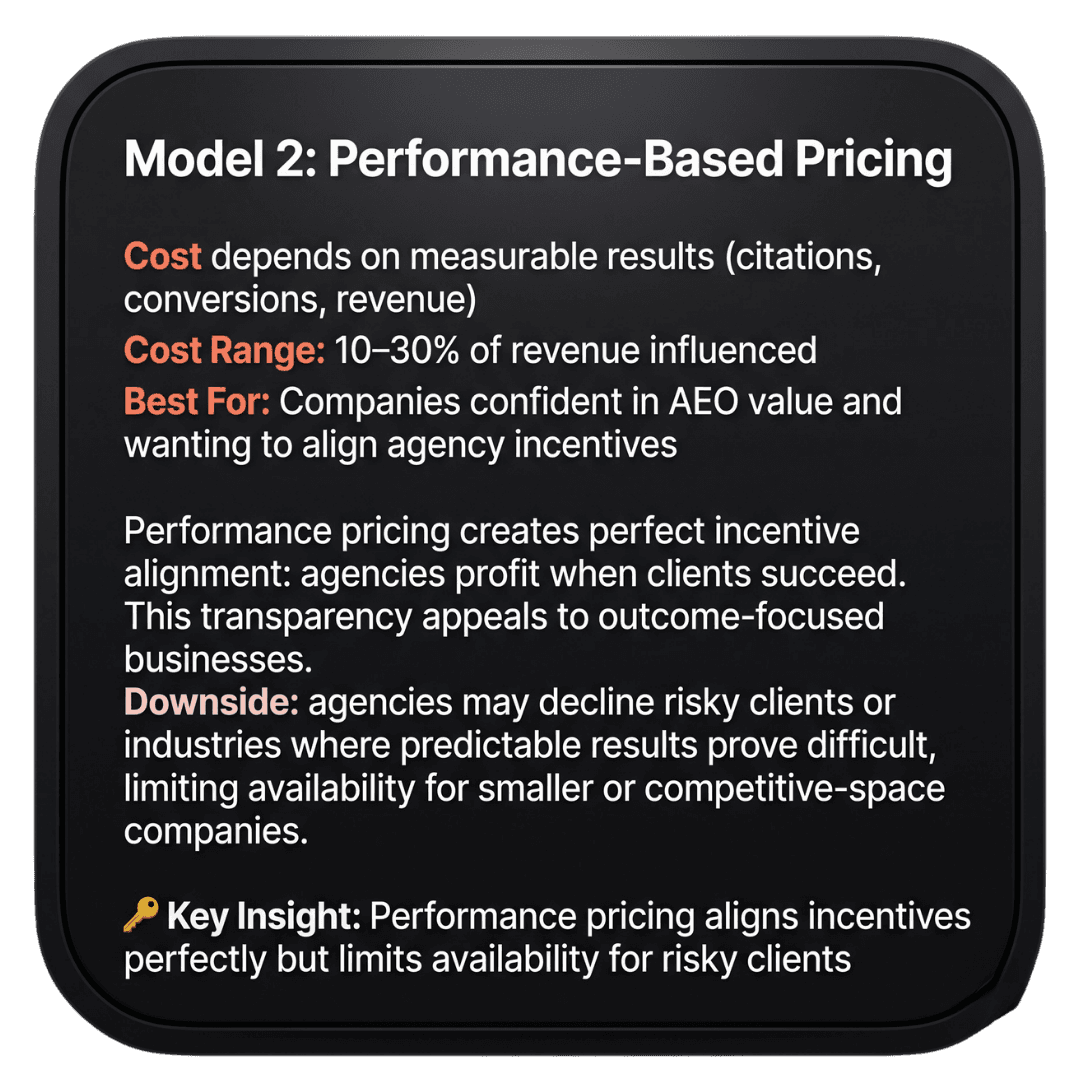
Structure: Cost depends on measurable results (citations, conversions, revenue)
Cost Range: 10-30% of revenue influenced
Best For: Companies confident in AEO value and wanting to align agency incentives
Performance pricing creates perfect incentive alignment: agencies profit when clients succeed. This transparency appeals to outcome-focused businesses.
Downside: agencies may decline risky clients or industries where predictable results prove difficult, limiting availability for smaller or competitive-space companies.
Model 3: Project-Based Pricing
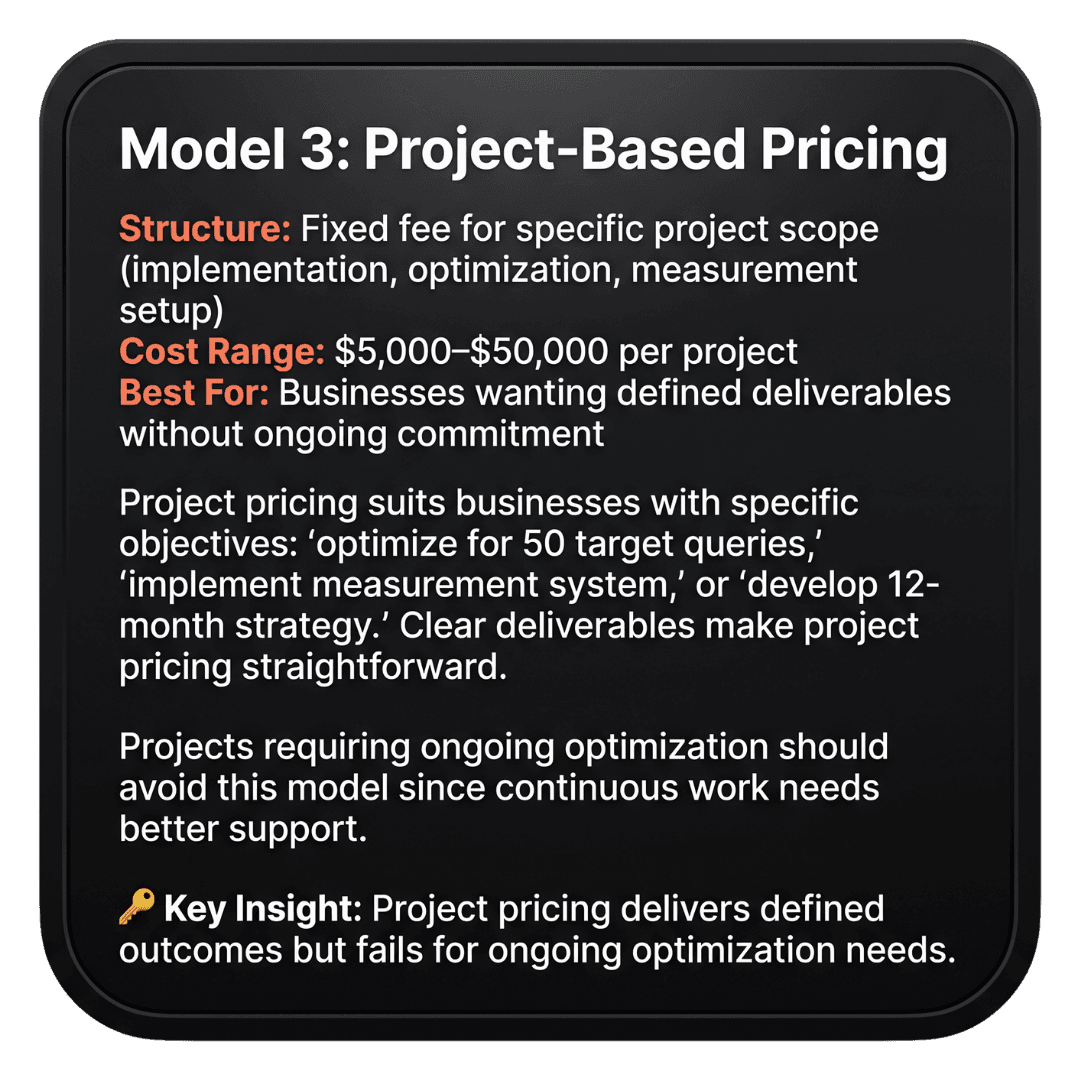
Structure: Fixed fee for specific project scope (implementation, optimization, measurement setup)
Cost Range: $5,000-$50,000 per project
Best For: Businesses wanting defined deliverables without ongoing commitment
Project pricing suits businesses with specific objectives: "optimize for 50 target queries," "implement measurement system," or "develop 12-month strategy." Clear deliverables make project pricing straightforward.
Projects requiring ongoing optimization should avoid this model since continuous work needs better support.
Model 4: Hourly Billing
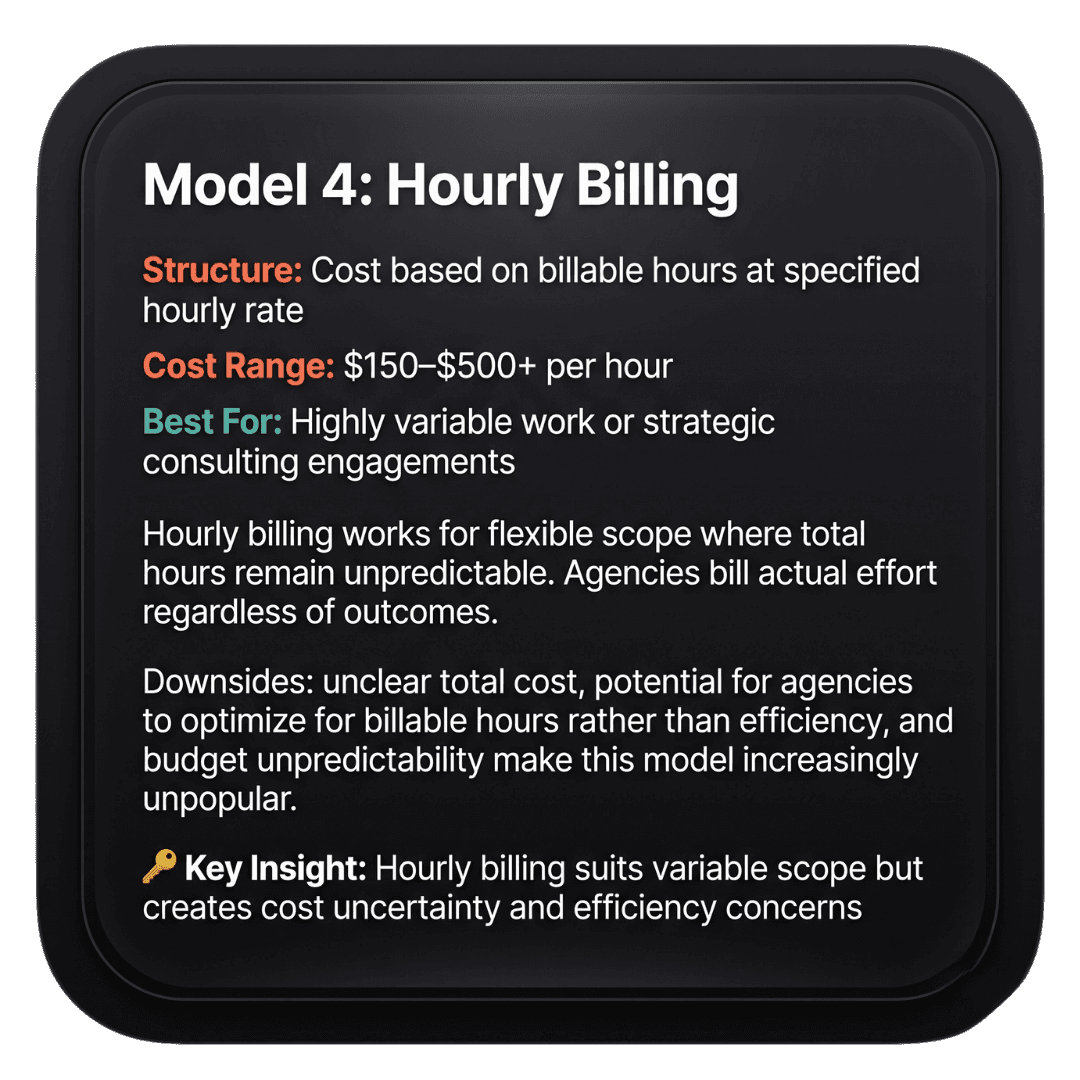
Structure: Cost based on billable hours at specified hourly rate
Cost Range: $150-$500+ per hour
Best For: Highly variable work or strategic consulting engagements
Hourly billing works for flexible scope where total hours remain unpredictable. Agencies bill actual effort regardless of outcomes.
Downsides: unclear total cost, potential for agencies to optimize for billable hours rather than efficiency, and budget unpredictability make this model increasingly unpopular.
Model 5: Hybrid Retainer + Performance
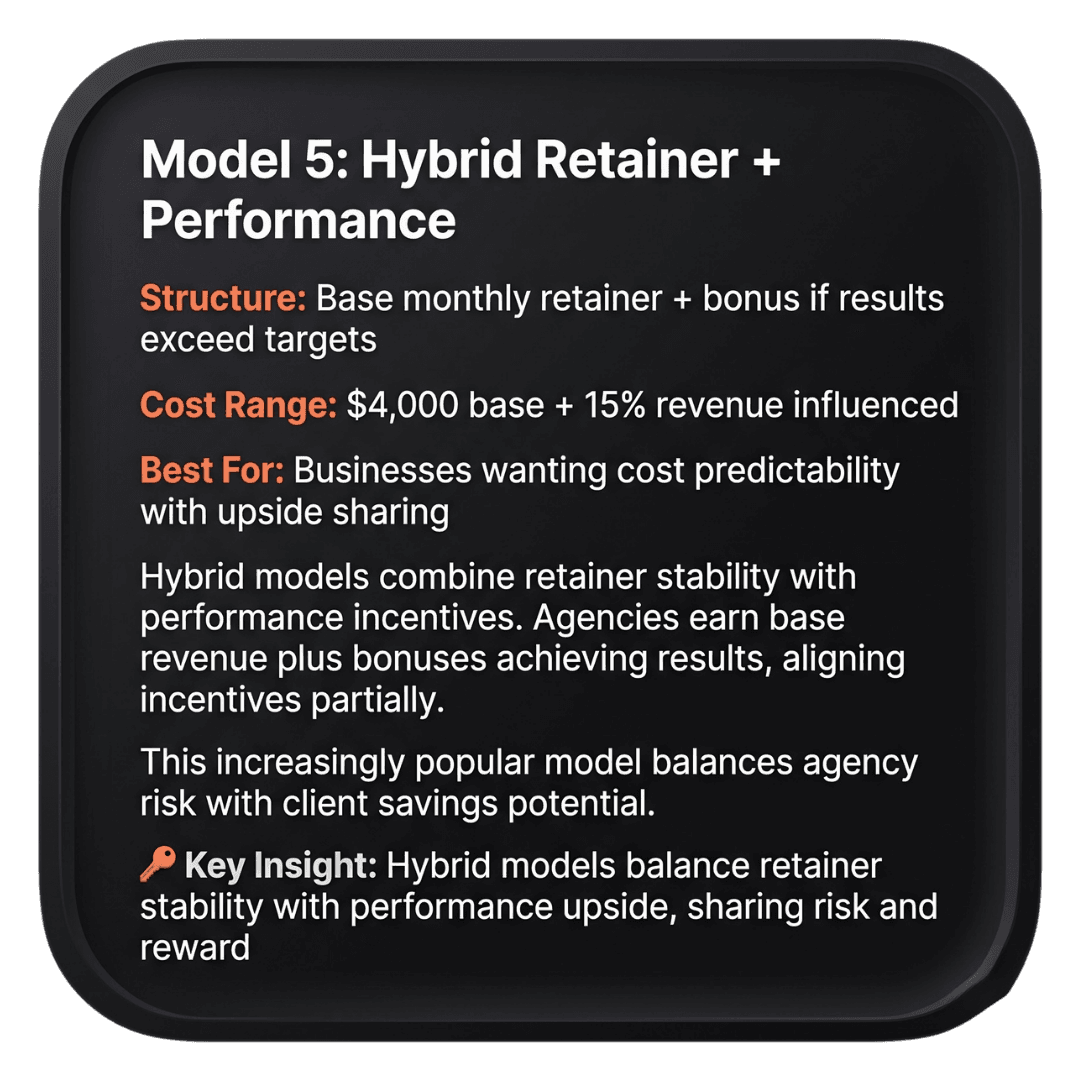
Structure: Base monthly retainer + bonus if results exceed targets
Cost Range: $4,000 base + 15% revenue influenced
Best For: Businesses wanting cost predictability with upside sharing
Hybrid models combine retainer stability with performance incentives. Agencies earn base revenue plus bonuses achieving results, aligning incentives partially.
This increasingly popular model balances agency risk with client savings potential.
Model 6: Citation-Based Pricing
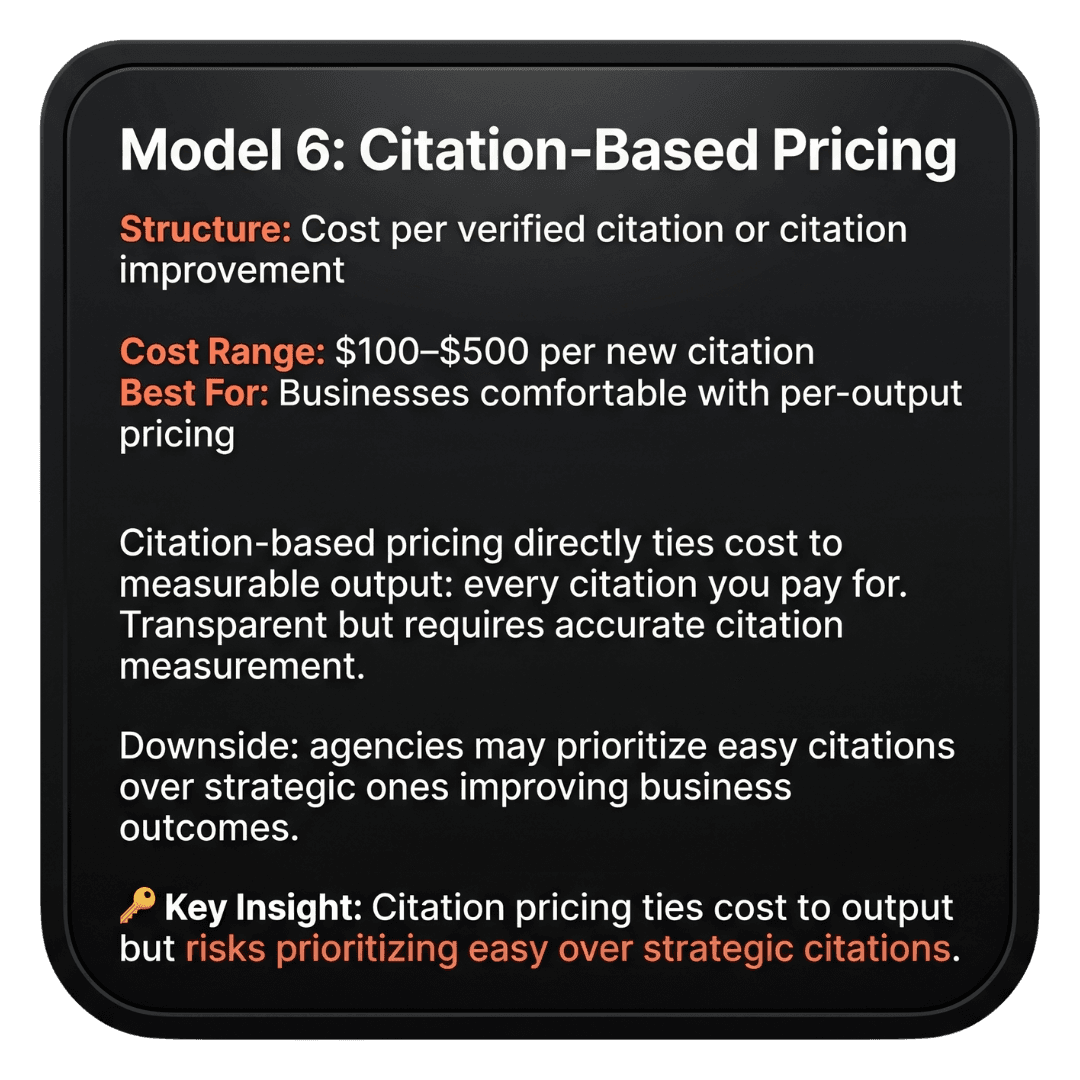
Structure: Cost per verified citation or citation improvement
Cost Range: $100-$500 per new citation
Best For: Businesses comfortable with per-output pricing
Citation-based pricing directly ties cost to measurable output: every citation you pay for. Transparent but requires accurate citation measurement.
Downside: agencies may prioritize easy citations over strategic ones improving business outcomes.
Model 7: Revenue Share Model
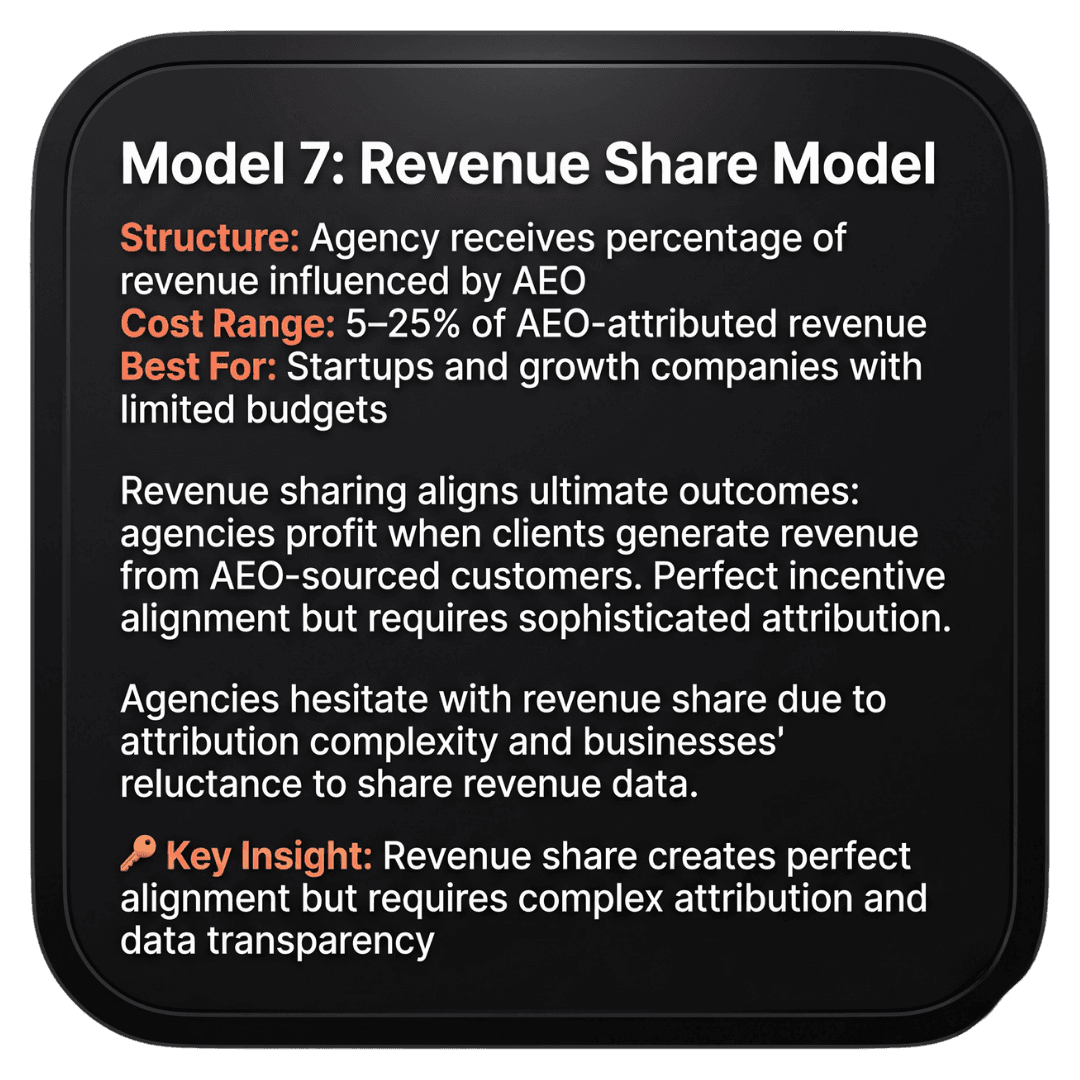
Structure: Agency receives percentage of revenue influenced by AEO
Cost Range: 5-25% of AEO-attributed revenue
Best For: Startups and growth companies with limited budgets
Revenue sharing aligns ultimate outcomes: agencies profit when clients generate revenue from AEO-sourced customers. Perfect incentive alignment but requires sophisticated attribution.
Agencies hesitate with revenue share due to attribution complexity and businesses' reluctance to share revenue data.
Model 8: Tiered Pricing Structure
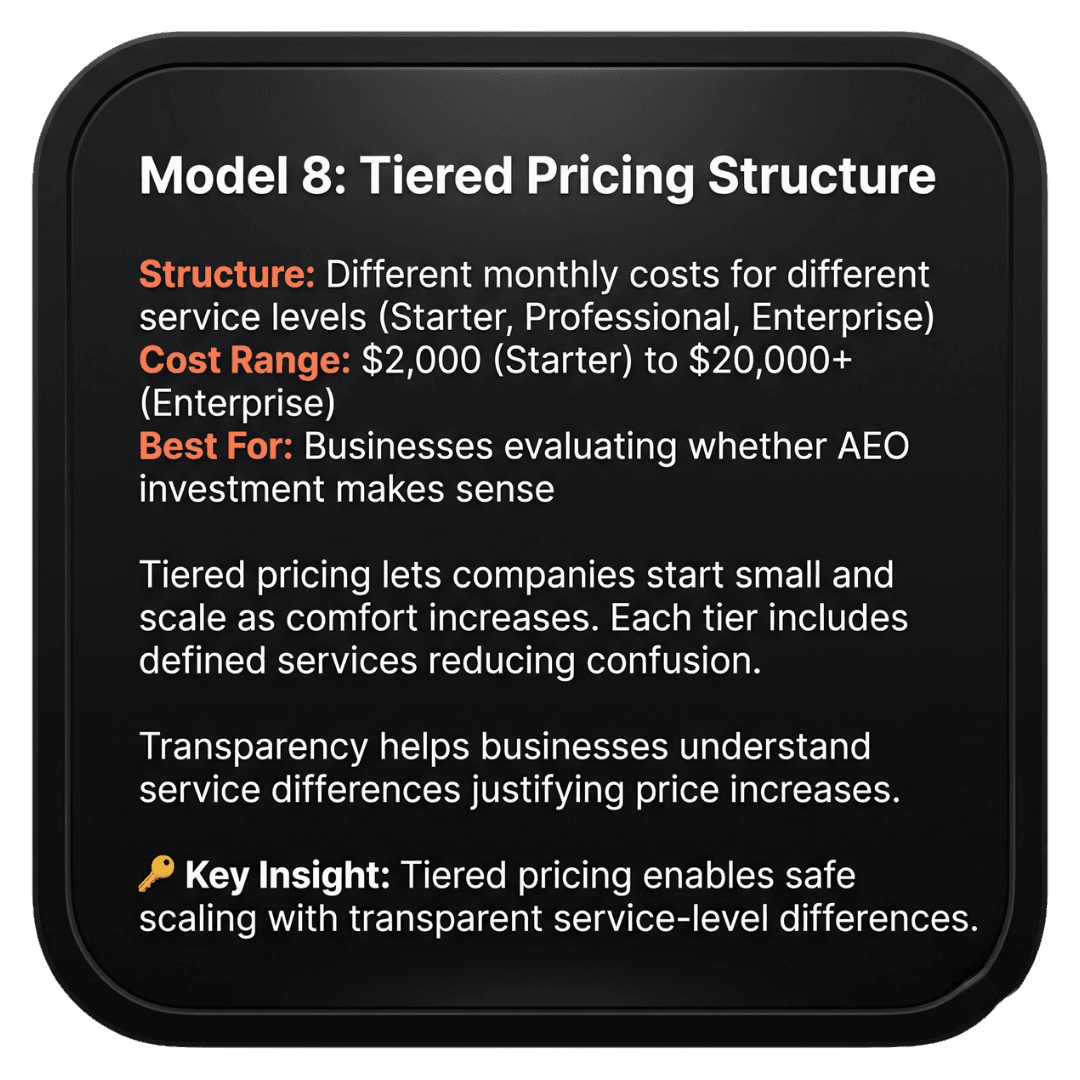
Structure: Different monthly costs for different service levels (Starter, Professional, Enterprise)
Cost Range: $2,000 (Starter) to $20,000+ (Enterprise)
Best For: Businesses evaluating whether AEO investment makes sense
Tiered pricing lets companies start small and scale as comfort increases. Each tier includes defined services reducing confusion.
Transparency helps businesses understand service differences justifying price increases.
Model 9: Engagement-Level Pricing
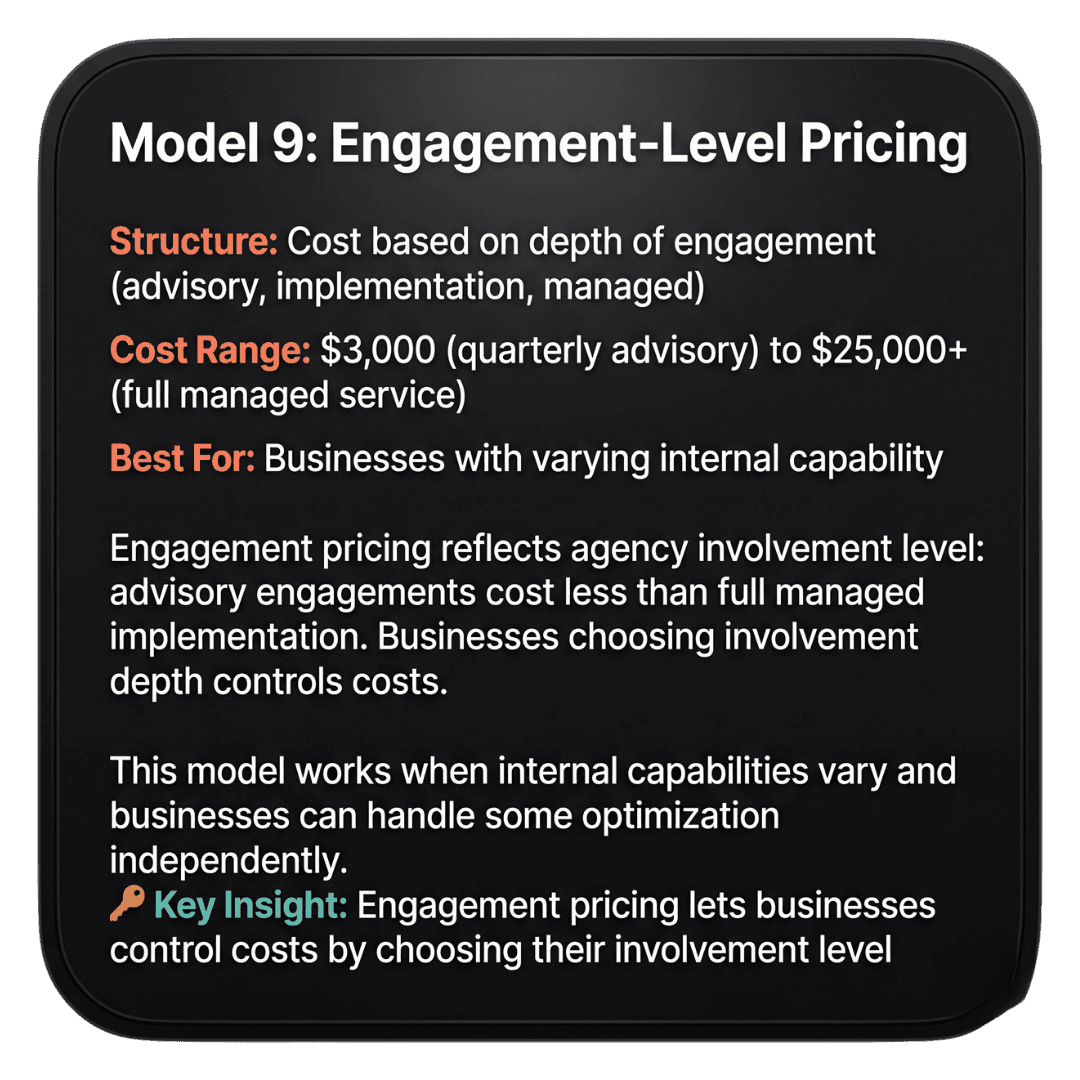
Structure: Cost based on depth of engagement (advisory, implementation, managed)
Cost Range: $3,000 (quarterly advisory) to $25,000+ (full managed service)
Best For: Businesses with varying internal capability
Engagement pricing reflects agency involvement level: advisory engagements cost less than full managed implementation. Businesses choosing involvement depth controls costs.
This model works when internal capabilities vary and businesses can handle some optimization independently.
Model 10: Platform-Specific Pricing
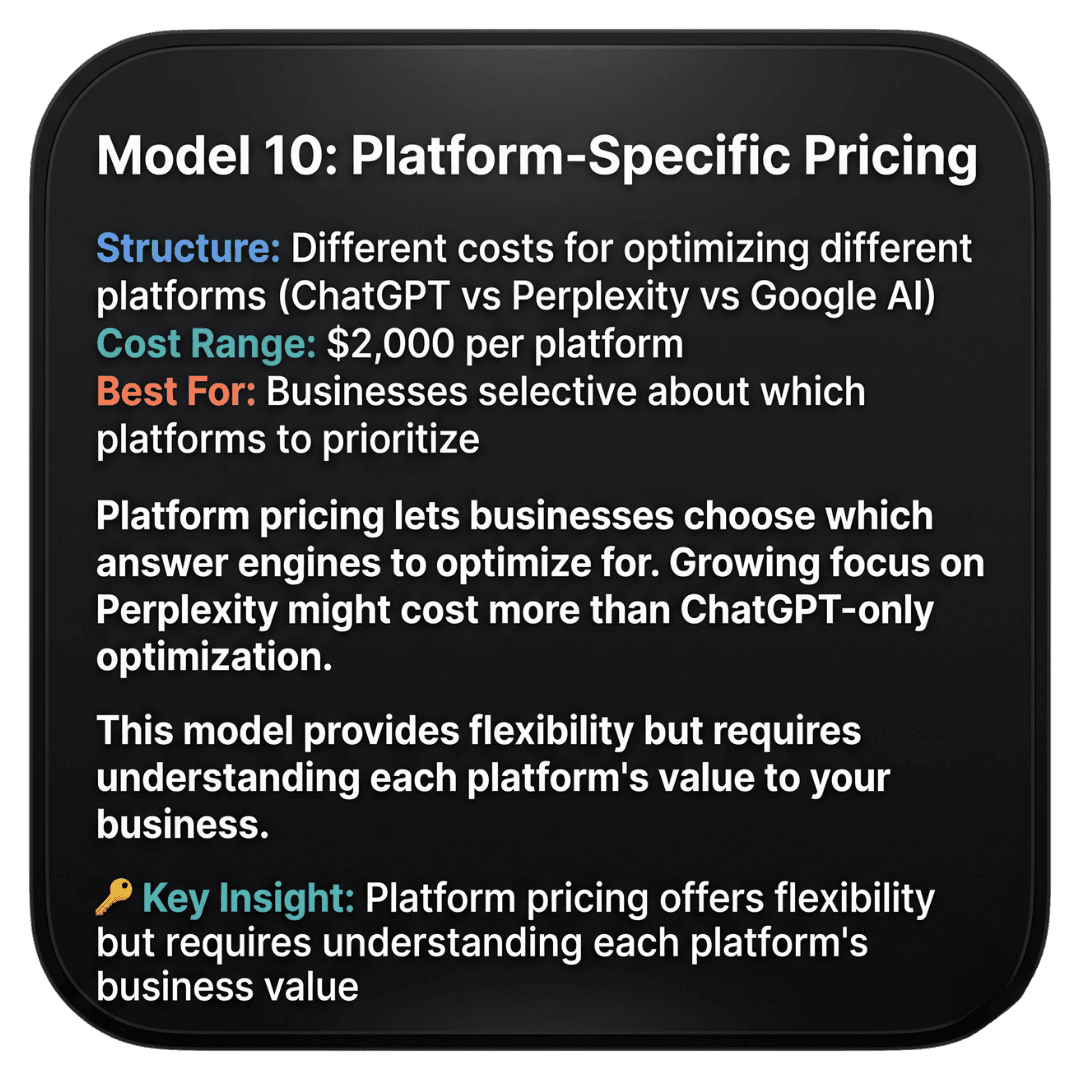
Structure: Different costs for optimizing different platforms (ChatGPT vs Perplexity vs Google AI)
Cost Range: $2,000 per platform
Best For: Businesses selective about which platforms to prioritize
Platform pricing lets businesses choose which answer engines to optimize for. Growing focus on Perplexity might cost more than ChatGPT-only optimization.
This model provides flexibility but requires understanding each platform's value to your business.
Model 11: Quarterly Milestone Pricing
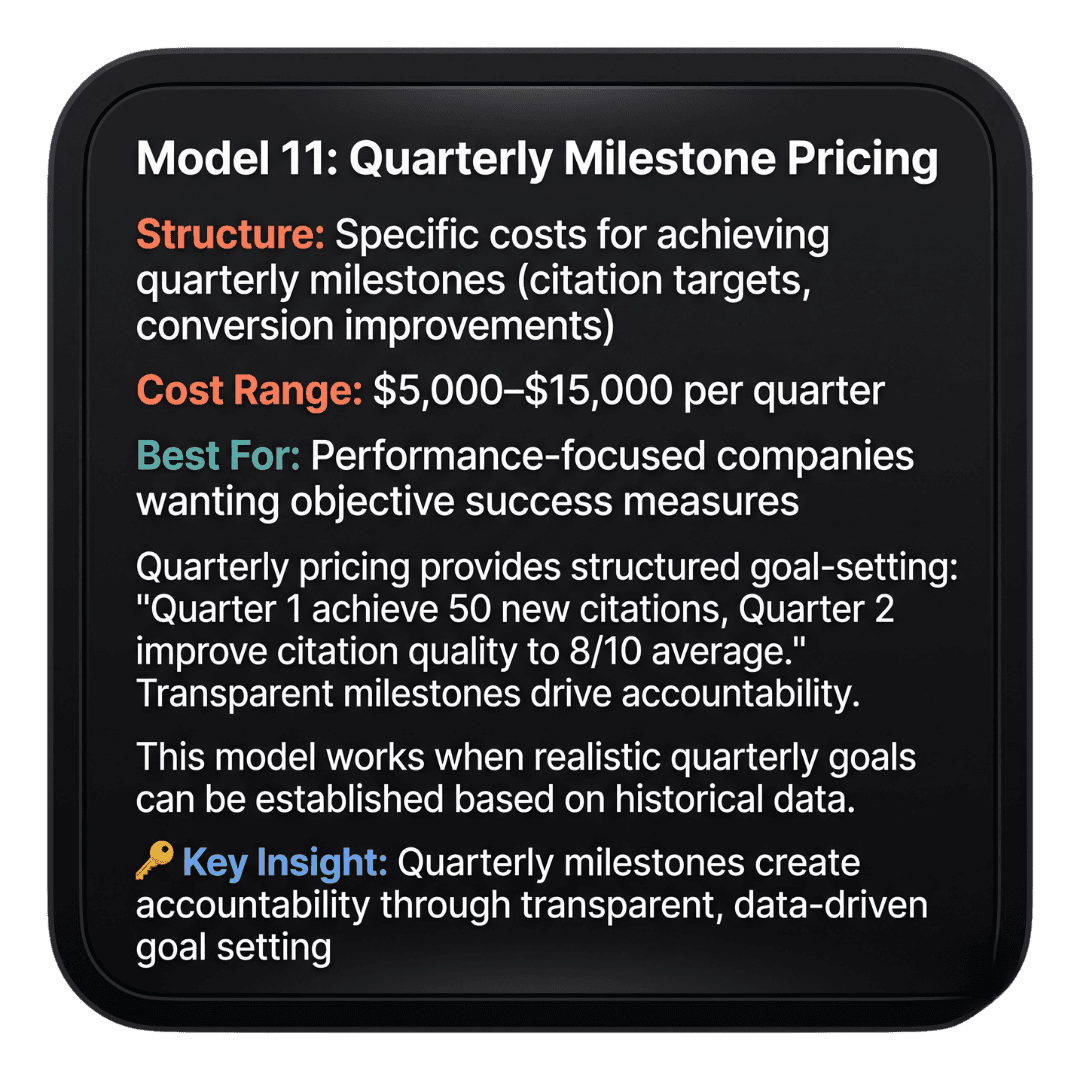
Structure: Specific costs for achieving quarterly milestones (citation targets, conversion improvements)
Cost Range: $5,000-$15,000 per quarter
Best For: Performance-focused companies wanting objective success measures
Quarterly pricing provides structured goal-setting: "Quarter 1 achieve 50 new citations, Quarter 2 improve citation quality to 8/10 average." Transparent milestones drive accountability.
This model works when realistic quarterly goals can be established based on historical data.
Model 12: Setup Fee + Retainer
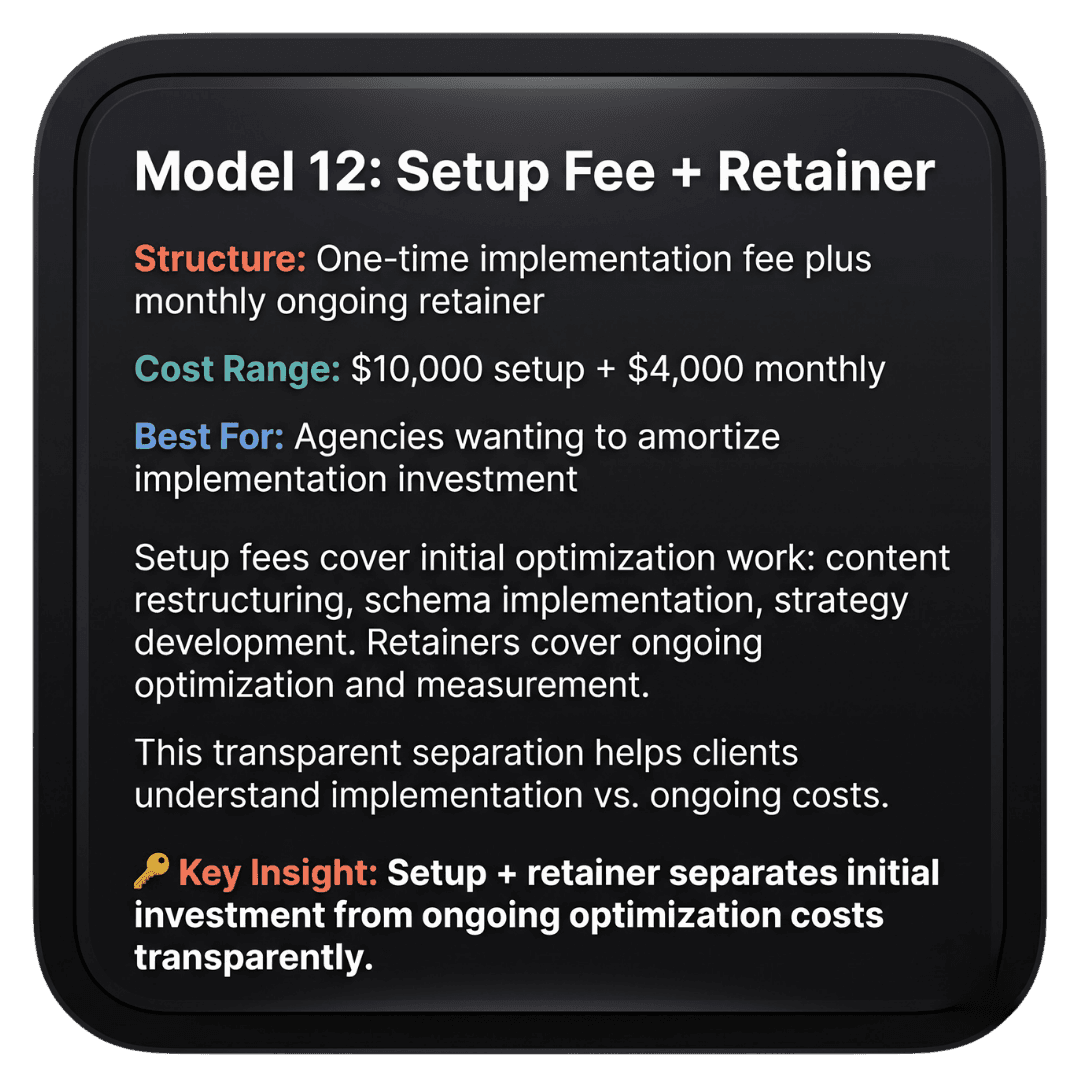
Structure: One-time implementation fee plus monthly ongoing retainer
Cost Range: $10,000 setup + $4,000 monthly
Best For: Agencies wanting to amortize implementation investment
Setup fees cover initial optimization work: content restructuring, schema implementation, strategy development. Retainers cover ongoing optimization and measurement.
This transparent separation helps clients understand implementation vs. ongoing costs.
Model 13: ROI-Based Pricing
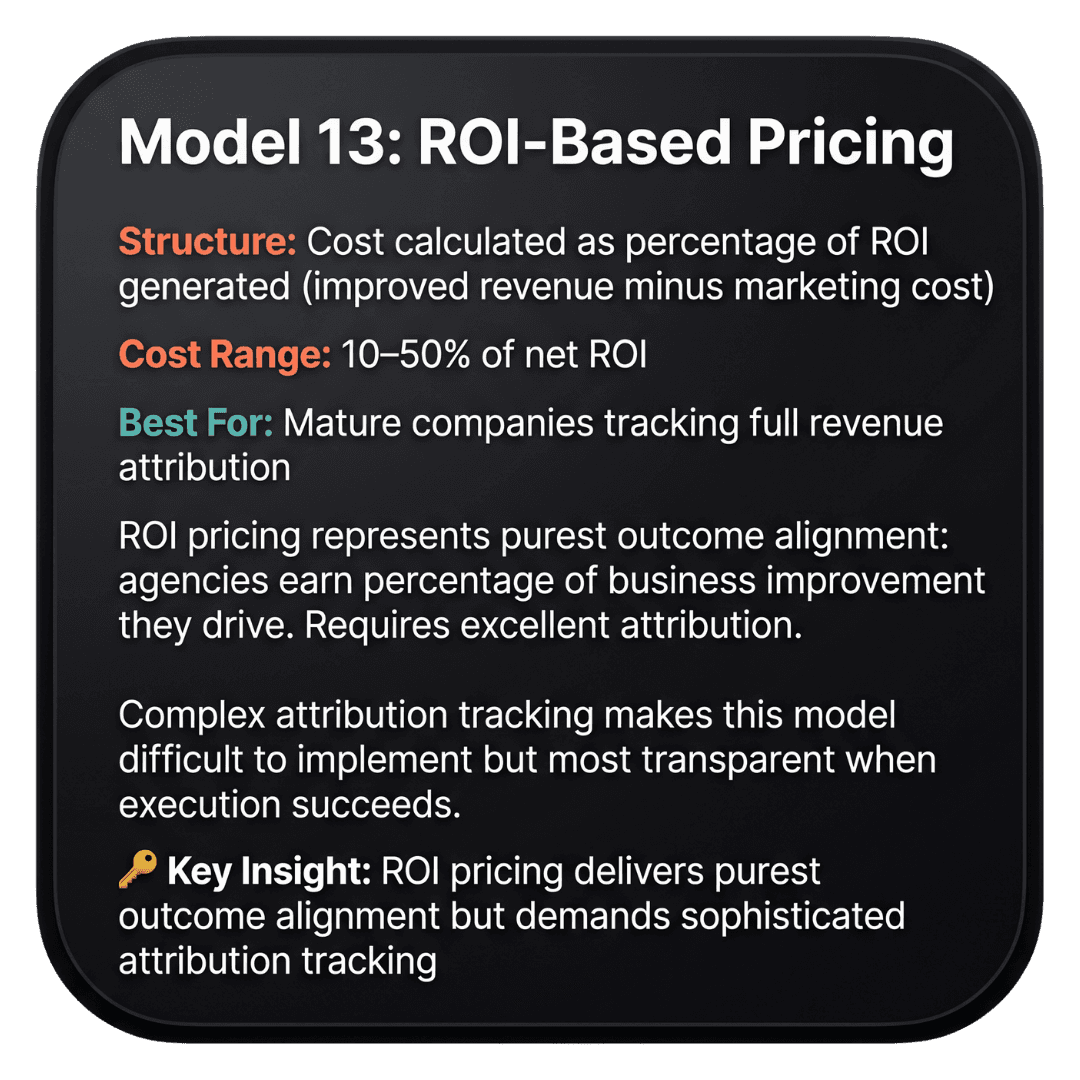
Structure: Cost calculated as percentage of ROI generated (improved revenue minus marketing cost)
Cost Range: 10-50% of net ROI
Best For: Mature companies tracking full revenue attribution
ROI pricing represents purest outcome alignment: agencies earn percentage of business improvement they drive. Requires excellent attribution.
Complex attribution tracking makes this model difficult to implement but most transparent when execution succeeds.
Model 14: Custom Package Pricing
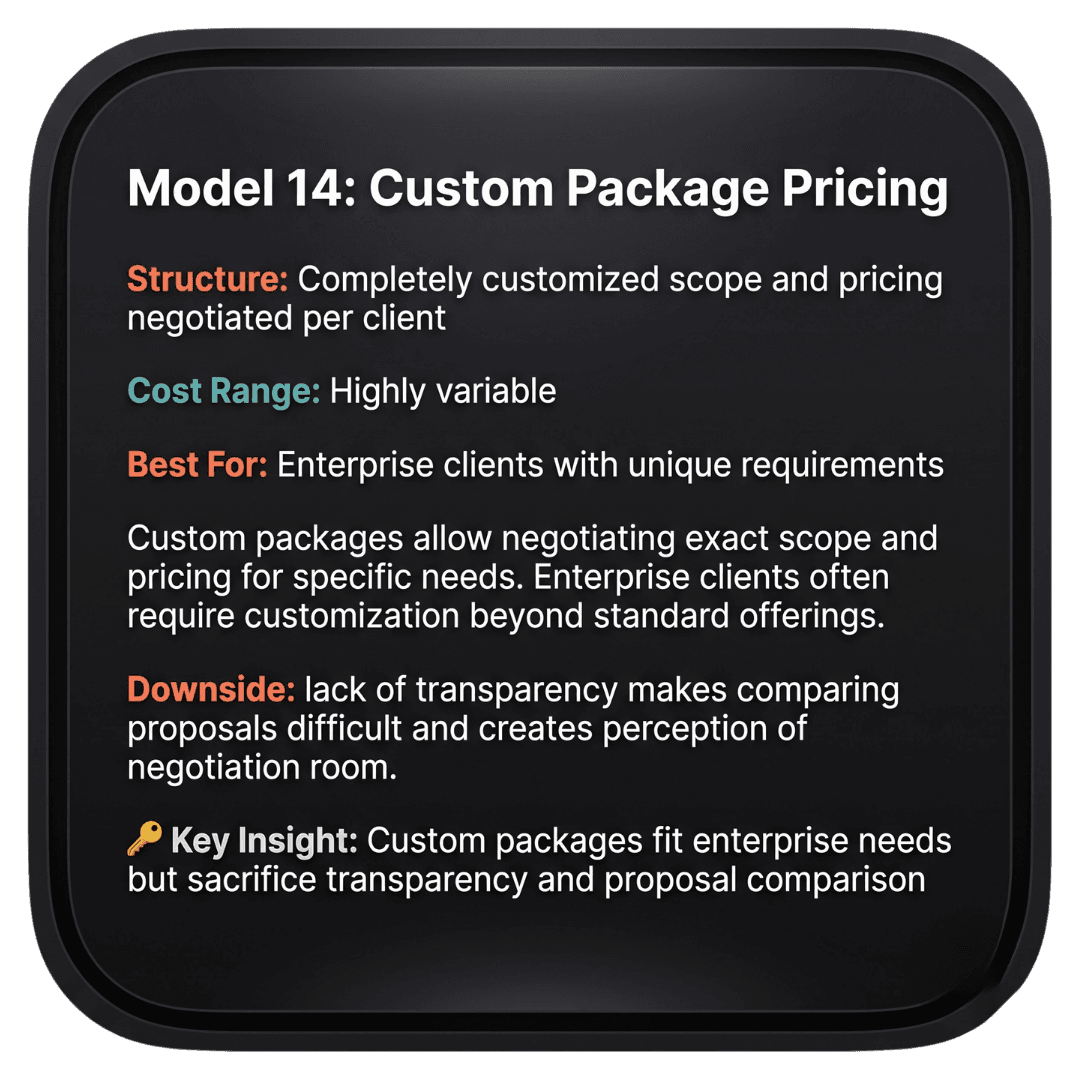
Structure: Completely customized scope and pricing negotiated per client
Cost Range: Highly variable
Best For: Enterprise clients with unique requirements
Custom packages allow negotiating exact scope and pricing for specific needs. Enterprise clients often require customization beyond standard offerings.
Downside: lack of transparency makes comparing proposals difficult and creates perception of negotiation room.
Model 15: Audit + Strategy + Execution Pricing
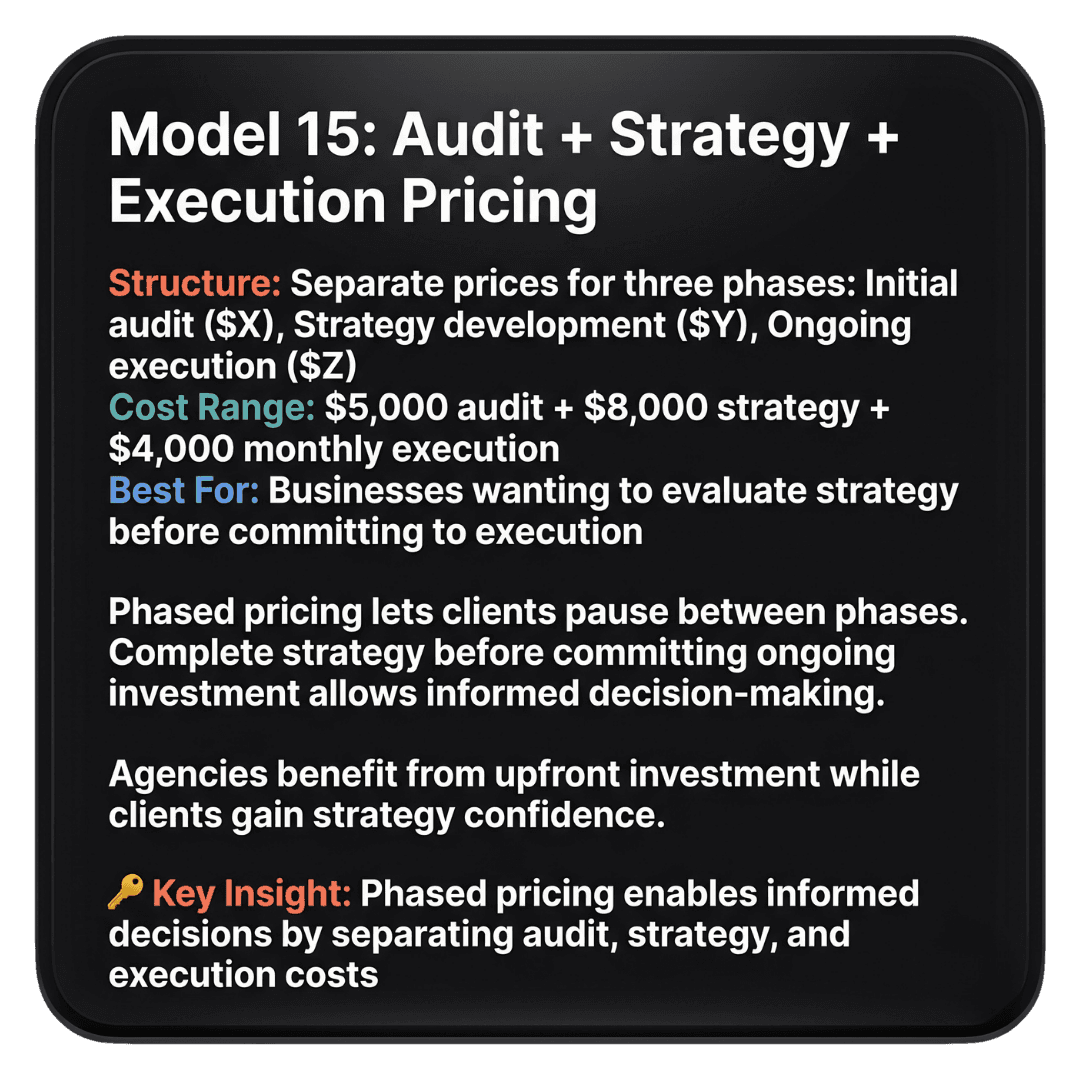
Structure: Separate prices for three phases: Initial audit ($X), Strategy development ($Y), Ongoing execution ($Z)
Cost Range: $5,000 audit + $8,000 strategy + $4,000 monthly execution
Best For: Businesses wanting to evaluate strategy before committing to execution
Phased pricing lets clients pause between phases. Complete strategy before committing ongoing investment allows informed decision-making.
Agencies benefit from upfront investment while clients gain strategy confidence.
Model 16: Dedicated Team Pricing
Structure: Cost for dedicated account team assigned exclusively to your account
Cost Range: $15,000-$40,000+ monthly
Best For: Enterprise clients needing high-touch support
Dedicated teams provide exclusive attention unavailable at lower price points. Premium pricing reflects exclusive resource allocation.
Smaller companies cannot justify dedicated team costs, limiting this model to enterprise budgets.
Model 17: Usage-Based Pricing
Structure: Cost based on query volume, number of tracked keywords, or measurement frequency
Cost Range: $0.50-$5 per tracked query monthly
Best For: Businesses with highly variable optimization needs
Usage pricing scales with actual activity. Companies tracking 100 queries pay less than those tracking 1,000 queries.
This model encourages efficiency but creates unpredictable costs if query volumes increase.
Model 18: Industry-Specific Pricing
Structure: Different pricing for different industries based on optimization difficulty
Cost Range: $2,000 (simple retail) to $15,000+ (regulated healthcare)
Best For: Agencies specializing in specific high-regulation industries
Healthcare, financial services, and legal optimization costs more due to compliance complexity. Industry-specific pricing reflects real cost differences.
This transparent model helps prospects understand why regulated industries cost more.
Model 19: Volume Discount Pricing
Structure: Lower per-unit costs for companies optimizing larger scale
Cost Range: $100/keyword (1-50 keywords) to $30/keyword (500+ keywords)
Best For: Large companies optimizing extensive keyword or query portfolios
Volume discounts incentivize larger engagements. Unit cost decreases as total scope increases, encouraging bigger investments.
This model benefits large companies but disadvantages smaller competitors unable to achieve volume discounts.
Comparing Pricing Models: Which Offers Best Value?
Budget Predictability
Fixed retainers and tiered pricing provide maximum predictability. Performance-based, revenue share, and ROI models create variable costs tied to results.
Budget-constrained companies should prioritize fixed pricing while outcome-confident companies can accept variable models.
Risk Alignment
Performance-based, revenue share, and ROI models align risk: agencies share client risk by tying profits to results. Fixed retainers place risk entirely on clients.
Risk-sharing models demonstrate agency confidence in their ability to deliver results.
Transparency and Simplicity
Project-based, tiered, and setup-fee-plus-retainer models offer maximum transparency. Custom packages and negotiated pricing lack clarity.
Transparency enables confident decision-making; complexity creates uncertainty and negotiation friction.
Alignment With Business Outcomes
Performance-based, revenue share, and ROI models align with business outcomes perfectly. Fixed retainers may misalign if agency profits regardless of results.
Outcome-aligned pricing ensures agencies prioritize client success over billable hours.
Red Flags in AEO Pricing
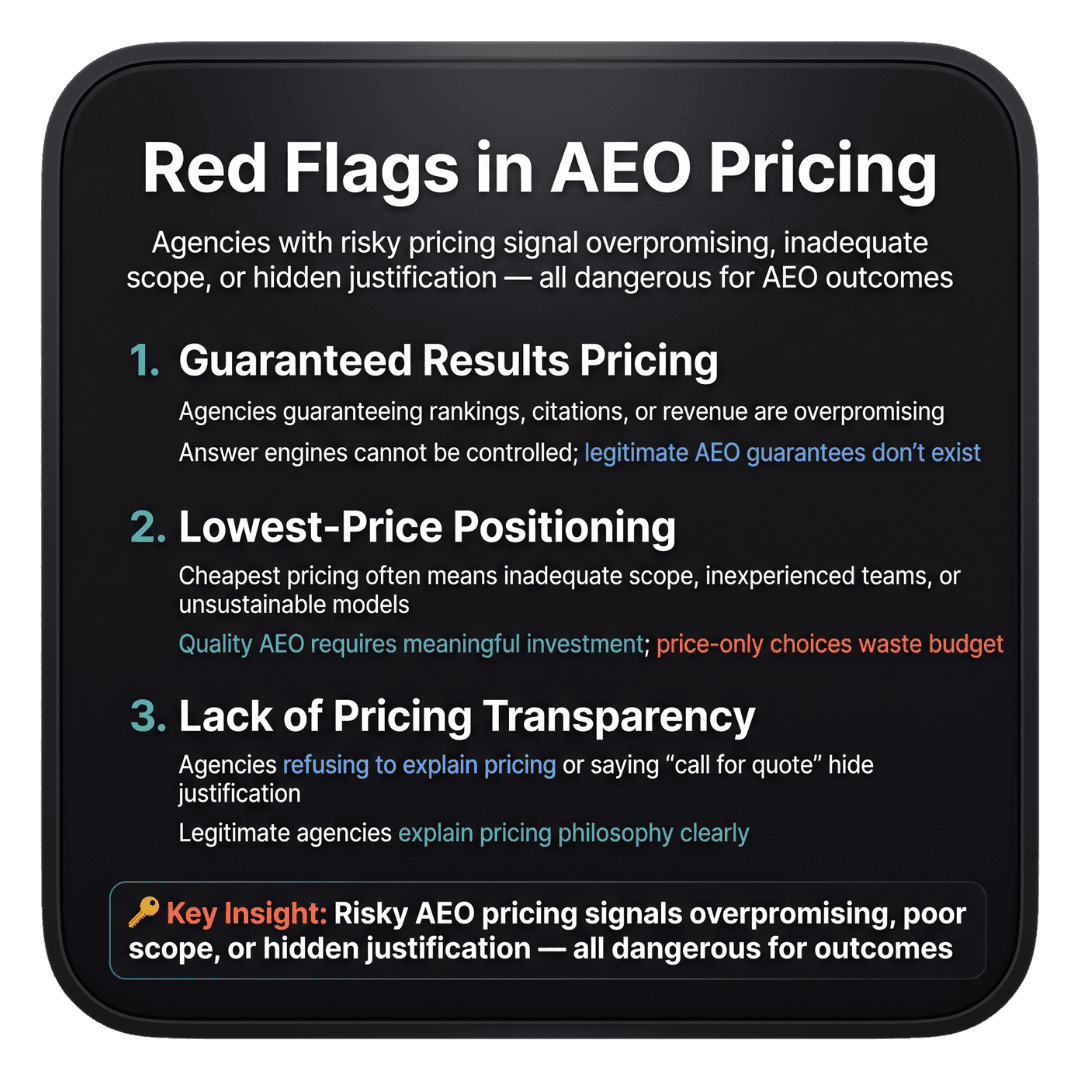
Guaranteed Results Pricing
Agencies guaranteeing rankings, citation numbers, or revenue are overpromising. Answer engines cannot be controlled guaranteeing specific outcomes.
Legitimate guarantees don't exist in AEO. Agencies offering them are either misrepresenting services or planning to underdeliver.
Lowest-Price Positioning
Cheapest pricing often indicates: inadequate service scope, inexperienced teams, or unsustainable business models. Quality AEO costs meaningful investment.
Choosing based on price alone typically results in poor outcomes and wasted budget.
Lack of Pricing Transparency
Agencies refusing to explain pricing models or providing vague "call for quote" responses hide pricing justification. Legitimate agencies explain pricing philosophy.
Demand clear pricing explanations before engaging.
Negotiating AEO Pricing
Understand Your Needs First
Define exactly what you need before discussing pricing. Agencies cannot quote accurately without understanding scope.
Vague requirements lead to vague pricing making comparison impossible.
Get Multiple Proposals
Request detailed proposals from 3-5 agencies explaining pricing rationale. Comparison reveals market norms and outliers.
Proposals should explain what you're paying for, not just monthly cost.
Evaluate Value, Not Price
Compare expected outcomes and included services alongside cost. Agency A at $8,000 monthly with dedicated team and real-time measurement may provide better value than Agency B at $3,000 with minimal support.
Cost per expected outcome matters more than absolute monthly fee.
Web of Picasso's Transparent Pricing Philosophy
Web of Picasso uses hybrid retainer-plus-performance pricing believing agencies should share client risk. Our base retainers ($4,000-$20,000 monthly depending on scope) are supplemented with performance bonuses when clients exceed agreed targets.
This transparent model provides budget predictability while aligning our success with client outcomes. We explain exactly what's included at each pricing tier, helping clients understand value received.
Contact Web of Picasso
Website: Visit Web of Picasso
Email: info@webofpicasso.net
Get Started: Book your free AEO pricing consultation and proposal