Making Your Enterprise Future Ready: 15 AEO Implementation Steps for 2026
Design

Tanuj Sarva
02/05/2026

How do enterprises become future-ready for AI search in 2026? Enterprise AEO implementation requires 15 strategic steps across five phases: foundation assessment, technical infrastructure, content authority, cross-team alignment, and measurement optimization, often supported by specialized aeo ai services and tailored AEO services that understand enterprise-scale needs. Companies following this systematic approach achieve 400%+ ROI while positioning themselves as the trusted sources AI platforms cite when prospects research solutions. Understanding the top ChatGPT SEO companies will help enterprises leverage the right AEO strategies for 2026.
Why Traditional SEO Strategies Fail at Enterprise Scale
Most enterprise organizations approach Answer Engine Optimization like they approached traditional SEO - as a marketing activity managed by a single department with tactical optimizations applied after decisions are made. For more detailed insights into optimizing your approach, check out our comprehensive AI-search optimization guide alongside Web of Picasso's AEO optimisation services for hands-on execution support. This approach fundamentally fails in the AI search era because AEO success requires infrastructure changes touching product, development, legal, and content teams.
Understanding the benefits of our perplexity aeo service can help you develop a competitive advantage.
Check out our comprehensive overview of Perplexity AEO agency services to better understand how these platforms can improve your marketing effectiveness.
According to Gartner's 2026 analysis, traditional search volume will drop 25% as AI chatbots dominate discovery. Enterprise companies continuing to optimize only for traditional search while ignoring answer engine visibility face permanent market share loss to competitors implementing comprehensive AEO strategies.
At Web of Picasso, I've worked with enterprise clients managing thousands of pages across multiple brands, regions, and product lines. The organizations achieving exceptional AEO results treat it as infrastructure requiring executive sponsorship rather than marketing tactics managed in isolation.
You can find more information about the top services available from a specialist agency that focuses on AEO strategies.
The fundamental difference: successful enterprise AEO lives upstream in decision-making about site structure, taxonomy, content scope, and data modeling - not downstream as optimization applied to finished work. This requires organizational restructuring that most enterprises haven't yet undertaken.
Understanding the potential gains in AI visibility is crucial, and it's essential to recognize the benefits of a ChatGPT SEO agency in this context.
The Enterprise AEO Opportunity in 2026
While 70% of organizations believe AEO will significantly impact digital strategy, only 20% have begun implementation. This creates massive first-mover advantages for enterprises willing to invest systematically before competitive intensity increases.
Enterprise brands appearing consistently in ChatGPT, Perplexity, and Google AI Overviews establish authority patterns that become exponentially more difficult for competitors to displace. AI platforms develop trust relationships with sources cited repeatedly, creating compound advantages for early adopters.
From my 5+ years building Web of Picasso into a leading AEO agency, enterprise clients implementing comprehensive strategies 12-18 months before competitors capture 5-10x more AI citation market share. The early adoption advantage strengthens over time as citation patterns compound.
Phase 1: Foundation & Strategic Assessment
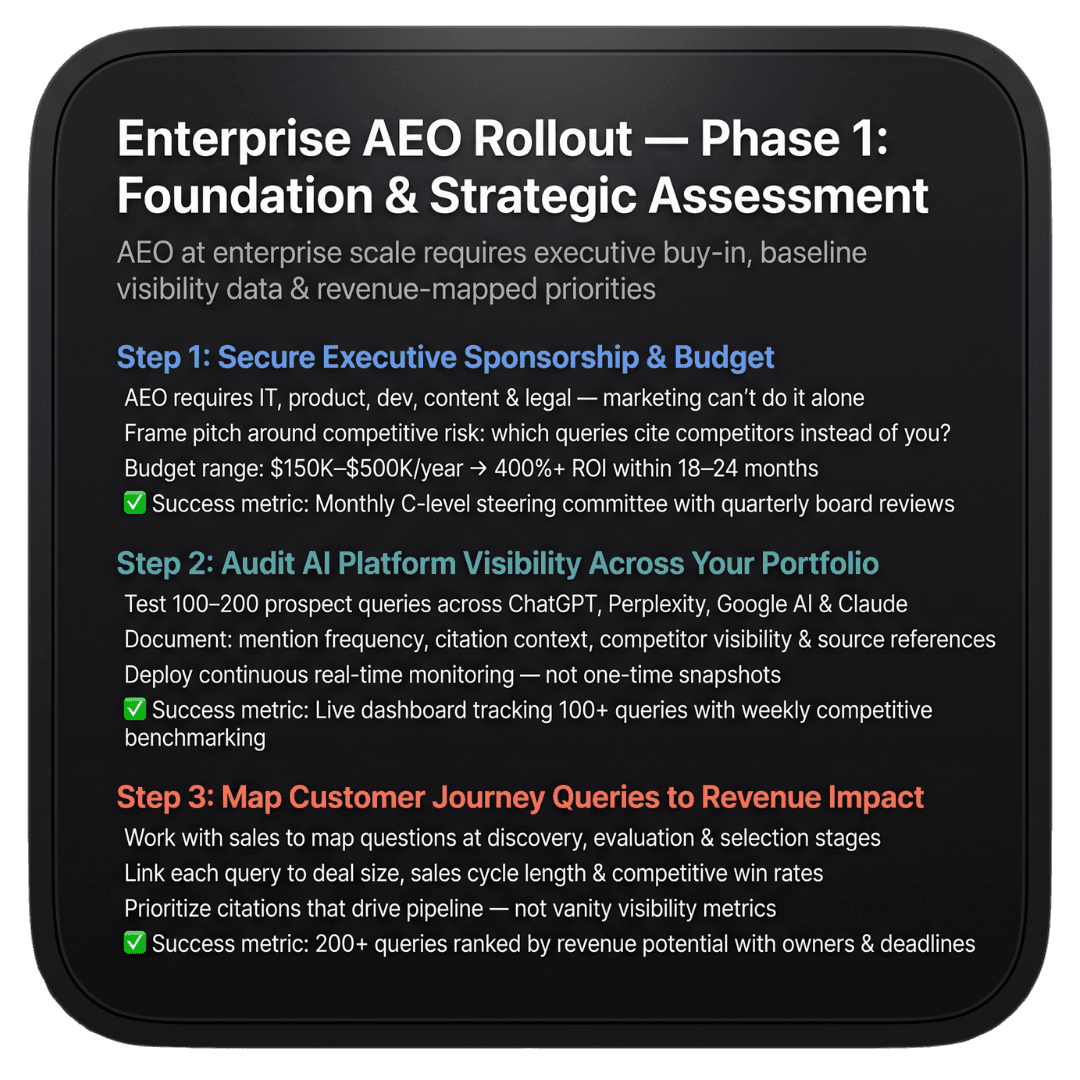
Step 1: Secure Executive Sponsorship and Cross-Functional Budget
Answer Engine Optimization fails at enterprise scale without C-level sponsorship because implementation requires resources from IT, product, development, content, and legal. Marketing alone cannot fund or execute comprehensive AEO strategies.
Build your business case around competitive risk rather than opportunity. Show executives how many category-defining queries currently cite competitors instead of your brand, quantify the pipeline impact of losing AI-driven discovery, and demonstrate how answer engine invisibility threatens brand relevance.
Secure dedicated budget covering agency partnership, technology infrastructure, content production, engineering resources, and cross-team coordination. Web of Picasso clients allocating $150K-$500K annually for enterprise AEO programs see 400%+ ROI within 18-24 months. See how we calculate enterprise AEO ROI across the program.
Success Metric: Executive steering committee meets monthly to review AEO progress with representatives from marketing, product, IT, and content organizations providing quarterly business reviews to board.
Step 2: Audit Current AI Platform Visibility Across Your Portfolio
Most enterprises have zero visibility into how AI platforms currently represent their brands, products, and solutions. This baseline assessment reveals competitive gaps and prioritization opportunities that justify continued investment.
Test 100-200 queries prospects ask when researching solutions in your category across ChatGPT, Perplexity, Google AI Overviews, and Claude. For businesses looking to excel in AI-driven strategies, Web of Picasso's Perplexity SEO agency offers unmatched expertise. To effectively navigate the AEO landscape, learn more about Perplexity AEO and how it can improve your digital marketing strategies. Our 47-point technical AEO audit maps the infrastructure gaps this baseline reveals. Document brand mention frequency, citation context quality, competitor visibility, and which content sources AI platforms reference.
Implement continuous monitoring showing real-time citation frequency across platforms using tools like HubSpot AEO or proprietary tracking. This ongoing visibility prevents optimization blind spots and enables rapid response to competitive threats.
Success Metric: Comprehensive visibility dashboard showing citation frequency across 100+ target queries with weekly trend analysis and competitive benchmarking against three primary competitors.
Step 3: Map Customer Journey Queries to Revenue Impact
Not all AI citations create equal business value. Enterprise AEO prioritization requires understanding which queries prospects ask at different buyer journey stages and the revenue potential each represents.
Work with sales teams to identify questions prospects ask during discovery, evaluation, and selection phases. Map these queries to deal size, sales cycle length, and competitive win rates to calculate revenue potential of capturing each citation opportunity.
This query-to-revenue mapping ensures optimization efforts focus on high-value opportunities generating immediate business impact rather than vanity metrics that look impressive but don't drive pipeline.
Success Metric: Prioritized query list covering 200+ searches ranked by annual revenue potential with assigned ownership and target completion dates for optimization.
Phase 2: Technical Infrastructure & AI Accessibility
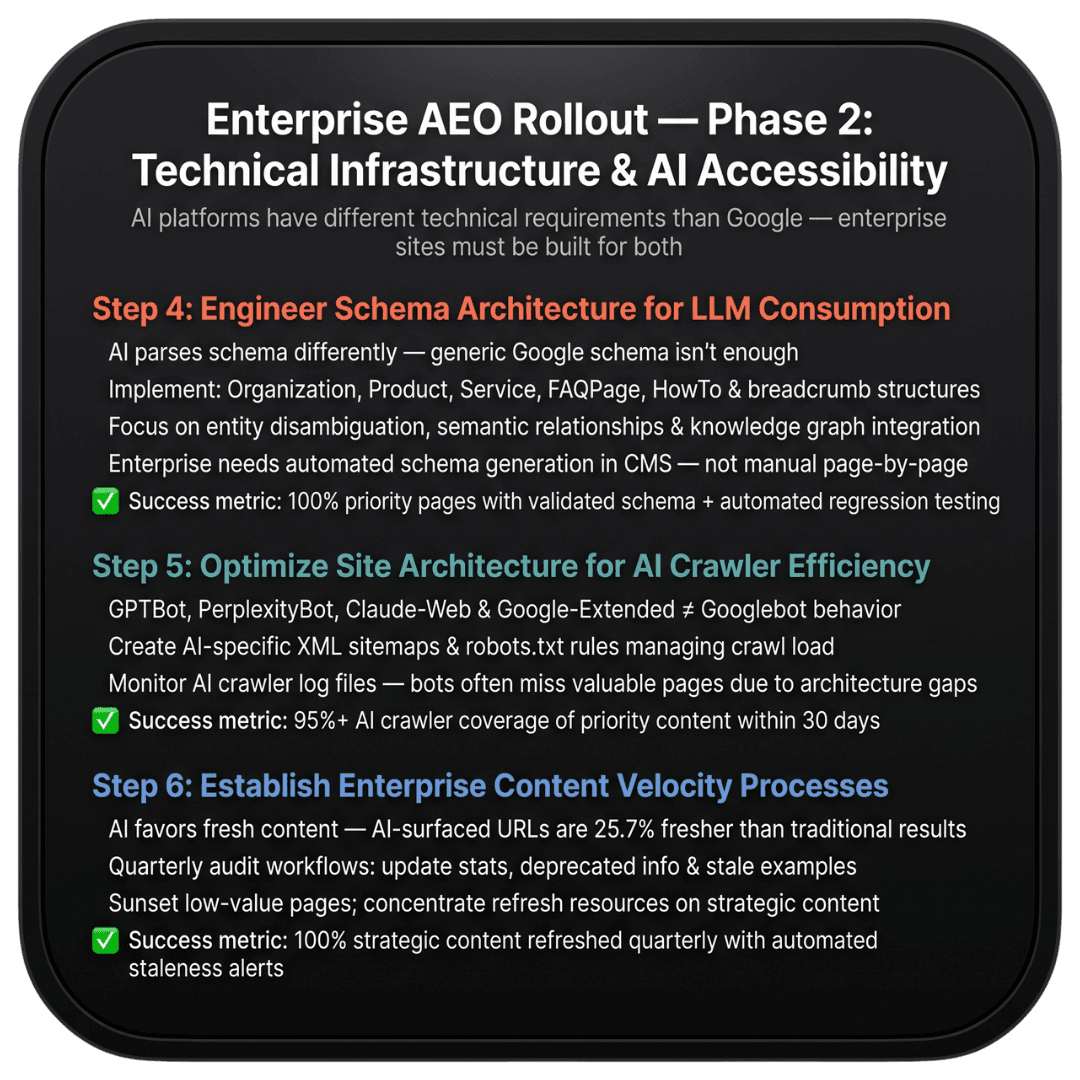
Step 4: Engineer Schema Architecture for LLM Consumption
AI platforms parse structured data differently than traditional search engines. Enterprise AEO requires schema engineering specifically calibrated for how LLMs extract and interpret entity relationships rather than generic implementations designed for Google.
Implement comprehensive schema markup covering Organization, Product, Service, FAQPage, HowTo, and breadcrumb structures validated against Schema.org standards. Focus on entity disambiguation, semantic relationships, and knowledge graph integration that help AI platforms understand your authority within category taxonomies.
Enterprise sites managing thousands of pages require automated schema generation integrated into CMS workflows rather than manual implementation. On WordPress, our WordPress AEO services automate this structured-data rollout across templates. This scalability ensures new content launches with proper structured data without creating deployment bottlenecks.
Success Metric: 100% of priority pages implement validated schema markup with automated testing preventing regression and monthly audits ensuring accuracy as content evolves.
Step 5: Optimize Site Architecture for AI Crawler Efficiency
AI platform crawlers (GPTBot, PerplexityBot, Claude-Web, Google-Extended) behave differently than Googlebot and face tighter crawl budgets. Enterprise sites must architect information hierarchy optimizing for AI bot efficiency rather than just traditional search visibility.
Implement XML sitemaps specifically for AI crawlers, create optimized robots.txt rules allowing AI bot access while managing crawl load, and establish clear site hierarchy enabling efficient content discovery without excessive hop depth.
Monitor AI crawler behavior in log files to understand actual access patterns. Many enterprises discover AI bots concentrate on specific content types while missing valuable pages due to architecture inefficiencies easily fixed once identified.
Success Metric: AI crawler coverage reaching 95%+ of priority content within 30 days with log file analysis showing efficient crawl patterns and minimal wasted bot resources on low-value pages.
Step 6: Establish Enterprise Content Velocity Processes
AI platforms favor recently updated content - research shows AI-surfaced URLs are 25.7% fresher than traditional search results. Enterprise AEO requires systematic content refresh processes maintaining information currency at scale.
Implement content audit workflows identifying outdated statistics, deprecated information, and stale examples requiring updates. Establish governance ensuring subject matter experts review accuracy quarterly with standardized processes for rapid content updates when competitive or market changes demand response.
Many enterprises maintain thousands of pages no one actively manages. Sunset low-value content consuming crawl budget while concentrating refresh resources on strategic pages driving business outcomes.
Success Metric: 100% of strategic content refreshed quarterly with automated staleness detection flagging pages requiring updates and workflow management ensuring timely subject matter expert review.
Phase 3: Content & Authority Building
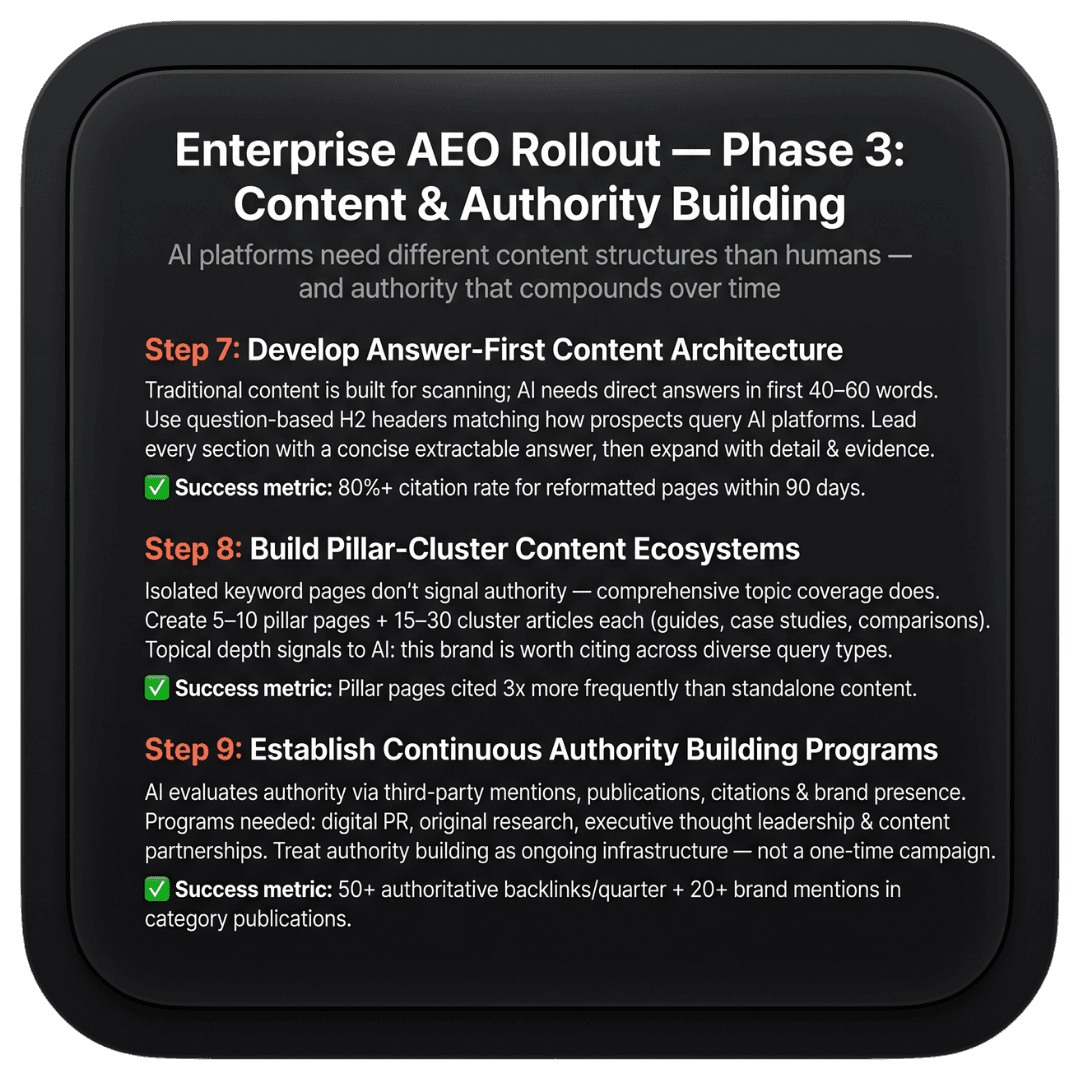
Step 7: Develop Answer-First Content Architecture
Traditional enterprise content is written for scanning - headings, bullets, and visual hierarchy help readers find relevant sections. AI platforms require different structures providing direct answers in the first 40-60 words under each heading with comprehensive detail following.
Restructure strategic content using question-based H2 headers matching how prospects query AI platforms. Lead each section with concise answer statements AI systems can extract as direct responses before expanding with supporting detail, examples, and evidence.
This answer-first approach serves both human readers and AI platforms effectively. Users get immediate value while AI systems find extractable content perfectly formatted for citation in generated responses.
Success Metric: 100% of new strategic content follows answer-first formatting with content audits showing 80%+ citation rate for reformatted pages within 90 days of implementation.
Step 8: Build Pillar-Cluster Content Ecosystems
Enterprise AEO requires demonstrating comprehensive topical authority rather than isolated keyword targeting. Implement pillar-cluster architecture where definitive guide pages establish category expertise supported by detailed cluster content addressing specific sub-topics.
Create 5-10 pillar pages covering core category topics prospects research during early buyer journey stages. Support each pillar with 15-30 cluster articles, case studies, implementation guides, and comparison content demonstrating depth that AI platforms recognize as authoritative.
This topical authority, a core element of top AI-driven content strategies, signals to AI platforms that your brand possesses comprehensive expertise worth citing across diverse query types rather than narrow specialization on limited topics.
Success Metric: Complete pillar-cluster ecosystems for five core categories with internal linking structure connecting related content and citation performance analysis showing pillar pages referenced 3x more frequently than standalone content.
Step 9: Establish Continuous Authority Building Programs
AI platforms evaluate authority through third-party mentions, citations in authoritative publications, academic references, and brand presence across trusted sources. Enterprise AEO requires systematic programs building these authority signals continuously.
Implement digital PR initiatives targeting authoritative publications in your category, develop research programs producing data other sources cite, establish subject matter expert positioning for leadership team members, and create content partnerships with complementary brands strengthening semantic relationships.
Authority building is long-term infrastructure rather than tactical campaign work. Enterprises treating it as ongoing program rather than one-time project achieve compound improvements as trust signals accumulate.
Success Metric: 50+ new authoritative backlinks quarterly with 20+ brand mentions in category-defining publications and measurable improvements in entity salience scores indicating stronger AI platform recognition.
Phase 4: Cross-Team Alignment & Governance
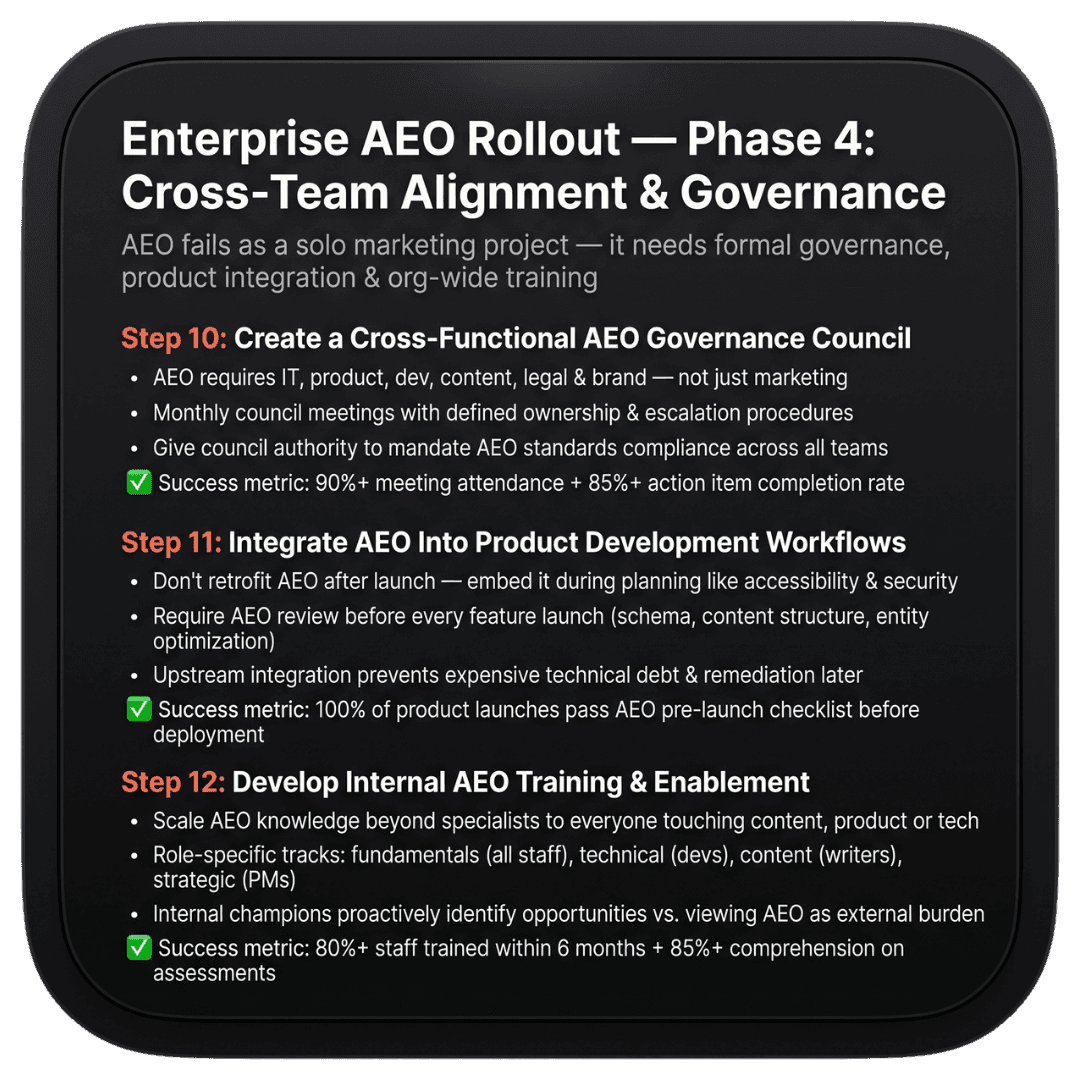
Step 10: Create Cross-Functional AEO Governance Council
Enterprise AEO fails when treated as marketing initiative because success requires coordinated action from IT, product, development, content, legal, and brand teams. Formal governance structures ensure accountability and eliminate implementation roadblocks.
Establish monthly AEO council meetings with defined membership from each stakeholder organization. Create clear ownership for deliverables, implement escalation procedures for blocking issues, and give the council authority to require compliance with AEO standards from all teams.
This governance structure moves AEO from optional marketing activity to mandatory infrastructure requirement that all teams must accommodate in their planning and execution.
Success Metric: Governance council meets monthly with 90%+ attendance, documented action item completion rates exceeding 85%, and established escalation procedures resolving blocking issues within one sprint cycle.
Step 11: Integrate AEO Requirements Into Product Development
Most enterprises treat AEO as something marketing optimizes after product teams build features and launch pages. This approach fails because optimal AEO requires decisions about naming, taxonomy, structure, and content architecture made during planning rather than applied retroactively.
Embed AEO requirements into product development workflows alongside accessibility, performance, and security standards. Require AEO review before feature launches with explicit criteria for schema implementation, content structure, and entity optimization that teams must satisfy.
This upstream integration prevents technical debt accumulation requiring expensive remediation later while ensuring new launches immediately benefit from AEO best practices.
Success Metric: 100% of product launches include AEO review with pre-launch checklist covering schema, content structure, and entity optimization completed before deployment approval.
Step 12: Develop Internal AEO Training & Enablement
Enterprise AEO requires dozens or hundreds of team members understanding principles and following best practices. Formal training programs scale knowledge beyond core specialists to everyone touching content, product, or technical systems.
Create role-specific training covering AEO fundamentals for general staff, technical implementation for developers, content optimization for writers, and strategic implications for product managers. Establish certification programs validating knowledge and requiring annual renewal as practices evolve.
Web of Picasso's enterprise clients report that systematic training dramatically accelerates AEO adoption by building internal champions who proactively identify optimization opportunities rather than viewing AEO as external requirement.
Success Metric: 80%+ of relevant staff complete role-appropriate AEO training within six months with knowledge assessments showing 85%+ comprehension and observable implementation improvements in daily work.
Phase 5: Measurement, Optimization & Continuous Improvement
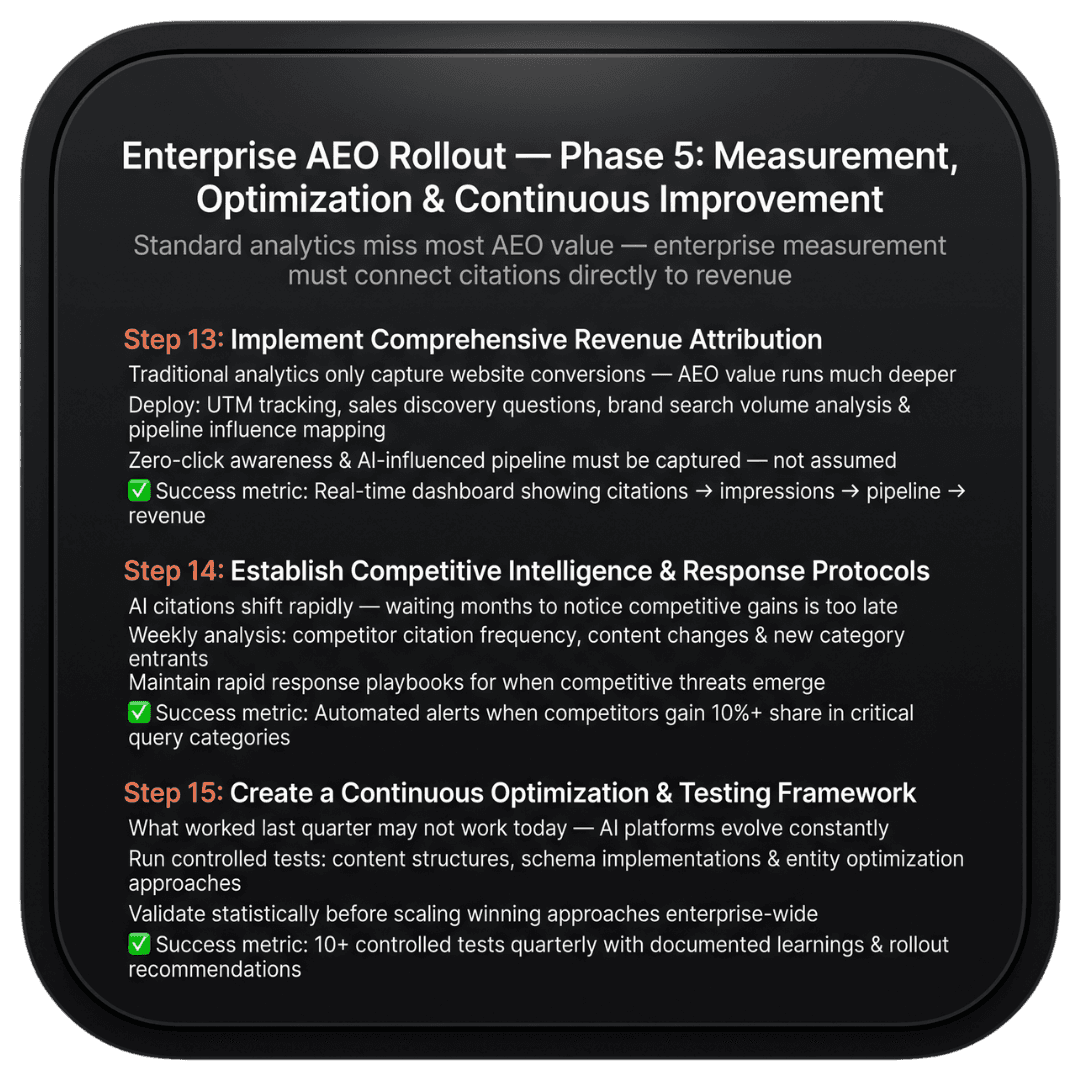
Step 13: Implement Comprehensive Attribution Connecting Citations to Revenue
Traditional analytics completely miss AEO value because they measure only website conversions while ignoring zero-click awareness and AI-influenced pipeline. Enterprise measurement requires comprehensive attribution connecting AI citations to actual business outcomes.
Deploy tracking infrastructure capturing AI-sourced leads through UTM parameters, implement sales process questions identifying AI platform discovery, analyze brand search volume increases following citation improvements, and measure pipeline influenced by answer engine visibility even when initial discovery happens through AI platforms.
This comprehensive attribution proves ROI to executives and justifies continued investment by demonstrating business impact that standard Google Analytics never captures.
Success Metric: Real-time dashboard showing AI citations, zero-click brand impressions, attributed pipeline, and revenue influenced by answer engine visibility with monthly reports connecting AEO investment directly to business outcomes — including top answer engine optimization strategies.
Step 14: Establish Competitive Intelligence & Response Protocols
AI platform citations shift rapidly as competitors launch optimizations and answer engines update training data. Enterprise AEO requires continuous competitive monitoring with defined response protocols addressing threats before they damage market position.
Implement weekly competitive analysis tracking how competitors' citation frequency changes across target queries, analyze their content and technical optimizations, identify new entrants capturing citations in your category, and maintain playbooks defining rapid response procedures when competitive threats emerge.
Many enterprises only discover competitive AEO gains months later when pipeline impact becomes visible. Proactive monitoring enables immediate response before losing significant market share.
Success Metric: Weekly competitive intelligence reports identifying citation share changes with automated alerting triggering response protocols when competitors gain 10%+ share in critical query categories.
Step 15: Create Continuous Optimization & Testing Framework
AI platforms evolve continuously with algorithm updates, new features, and changing citation criteria. Enterprise AEO requires systematic testing validating which optimizations drive results rather than assuming tactics that worked previously remain effective.
Establish formal testing protocols comparing different content structures, schema implementations, and entity optimization approaches. Measure citation impact across sufficient query volume to achieve statistical significance before scaling winning approaches across content portfolios.
This testing discipline prevents wasting resources on ineffective tactics while identifying high-impact optimizations worthy of enterprise-wide implementation.
Success Metric: Minimum 10 controlled tests quarterly with documented learnings, measurable citation impact, and formal recommendations for portfolio-wide implementation of validated optimizations.
How Web of Picasso Accelerates Enterprise AEO Implementation
At Web of Picasso, we've refined systematic approaches specifically designed for enterprise complexity. Our methodology addresses the unique challenges large organizations face implementing AEO across thousands of pages, multiple brands, and diverse stakeholder groups.
Proven Enterprise Frameworks
We provide comprehensive implementation frameworks covering all 15 steps with role-based playbooks, governance templates, technical specifications, and change management processes that eliminate the trial-and-error waste enterprises typically face.
Our frameworks are battle-tested across 150+ brand implementations including Fortune 500 companies, ensuring they accommodate enterprise realities like complex approval processes, distributed teams, and technical constraints.
Executive Stakeholder Management
Enterprise AEO requires continuous executive engagement to maintain sponsorship and secure resources. We provide executive communication support including board presentation materials, business case development, and quarterly business reviews connecting AEO investment to strategic objectives.
This stakeholder management ensures your AEO program maintains priority and funding even as organizational attention shifts to other initiatives.
Cross-Team Integration Support
We facilitate governance council establishment, provide training for technical and content teams, create documentation enabling independent execution, and offer escalation support when implementation obstacles arise.
Our experience working across IT, product, development, and content organizations helps bridge communication gaps and align diverse teams around shared AEO objectives.
Technology & Measurement Infrastructure
We deploy proprietary tracking showing real-time citation performance across all major AI platforms with comprehensive attribution connecting visibility to pipeline and revenue. This measurement infrastructure proves ROI and enables data-driven optimization prioritization.
Enterprise clients receive executive dashboards, operational reporting, and competitive intelligence that support both strategic planning and tactical execution.
The Enterprise Implementation Timeline
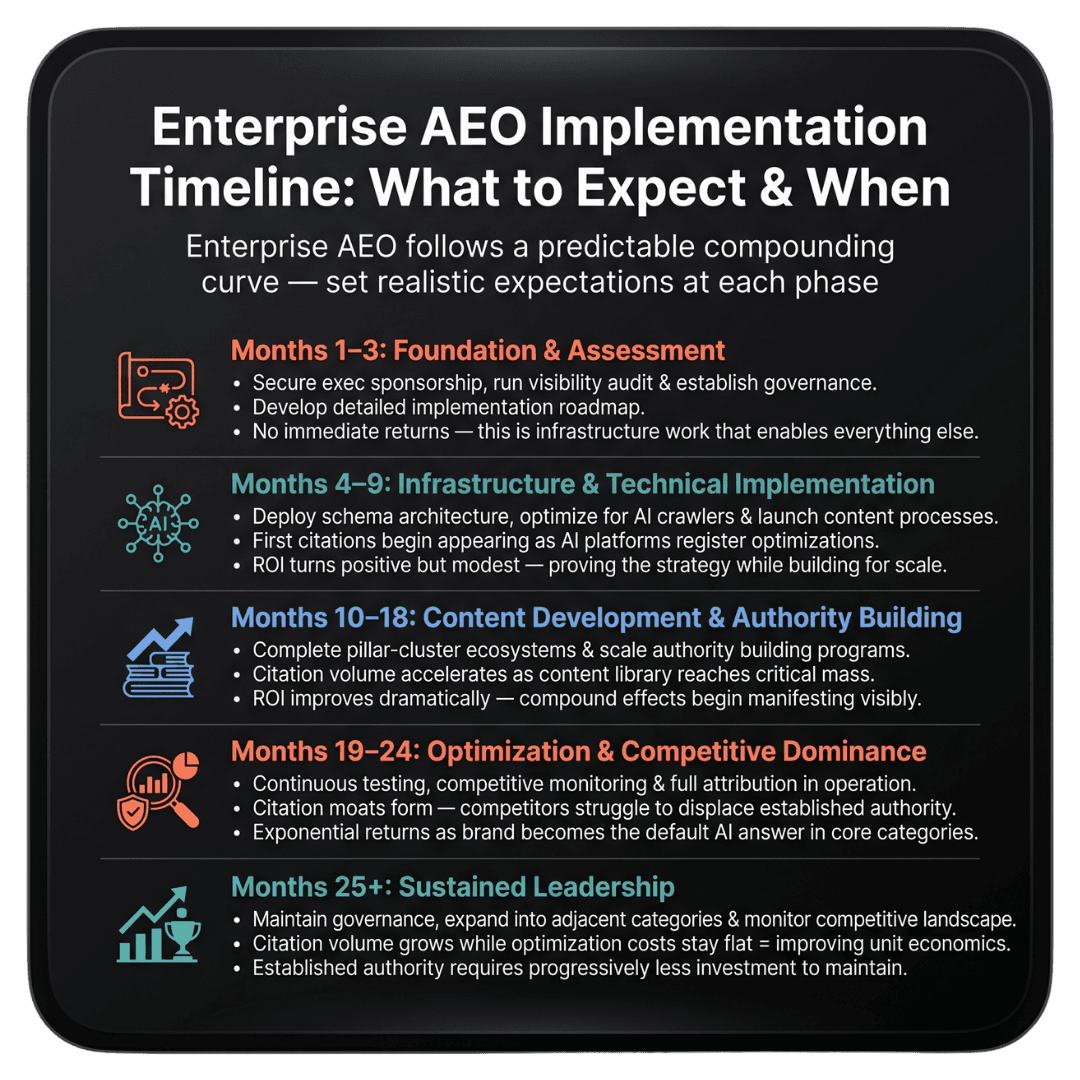
Enterprise AEO implementation follows a predictable timeline based on organizational complexity and existing technical foundations. Understanding expected progress at each phase helps set realistic expectations.
Months 1-3: Foundation & Assessment Phase
Secure executive sponsorship, conduct comprehensive visibility audit, establish governance structures, and develop detailed implementation roadmap. This phase requires significant organizational alignment but minimal technical execution.
Expect investment without immediate returns as you build the foundations required for systematic optimization. This is infrastructure work that enables all future results.
Months 4-9: Infrastructure & Technical Implementation
Deploy schema architecture, optimize site structure for AI crawlers, implement content processes, and begin strategic content development. First citations appear as AI platforms incorporate optimizations.
ROI turns positive but remains modest as initial optimizations start generating citations. You're proving the strategy works while building systems for scale.
Months 10-18: Content Development & Authority Building
Complete pillar-cluster content ecosystems, scale authority building programs, expand citation capture across broader query sets, and refine approaches based on performance data.
Citation volume accelerates substantially as content library reaches critical mass and authority signals strengthen. ROI improves dramatically as compound effects begin manifesting.
Months 19-24: Optimization & Competitive Dominance
Continuous testing identifies high-impact optimizations, competitive monitoring enables rapid response, comprehensive attribution proves business value, and established authority creates citation moats competitors struggle to overcome.
This phase delivers exponential returns as citation patterns compound and market position strengthens. Your brand becomes the default answer AI platforms cite across core categories.
Months 25+: Sustained Leadership
Maintain governance structures, continue content development, monitor competitive landscape, and expand into adjacent categories. Established authority creates sustained advantages requiring progressively less investment to maintain.
ROI continues expanding as citation volume grows while optimization costs remain relatively flat, dramatically improving unit economics quarter over quarter.
Common Enterprise AEO Implementation Pitfalls
Most enterprises make predictable mistakes that delay results and waste resources. Understanding these pitfalls helps avoid expensive errors.
Treating AEO as Marketing Initiative
Marketing departments cannot implement enterprise AEO successfully because they lack authority over technical infrastructure, product roadmaps, and content systems. AEO requires executive-level sponsorship treating it as infrastructure rather than campaign.
Organizations that continue treating AEO as marketing activity watch competitors pull ahead because they can't secure resources or organizational alignment required for comprehensive implementation.
Expecting Quick Results from Complex Changes
Enterprise AEO requires 12-18 months to deliver substantial returns because implementation touches multiple systems requiring coordination across diverse teams. Organizations expecting 90-day results typically abandon programs before benefits manifest.
Patient capital and sustained executive commitment enable the compound returns that make AEO one of the highest-ROI investments enterprises make.
Optimizing for Vanity Metrics
Many enterprises celebrate citation frequency without connecting to business outcomes. The goal isn't maximum citations - it's citations for queries driving high-value pipeline with attribution proving revenue impact.
Focus relentlessly on revenue-connected metrics rather than vanity KPIs that look impressive in presentations but don't justify continued investment.
Underinvesting in Measurement Infrastructure
Enterprises often spend heavily on optimization while skimping on measurement, making ROI impossible to prove. Comprehensive attribution infrastructure should represent 15-20% of total AEO budget because proving value enables securing additional resources.
The ability to show executives exactly how AEO investment connects to pipeline and revenue justifies expanded budgets that accelerate results.
Why Enterprise AEO Can't Wait
The competitive advantage window for enterprise AEO implementation is closing rapidly. As more organizations recognize answer engine importance and deploy comprehensive strategies, early adopter advantages will compress.
Enterprises establishing authority now build citation patterns that become exponentially more difficult for later entrants to displace. AI platforms develop trust relationships with consistently cited sources, creating compounding advantages for brands that move first.
From my experience building Web of Picasso and working with enterprise clients, organizations implementing comprehensive AEO strategies 12-18 months before competitors capture 5-10x more market share in AI-driven discovery.
The enterprises dominating answer engine visibility in 2028 will be those investing systematically in 2026. Delayed implementation doesn't just postpone benefits - it allows competitors to build advantages that become progressively harder to overcome.
Getting Started: Your First 30 Days
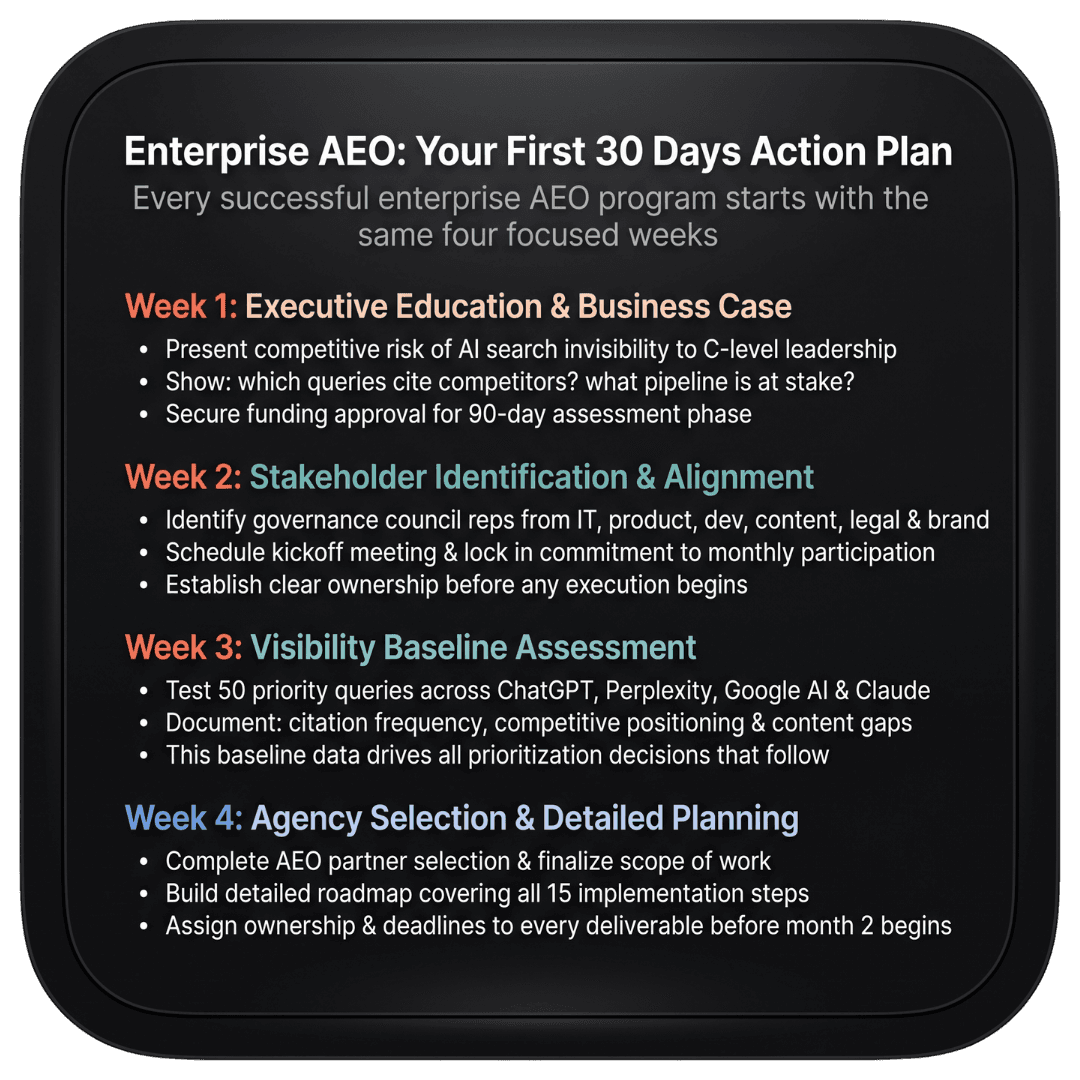
Enterprise AEO implementation seems overwhelming given organizational complexity, but every successful program starts with focused initial actions creating momentum.
Week 1: Executive Education & Business Case
Present business case to C-level leadership showing competitive risks of AI search invisibility and market share opportunities from comprehensive AEO implementation. Secure agreement to fund 90-day assessment phase.
Week 2: Stakeholder Identification & Initial Alignment
Identify representatives from IT, product, development, content, legal, and brand organizations who will participate in governance council. Schedule kickoff meeting and secure commitment to monthly participation.
Week 3: Visibility Baseline Assessment
Conduct initial audit testing 50 priority queries across major AI platforms. Document current citation frequency, competitive positioning, and content gaps requiring attention.
Week 4: Agency Partner Selection & Detailed Planning
If partnering with external specialists, complete selection process and finalize statement of work. Develop detailed implementation roadmap covering all 15 steps with assigned ownership and timeline.
Ready to Make Your Enterprise Future-Ready?
Web of Picasso specializes in enterprise Answer Engine Optimization implementation with proven frameworks addressing the unique complexities large organizations face. We've guided Fortune 500 companies and leading brands through comprehensive AEO transformations delivering 400%+ ROI.
Our enterprise practice provides executive stakeholder management, cross-team integration support, technical implementation frameworks, and comprehensive measurement infrastructure proving business value at every stage.
Schedule a consultation to learn how we'll approach your specific situation, see our enterprise implementation framework, and understand the timeline and investment required for your organization.
Contact Web of Picasso
Website: Visit Web of Picasso
Email: info@webofpicasso.net
Get Started: Book your enterprise AEO assessment and implementation roadmap session