How to Choose an AEO Agency: 21 Critical Questions for B2B
Design

Tanuj Sarva
01/05/2026
How do you choose the right AEO agency for your B2B company? Finding the right AEO SEO company is crucial for optimizing your digital presence effectively. The questions you ask before signing reveal everything about whether an agency can actually deliver AI search visibility or just promises. Selecting the right chatgpt seo companies is crucial for navigating the complex landscape of digital marketing today.
Businesses seeking to enhance their visibility in AI should consider using perplexity ai seo services effectively for tailored strategies.
Leverage our expert AEO service insights and the best AEO agencies globally to navigate the complexities of modern search engine visibility with confidence. These 21 critical questions expose an AEO agency's true capabilities, methodology proof, and B2B expertise - separating legitimate specialists from traditional SEO agencies rebranding outdated services, in line with essential top answer engine optimization strategies.
To enhance your AI visibility, start with the fundamentals of what answer engine optimization is before you shortlist an agency.
Why Traditional SEO Vetting Questions Fail for AEO in 2026
Most B2B companies hire AEO agencies using the same questions they would ask traditional SEO providers. This approach fails because Answer Engine Optimization requires fundamentally different capabilities that standard SEO vetting never tests. If you're new to the category, our guide to hiring an AEO agency for B2B businesses explains what those capabilities look like in practice.
If you're exploring options, understanding what ChatGPT SEO services cost can help you budget for the right AEO partner.
Traditional questions about backlink strategies and keyword rankings miss what actually matters for AI search visibility. They don't reveal whether an agency understands entity optimization, schema engineering for LLMs, or how to structure content for AI platform citations.
To find tailored strategies for your needs, see why brands choose our AEO agency, a leader in digital transformation.
The cost of choosing wrong extends far beyond wasted budget. According to Gartner's analysis, traditional search engine volume will drop 25% by 2026 as AI chatbots dominate discovery. B2B companies investing in outdated SEO while competitors capture AI citations face permanent market share loss.
During my 5+ years building Web of Picasso into a leading AEO agency, I've watched B2B companies waste 6-12 months with agencies claiming AEO expertise but delivering traditional SEO tactics. The agencies genuinely capable of AI search optimization represent less than 10% of those marketing these services.
The Hidden Cost of Choosing Wrong
B2B buying cycles mean mistakes compound quickly. Your 6-month agency contract doesn't just delay results - it allows competitors to build AI citation authority that becomes increasingly difficult to displace. Before you sign, compare AEO pricing models so you know what a fair investment looks like.
When AI platforms like ChatGPT, Perplexity, and Google AI Overviews consistently cite your competitor as the trusted expert in your category, they're building compound advantages—one reason many teams start by considering a perplexity seo company. Each citation reinforces trust patterns that AI systems use to determine future recommendations.
The B2B companies winning in 2026 asked these 21 questions before signing. The ones struggling hired based on polished sales presentations and generic promises about "AI optimization" without testing actual capabilities.
Category 1: AEO Capabilities & AI Search Expertise
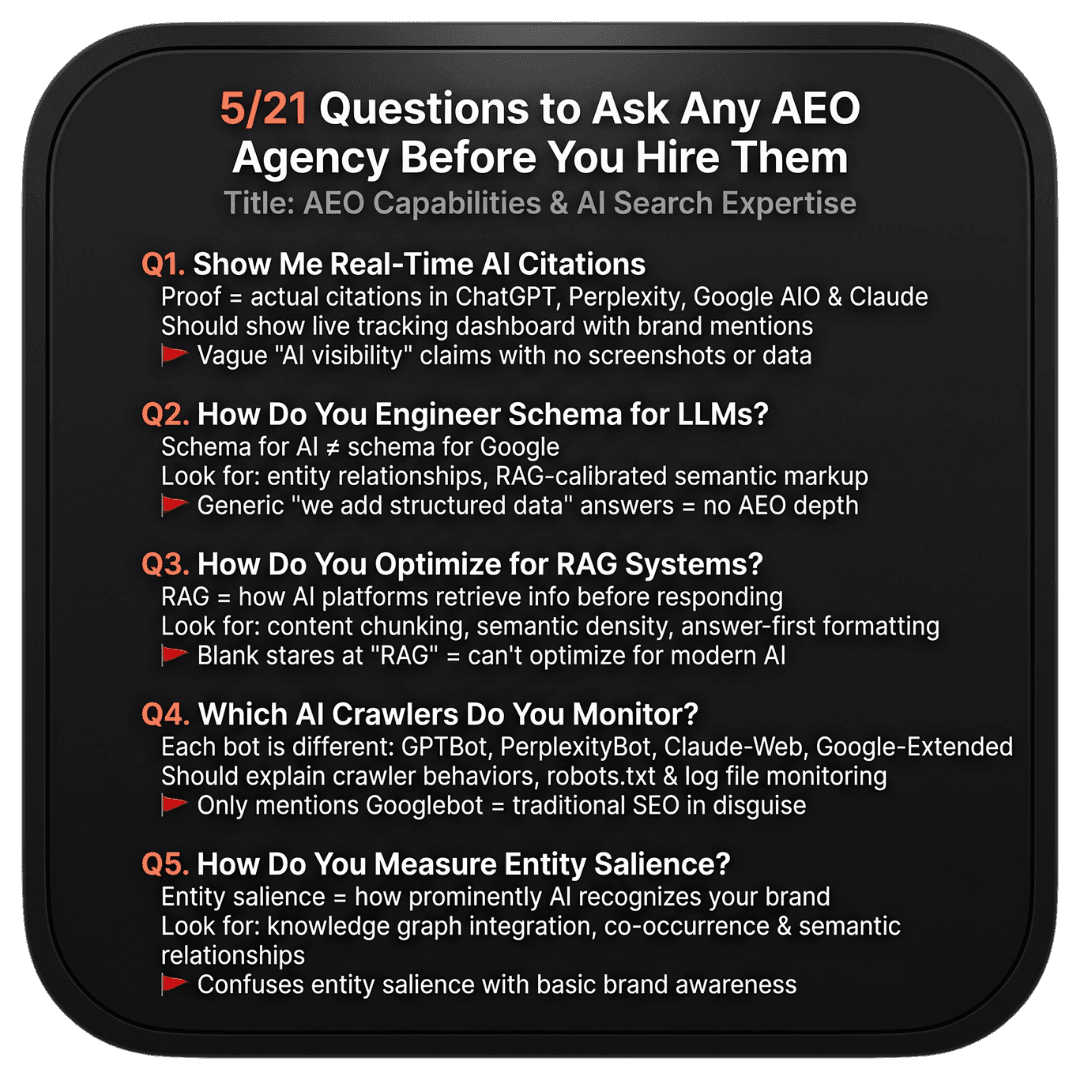
These questions test whether an agency genuinely specializes in Answer Engine Optimization or simply rebranded traditional SEO services with AI buzzwords. Real AEO requires specific technical capabilities and proven methodologies — the backbone of any legitimate professional AEO services — that most agencies lack.
Question 1: Show Me Real-Time AI Citations You've Generated for B2B Clients
Why This Matters: Anyone can claim they do "AEO" or "AI optimization." Real proof means showing actual citations in ChatGPT, Perplexity, Google AI Overviews, and Claude with screenshots, dates, and prompts that triggered them.
What to Listen For: Agencies should pull up their tracking dashboard and show you real-time data of brand mentions across multiple AI platforms. They should explain the specific prompts triggering citations and demonstrate how they track citation frequency and quality.
Red Flags: Vague promises about "improving AI visibility" without concrete examples. Agencies that can't demonstrate live tracking capabilities or show only Google Featured Snippets (which is traditional SEO, not AEO) lack genuine specialization.
For businesses looking to optimize their AI strategies, it is crucial to find quality AEO solutions tailored to specific needs.
Question 2: What's Your Schema Engineering Approach Specifically for LLM Consumption?
Why This Matters: AI platforms parse schema markup differently than traditional search engines. Generic schema implementation designed for Google doesn't optimize for how ChatGPT, Perplexity, and other LLMs extract and interpret structured data.
What to Listen For: Sophisticated answers about entity relationships, semantic markup calibrated for retrieval-augmented generation (RAG) systems, and specific schema types that AI platforms prioritize. Agencies should reference Schema.org standards while explaining LLM-specific optimization nuances.
Red Flags: Generic answers about "adding structured data" without explaining LLM-specific implementation differences. Agencies treating schema as a checkbox rather than strategic entity architecture lack AEO depth.
Question 3: How Do You Optimize for RAG (Retrieval-Augmented Generation) Systems?
Why This Matters: RAG is how modern AI platforms actually work - they retrieve information from external sources before generating responses. Optimizing for RAG requires different content structures than traditional SEO.
What to Listen For: Detailed explanations of content chunking strategies, semantic density optimization, answer-first formatting, and how they structure information for AI retrieval systems. Should mention specific techniques for improving retrieval probability.
Red Flags: Blank stares or confused responses when you mention RAG. Agencies unfamiliar with this fundamental AI architecture can't possibly optimize for it effectively.
Question 4: Which AI Crawlers Do You Monitor and How Do You Optimize for Each?
Why This Matters: Different AI platforms use different crawlers (GPTBot, PerplexityBot, Claude-Web, Google-Extended) with unique behaviors and priorities. Effective AEO requires optimizing for each platform's specific crawler patterns.
What to Listen For: Specific knowledge about different AI crawler behaviors, robots.txt considerations, crawl budget optimization for AI bots, and platform-specific technical requirements. Should explain how they monitor crawler activity in log files.
Red Flags: Agencies that only mention Googlebot or don't understand AI crawler differences. This indicates they're doing traditional SEO while calling it AEO.
Question 5: How Do You Measure and Improve Entity Salience?
Why This Matters: Entity salience determines how prominently AI systems recognize and prioritize your brand when generating responses. Building entity salience requires specific techniques beyond traditional brand building.
What to Listen For: Sophisticated understanding of knowledge graph integration, entity disambiguation, co-occurrence patterns, and semantic relationship engineering. Should explain how they establish your brand as a recognized entity within AI training data.
Red Flags: Confusion about what entity salience means or treating it the same as traditional brand awareness. These are related but require different optimization approaches.
Category 2: B2B Experience & Industry Knowledge
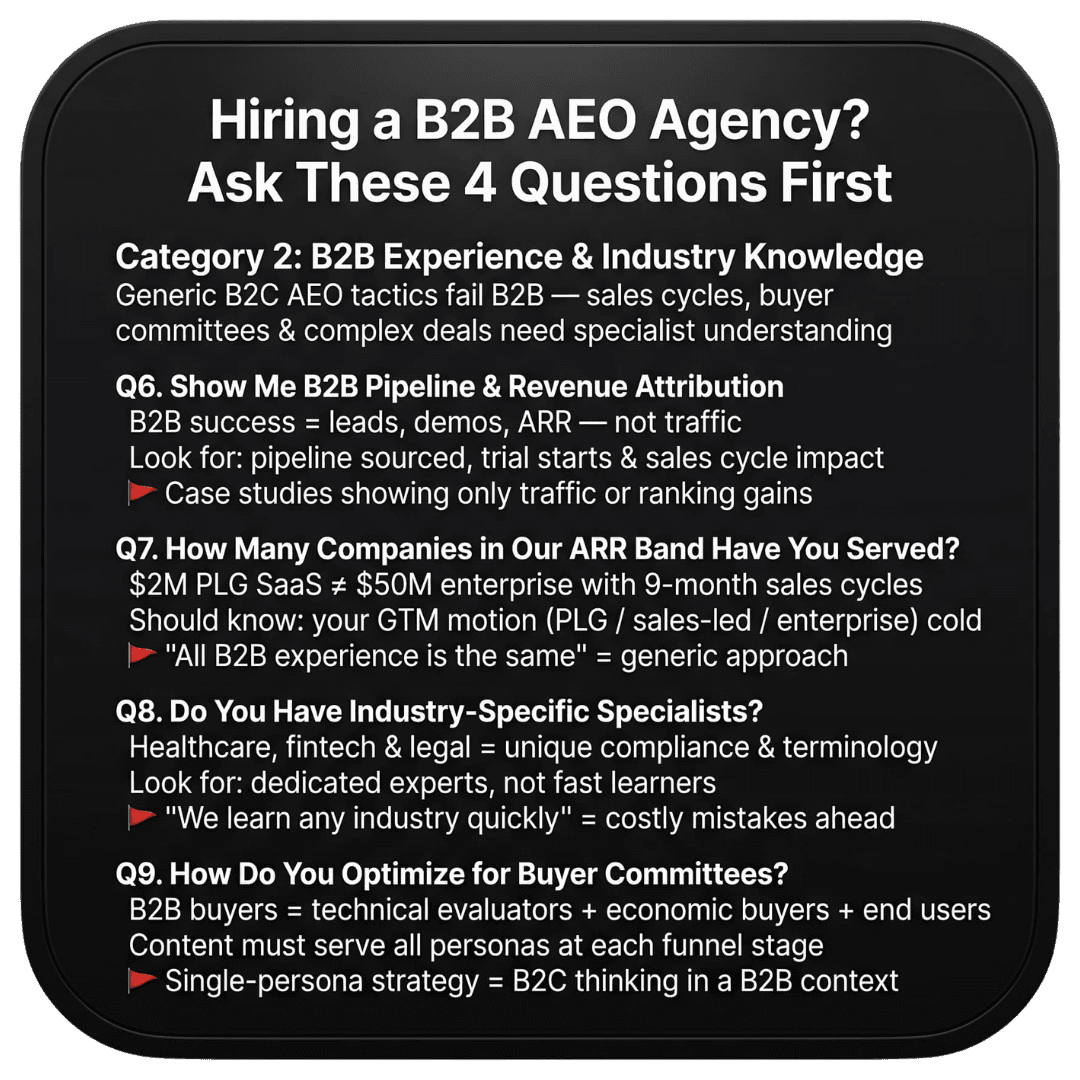
B2B sales cycles, buyer committees, and complex solutions require specialized understanding. Generic AEO tactics designed for B2C fail to capture the nuances of B2B search behavior and purchasing patterns. For proven options, see our roundup of leading B2B AEO specialists.
Question 6: Show Me B2B Case Studies with Pipeline and Revenue Attribution
Why This Matters: B2B success isn't about traffic - it's about qualified leads, sales pipeline, and revenue. Agencies should demonstrate they understand and measure what actually matters for B2B businesses.
What to Listen For: Case studies showing pipeline sourced, demo requests generated, trial starts, ARR influenced, and sales cycle impact. Should explain attribution methodology and how they separate AEO impact from other channels.
Red Flags: Case studies focused only on traffic increases or rankings without connecting to business outcomes. B2B agencies must tie visibility directly to revenue metrics.
Question 7: How Many Companies in Our ARR Band and Sales Motion Have You Served?
Why This Matters: A $2M ARR product-led growth SaaS company requires completely different AEO strategies than a $50M enterprise software company with 9-month sales cycles. Experience with similar business models matters tremendously.
What to Listen For: Specific examples of companies matching your ARR range and go-to-market motion (PLG vs. sales-led vs. enterprise). Should understand unique challenges of your business model without needing education.
Red Flags: Claiming "all B2B experience is the same" or only showing consumer brand case studies. Different B2B segments require fundamentally different optimization approaches.
Question 8: Do You Have Industry-Specific AEO Specialists on Your Team?
Why This Matters: Industries like healthcare, financial services, legal, and regulated B2B sectors face unique compliance requirements, terminology, and buyer behavior patterns. Generic optimization misses critical industry nuances.
What to Listen For: Dedicated team members with deep industry knowledge, examples of industry-specific schema implementations, understanding of regulatory constraints, and familiarity with industry terminology and buying patterns.
Red Flags: Agencies claiming they "learn quickly" about any industry. While adaptability matters, established industry expertise dramatically accelerates results and avoids costly mistakes.
Question 9: How Do You Optimize for Complex B2B Buyer Committees?
Why This Matters: B2B purchases involve multiple stakeholders (technical evaluators, economic buyers, end users) asking different questions at different funnel stages. Content must address all personas without diluting focus.
What to Listen For: Sophisticated understanding of multi-threaded B2B sales processes, content strategies addressing different buyer committee roles, and how to structure information for various decision-maker personas simultaneously.
Red Flags: Single-persona approaches or strategies that don't acknowledge the complexity of B2B buying committees. This indicates B2C thinking applied to B2B challenges.
Category 3: Methodology & Strategy
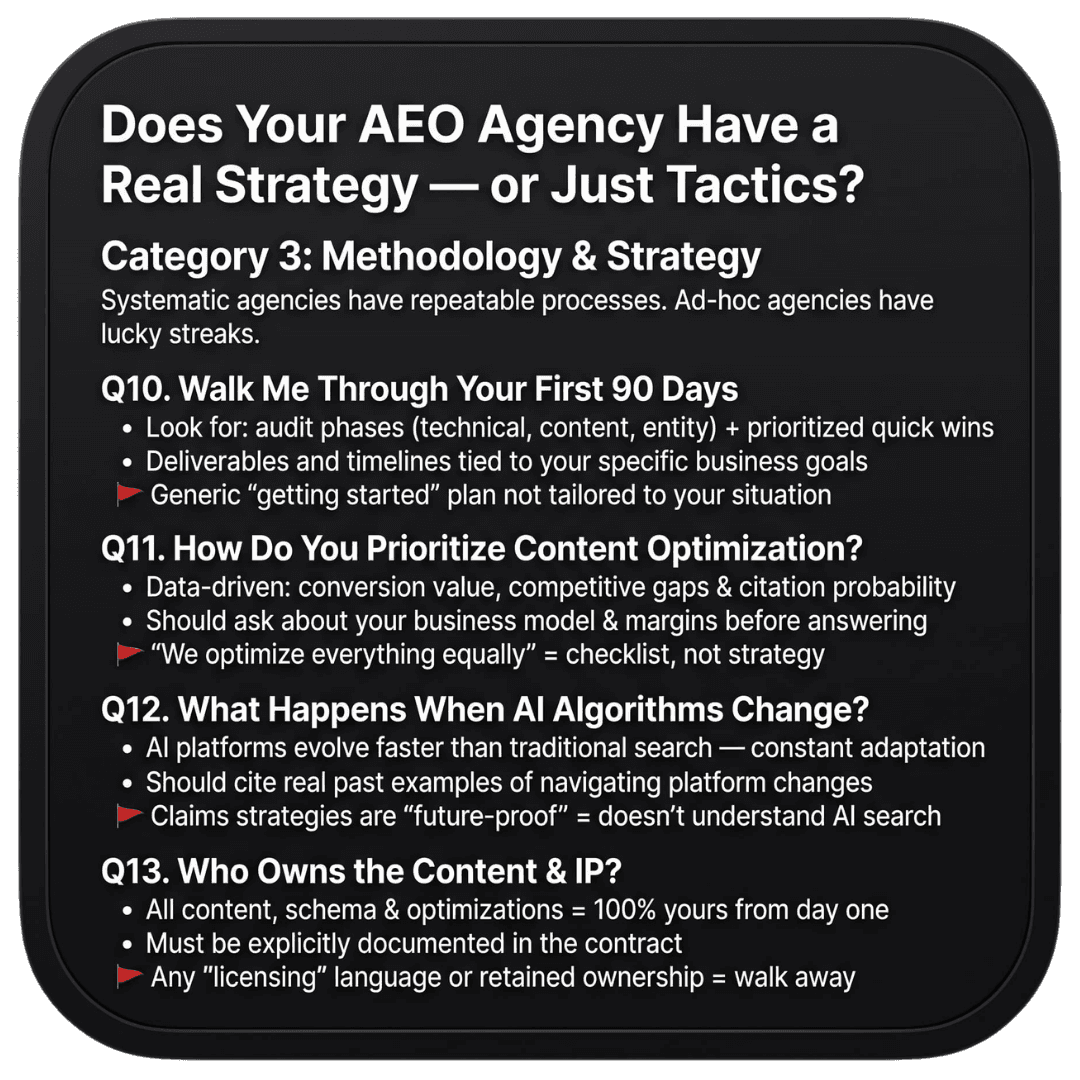
Understanding how an agency actually works reveals whether they have systematic, repeatable processes or rely on ad-hoc tactics. Methodology questions expose whether success was luck or replicable expertise.
Question 10: Walk Me Through Your First 90 Days
Why This Matters: The initial strategy period determines whether an agency wastes months on wrong priorities or immediately focuses on high-impact improvements. A clear 90-day plan indicates systematic thinking.
What to Listen For: Specific phases including audit (technical, content, entity), priority identification based on your business goals, quick wins balanced with long-term plays, and clear deliverables with timelines.
Red Flags: Vague answers about "getting started" or cookie-cutter timelines that don't reference your specific situation. Every engagement should have a customized approach based on your starting point.
Question 11: How Do You Prioritize Which Content to Optimize First?
Why This Matters: Resources are always limited. Great agencies prioritize based on business impact (conversion value, competitive difficulty, citation probability) rather than arbitrary factors or gut feel.
What to Listen For: Data-driven prioritization frameworks considering traffic potential, conversion impact, competitive gaps, and quick wins versus long-term authority building. Should ask about your business model and profit margins to inform priorities.
Red Flags: "We optimize everything equally" or starting with homepage/about pages by default. These signal checklist thinking rather than strategic prioritization.
Question 12: What Happens When AI Platform Algorithms Change?
Why This Matters: AI platforms evolve rapidly - faster than traditional search engines. Agencies need systematic approaches to monitoring changes and adapting strategies rather than reactive scrambling.
What to Listen For: Specific examples of past algorithm changes they navigated, monitoring systems they use, how quickly they adapt strategies, and their process for communicating changes to clients.
Red Flags: Claiming their strategies are "future-proof" or don't need adjustment. This indicates they don't understand how rapidly AI search evolves.
Question 13: How Do You Handle Content Ownership and IP?
Why This Matters: Some agencies retain ownership of content, making it expensive or difficult to end the relationship. Clear IP ownership prevents hostage situations if you need to switch providers.
What to Listen For: Straightforward confirmation that all content, schema implementations, and optimizations become your property immediately upon creation. Should be documented clearly in contracts.
Red Flags: Vague language about "licensing" content or retaining any ownership. You should own everything created for your business outright.
Category 4: Measurement & Reporting
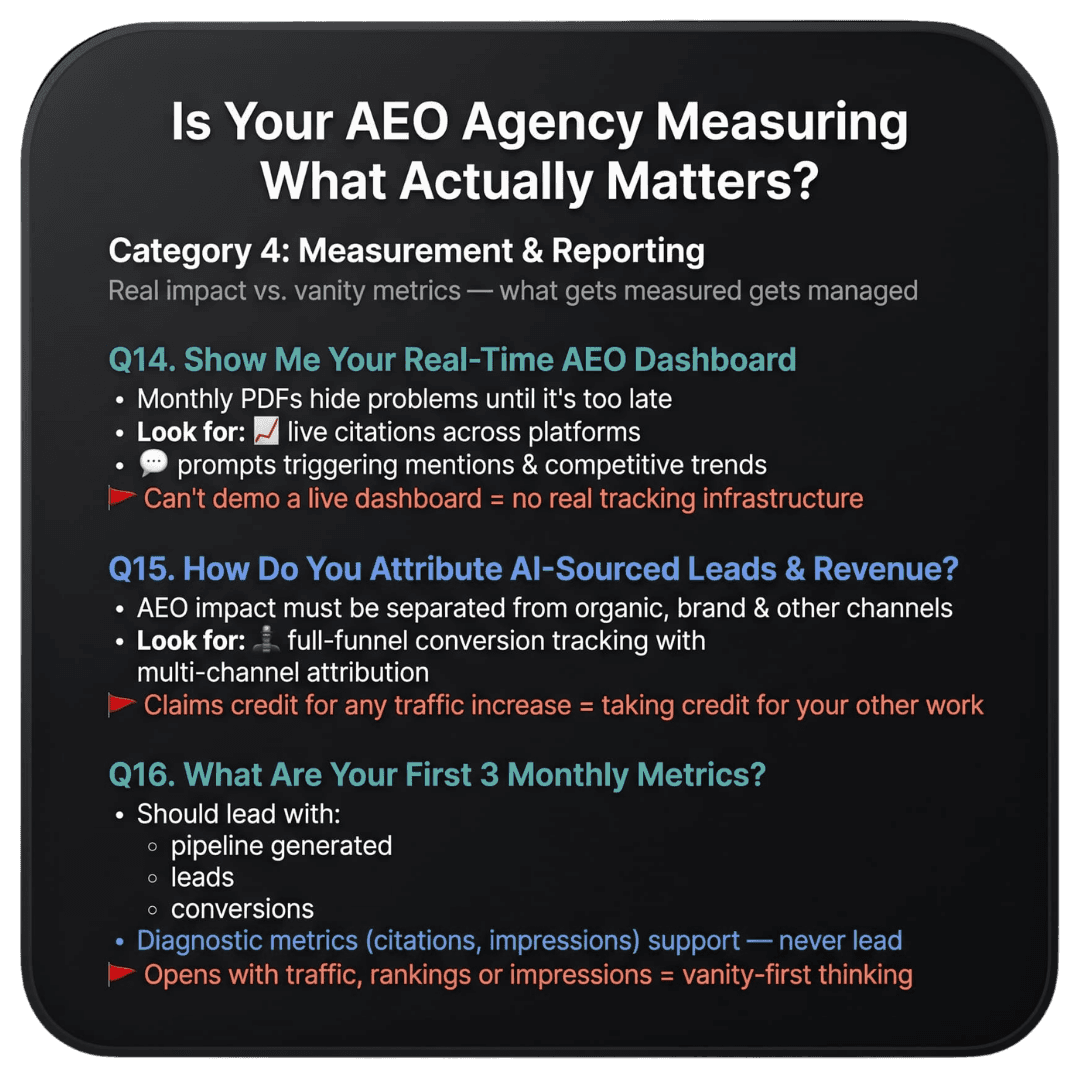
What gets measured gets managed. Understanding how an agency tracks success reveals whether they deliver real business impact or vanity metrics that look good but don't drive results.
Question 14: Show Me Your Real-Time AEO Dashboard
Why This Matters: Monthly PDF reports hide problems until it's too late. Real-time dashboards showing AI citations, platform performance, and business metrics enable proactive optimization.
What to Listen For: Live demonstration of their tracking dashboard showing citation frequency across platforms, prompt examples triggering mentions, competitive positioning, and trend analysis over time.
Red Flags: Agencies that can't show their tracking system live or rely solely on manual reporting. Legitimate AEO requires proprietary technology for continuous monitoring.
Question 15: How Do You Attribute AI-Sourced Leads and Revenue?
Why This Matters: Understanding which results came from AEO versus other channels proves ROI and justifies continued investment. Without attribution, you can't know if AEO actually works.
What to Listen For: Sophisticated attribution models that separate AI platform traffic from organic search, methods for tracking conversions through the funnel, and how they prevent taking credit for results they didn't generate.
Red Flags: Claiming credit for any traffic increase without proper attribution. Many agencies take credit for seasonal changes, brand campaigns, or other channel effects.
Question 16: What Are the First Three Metrics You'll Show Me Each Month?
Why This Matters: This reveals what an agency actually values. Great agencies lead with business-impact metrics (pipeline, leads, conversions) before discussing vanity metrics (impressions, rankings).
What to Listen For: Business outcome metrics first, supported by diagnostic metrics that explain performance. Should connect visibility improvements directly to lead generation and revenue impact.
Red Flags: Leading with traffic, impressions, or keyword rankings without connecting to business outcomes. These matter but aren't what determines AEO success for B2B companies.
Category 5: Team & Communication
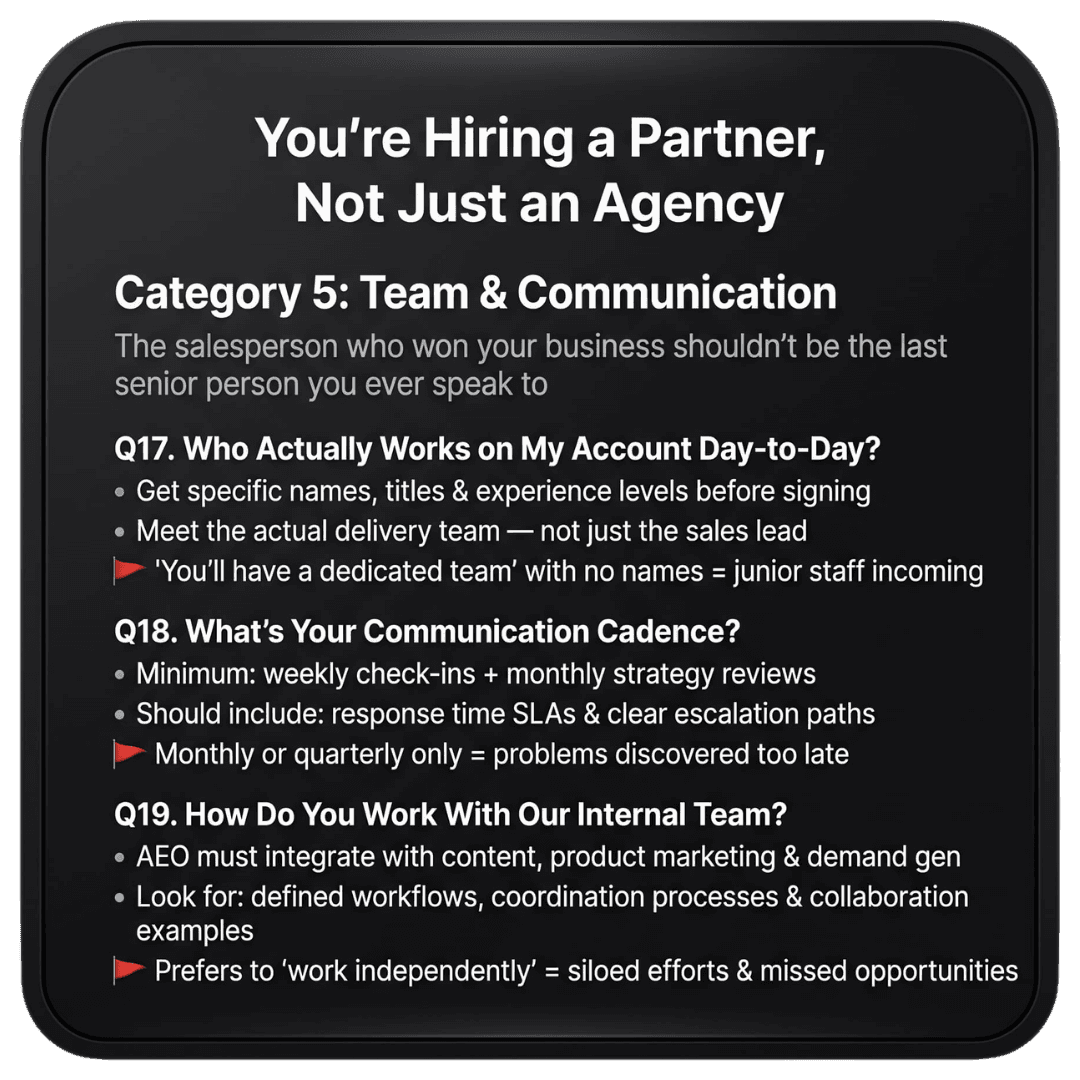
You're not just hiring an agency - you're entering a partnership. Understanding team structure and communication rhythms prevents the common situation where the salesperson disappears after signing.
Question 17: Who Actually Works on My Account Day-to-Day?
Why This Matters: Many agencies use senior people for sales but assign junior staff to actual work. You need to know who you'll really work with and their experience level.
What to Listen For: Specific names and titles of team members, their experience levels, how long they've been with the agency, and their specific roles on your account. Should meet these people before signing.
Red Flags: Vague answers about "dedicated teams" without naming individuals. If they won't tell you who does the work, it's probably not who you think.
Question 18: What's Your Communication Cadence and Format?
Why This Matters: Clear communication prevents the quarterly surprise of discovering strategies aren't working. Regular touchpoints enable course correction before problems become catastrophes.
What to Listen For: Specific schedules for meetings (weekly check-ins, monthly reviews), preferred communication channels, response time commitments, and escalation procedures for urgent issues.
Red Flags: Only offering monthly or quarterly reviews without regular check-ins. B2B AEO requires frequent collaboration to address competitive changes and market shifts quickly.
Question 19: How Do You Collaborate with Our Internal Marketing Team?
Why This Matters: AEO doesn't exist in isolation - it must integrate with content marketing, product marketing, demand gen, and other initiatives. Understanding collaboration approach prevents siloed efforts.
What to Listen For: Experience working alongside internal teams, specific processes for coordination, content workflow integration, and examples of successful collaboration with clients' marketing organizations.
Red Flags: Expecting to work completely independently without internal team interaction. Effective AEO requires collaboration with product marketers, content teams, and technical resources.
Category 6: Risk & Red Flags
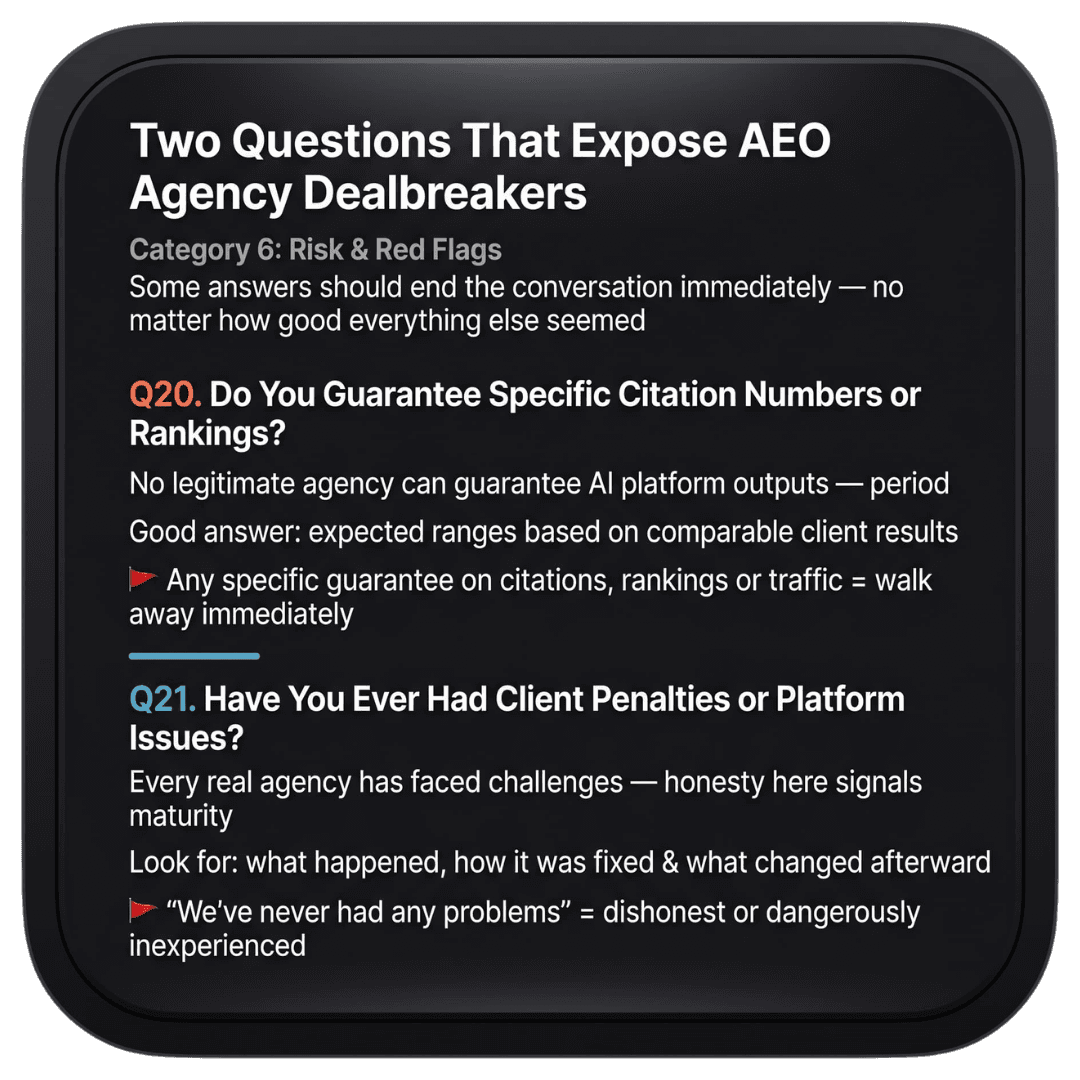
These final questions expose dealbreakers that should end conversations immediately. Some red flags are so severe they indicate you should keep searching regardless of other factors.
Question 20: Do You Guarantee Specific AI Citation Numbers or Rankings?
Why This Matters: No legitimate agency guarantees specific numbers because AI platforms don't work that way. Guarantees indicate either dishonesty or fundamental misunderstanding of how answer engines function.
What to Listen For: Honest acknowledgment that while they expect strong results based on experience, no one controls AI platform outputs completely. Should explain expected ranges based on comparable clients.
Red Flags: Any guarantees about specific citation frequencies, rankings, or traffic numbers. These promises are impossible to legitimately make and indicate problematic agencies.
Question 21: Have You Ever Been Penalized or Had Clients Face AI Platform Issues?
Why This Matters: How agencies handle problems reveals character. Admitting past challenges and explaining solutions demonstrates maturity. Claiming perfection suggests either dishonesty or dangerous inexperience.
What to Listen For: Honest discussion of challenges they've faced, how they resolved them, what they learned, and measures they've implemented to prevent recurrence.
Red Flags: Claiming they've never had problems or clients never faced issues. Every agency encounters challenges - what matters is how they handle them.
How Web of Picasso Answers These 21 Questions
At Web of Picasso, we welcome every question on this list because we have comprehensive answers backed by proven results. After optimizing 150+ brands for AI search visibility over 5+ years, we've built systematic approaches specifically designed for B2B Answer Engine Optimization.
Our Proof-Based Approach
We demonstrate live AI citations in ChatGPT, Perplexity, Google AI Overviews, and Claude for current clients, and we're the kind of partner brands should compare against those standards. Our proprietary tracking dashboard shows real-time citation frequency, context quality, competitive positioning, and business impact metrics.
Every schema implementation we design follows LLM-specific optimization principles that go far beyond generic structured data. We engineer entity relationships and semantic architectures specifically calibrated for retrieval-augmented generation systems.
B2B Specialization
We've served B2B companies across every ARR band from $2M to $500M+, understanding the unique challenges of product-led growth, sales-led, and enterprise go-to-market motions. Our case studies demonstrate pipeline sourced, demo requests generated, and ARR influenced - not just traffic increases.
Our team includes industry specialists in SaaS, fintech, healthcare technology, legal tech, and other complex B2B sectors. We understand buyer committees, multi-threaded sales processes, and how to optimize for various stakeholder personas simultaneously.
Systematic Methodology
Our first 90 days follow a proven framework: comprehensive audit (technical, content, entity analysis), strategic prioritization based on business impact, quick wins for early results, and foundation building for sustainable long-term authority.
We prioritize optimizations based on conversion value, competitive gaps, and citation probability - not arbitrary checklists. Every recommendation ties directly to your business goals and revenue objectives.
Transparent Measurement
Our clients access real-time dashboards 24/7 showing AI citations across all platforms, attribution models separating AEO impact from other channels, and business metrics that matter: leads generated, pipeline sourced, revenue influenced.
We lead monthly reviews with business outcomes first, then explain the visibility metrics driving those results. You'll never wonder whether AEO investment delivers ROI.
Partnership Communication
You'll know exactly who works on your account before signing - senior strategists with 5+ years AEO experience, not junior staff learning on your budget. We provide weekly check-ins, monthly strategy reviews, and integrate seamlessly with your internal marketing teams.
We've never guaranteed specific citation numbers because no ethical agency can. Instead, we show expected ranges based on 150+ comparable client experiences and deliver results that consistently exceed those expectations.
What Happens After You Ask These Questions
Most agencies will struggle answering 10-15 of these questions comprehensively. That's your signal to keep searching.
The rare agencies answering all 21 questions with specific examples, proven methodologies, and transparent proof deserve serious consideration. These represent the small percentage genuinely specializing in Answer Engine Optimization rather than rebranded SEO.
Use a structured scorecard comparing agencies objectively across these categories. Gut feel alone leads to expensive mistakes when choosing partners for capabilities this specialized and business-critical.
The Questions Most B2B Companies Never Ask (And Regret It)
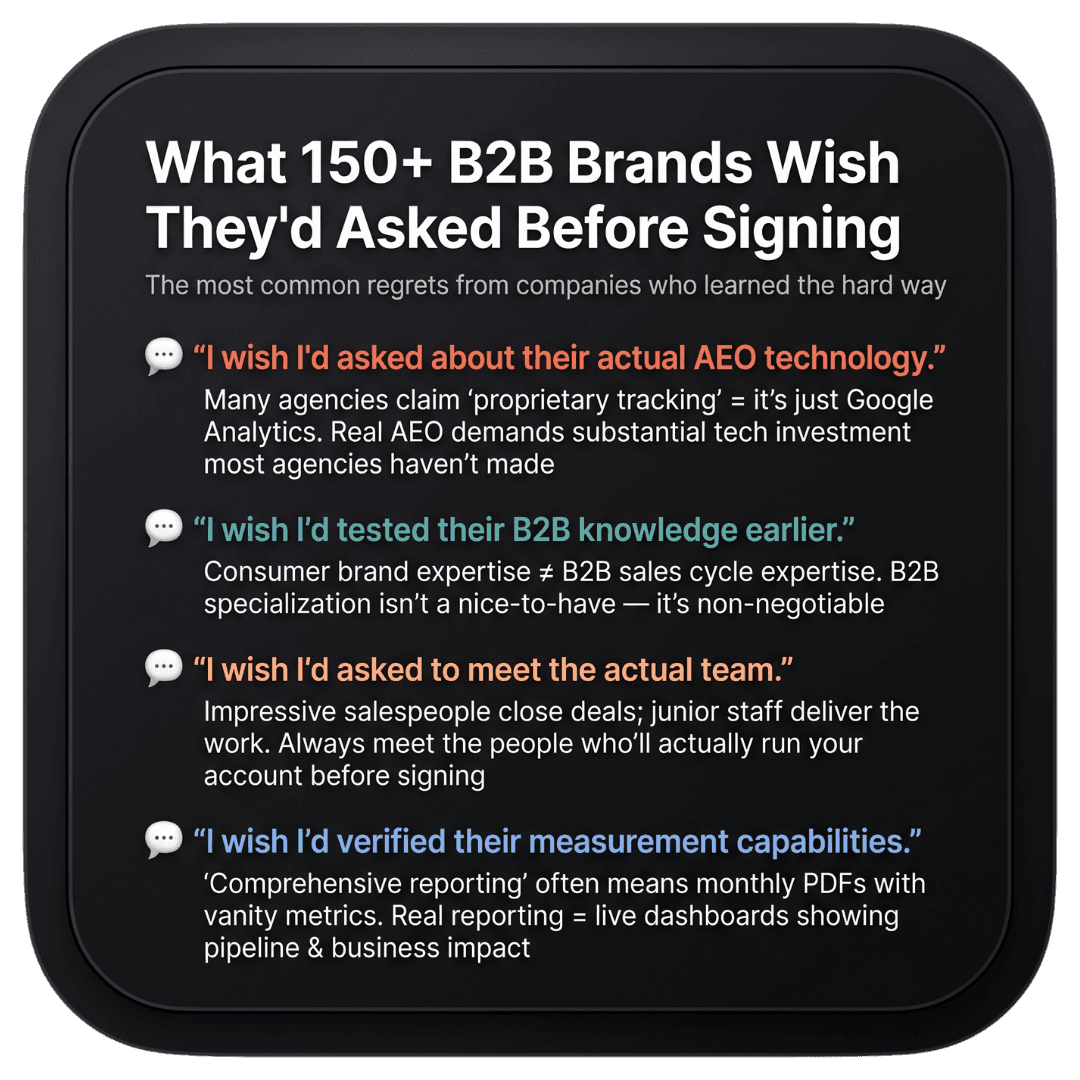
After working with 150+ B2B brands, I've seen patterns in what companies wish they'd asked before signing. Here are the most common regrets:
"I wish I'd asked about their actual AEO technology." Many agencies claim proprietary tracking but have nothing beyond basic Google Analytics. Real AEO requires substantial technology investment most agencies haven't made.
"I wish I'd tested their B2B knowledge earlier." Agencies good at consumer brand optimization often fail completely with complex B2B sales cycles. B2B specialization isn't optional.
"I wish I'd asked to meet the actual team." Too many companies sign based on impressive salespeople only to discover their account is handled by inexperienced junior staff.
"I wish I'd verified their measurement capabilities." Agencies promising "comprehensive reporting" often deliver monthly PDFs with vanity metrics instead of real-time dashboards showing business impact.
Using This Framework for Your Agency Search
Print these 21 questions and bring them to every agency conversation. Don't accept vague answers or promises to "follow up later" on critical questions.
The agencies worth hiring welcome difficult questions. They know their capabilities stand up to scrutiny and prefer educated clients who understand what they're buying.
Agencies that get defensive, dodge questions, or pressure you to sign before providing comprehensive answers are showing you exactly what working with them will feel like six months later.
Why This Matters More in 2026 Than Ever Before
The window for capturing AI search market share is closing rapidly. B2B companies establishing answer engine authority today are building advantages that compound over time.
When ChatGPT, Perplexity, and Google AI Overviews consistently cite your competitor as the trusted expert in your category, they're not just winning today's searches. They're building citation patterns and trust signals that make future displacement exponentially more difficult.
From my 5+ years specializing in AEO at Web of Picasso, I've watched early adopters capture 5-10x more market share than competitors who delayed. The compounding effects of early citations create momentum that becomes increasingly insurmountable as AI search adoption accelerates.
Ready to Have This Conversation?
Web of Picasso welcomes every question on this list and provides comprehensive, proof-based answers backed by 150+ successful B2B client implementations. We've built our entire agency around B2B Answer Engine Optimization - it's not a service line, it's our exclusive focus.
Schedule a consultation where we'll answer all 21 questions with specific examples from your industry, demonstrate our real-time tracking technology, and show you exactly how we'd approach your unique situation.
The B2B companies dominating AI search in 2026 are the ones asking these questions today.
Contact Web of Picasso
Website: Visit Web of Picasso
Email: info@webofpicasso.net
Get Started: Book your free comprehensive AEO consultation and get answers to all 21 questions