AEO vs SEO vs GEO: 17 Key Differences Marketing Teams Need
Design

Tanuj Sarva
05/05/2026
What's the difference between AEO, SEO, and GEO in 2026? These three optimization approaches target fundamentally different discovery channels requiring distinct strategies, content structures built for AI, and measurement frameworks. Marketing teams treating them identically waste 40-60% of optimization resources while missing critical visibility opportunities across all three channels.
Why Confusion Between AEO, SEO, and GEO Costs Marketing Teams Millions
Most marketing leaders treat AEO, SEO, and GEO as minor variations of traditional search optimization requiring simple content tweaks. This fundamental misunderstanding leads to: wasted optimization budget on tactics working for one channel while failing on others, delayed implementation of critical strategies across new platforms, and competitive losses to teams understanding platform-specific requirements.
According to Gartner's 2026 research, organizations implementing platform-specific optimization strategies achieve 3-5x better results than those applying uniform approaches across all three channels. The best-performing marketing teams in 2026 understand exactly how AEO, SEO, and GEO differ and allocate resources accordingly.
From my 5+ years building Web of Picasso, I've watched marketing teams struggle because they didn't understand these distinctions. The transition from SEO-only strategies to comprehensive AEO/SEO/GEO approaches fundamentally changes how organizations structure teams, allocate budgets, and measure success. For a deeper case, see 12 reasons AEO wins over SEO alone.
Quick Definition Summary
SEO (Search Engine Optimization): Optimizing websites to rank higher in traditional search engine results (Google, Bing, Yahoo) appearing as blue links in search results pages.
AEO (Answer Engine Optimization): Optimizing content for AI-powered platforms (ChatGPT, Perplexity, Claude, Copilot) where users get direct answers from AI systems rather than clicking through to websites—see what AEO is for the full definition.
GEO (Generative Engine Optimization): Optimizing content specifically for AI-generated search results (Google AI Overviews, Google's SGE feature) where AI summarizes multiple sources into unified answers users see before traditional results.
17 Key Differences Every Marketing Team Must Understand
Difference 1: Primary Discovery Channel
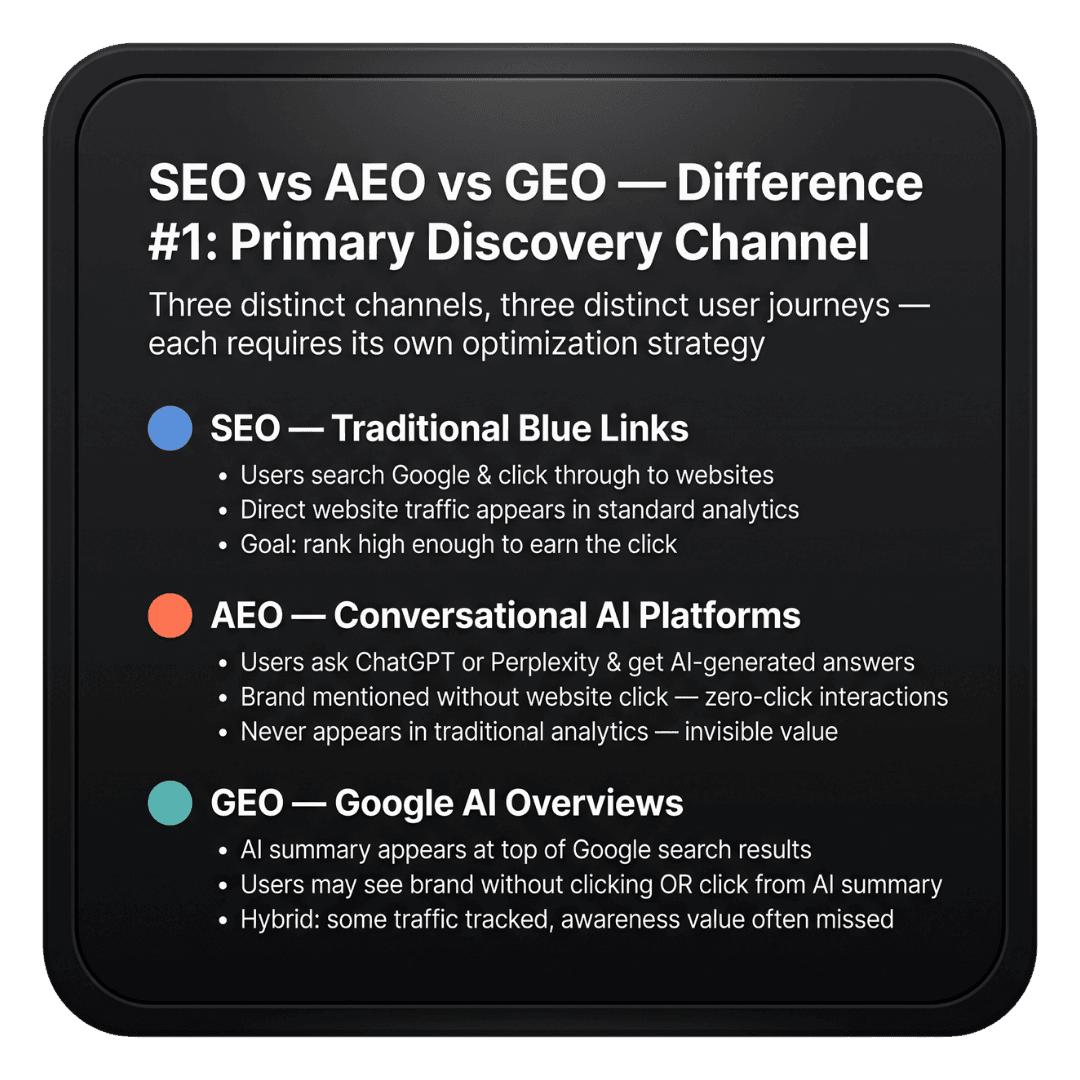
SEO focuses on Google's traditional blue link search results where users click through to websites. These paid clicks drive direct website traffic that appears in standard analytics.
AEO targets conversational AI platforms where users ask ChatGPT or Perplexity questions and receive AI-generated answers mentioning your brand without clicking your website. These zero-click interactions never appear in traditional analytics.
GEO optimizes for Google AI Overviews appearing at the top of search results summarizing multiple sources with citations. Users may see your brand mentioned without clicking through, or click your link from the AI summary rather than organic results.
Difference 2: User Behavior Patterns
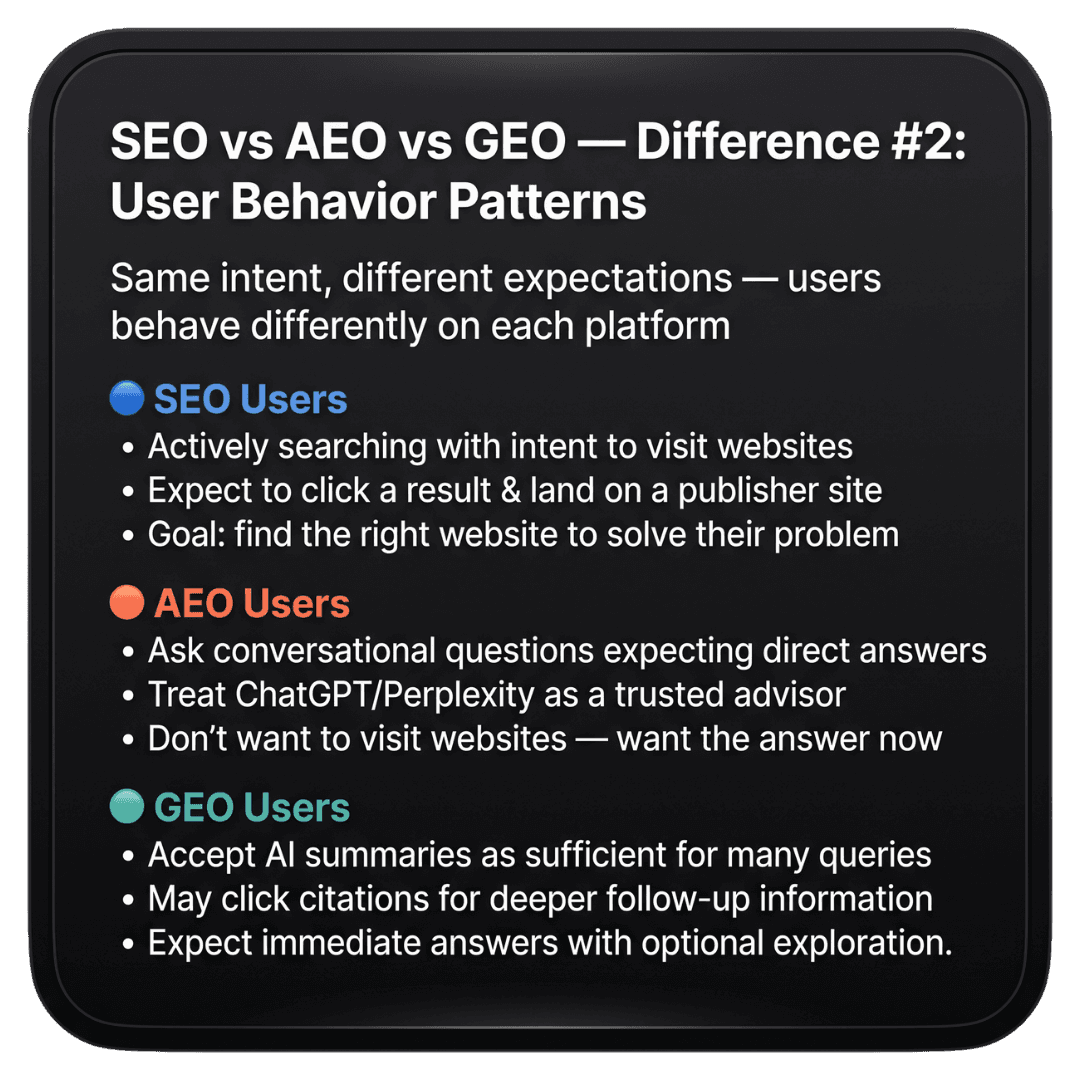
SEO users actively search for information intending to visit websites. They click search results expecting to land on publisher sites solving their problems through website content.
AEO users ask conversational questions expecting direct answers without website visits. They treat ChatGPT and Perplexity as trusted advisors answering questions immediately without requiring additional research or website navigation.
GEO users accept AI summaries as sufficient answers for many queries but may click citations for deeper information. They expect immediate answers from Google AI Overviews with optional follow-up exploration if needed.
Difference 3: Content Structure Requirements
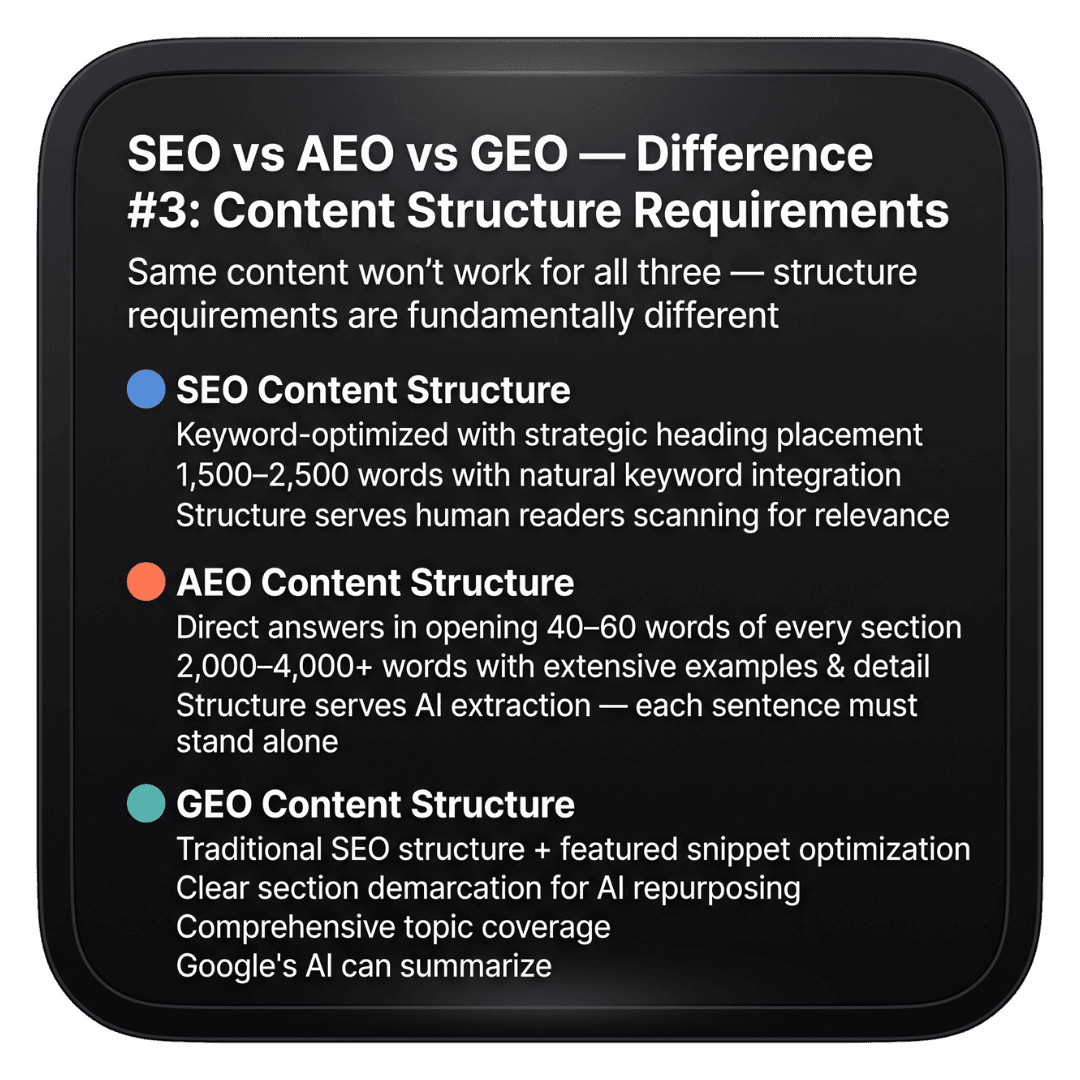
SEO favors keyword-optimized content with clear structure, strategic heading placement, and content length around 1500-2500 words with natural keyword integration. Search engines evaluate content against keyword relevance and user intent.
AEO requires answer-first content with direct answers in opening 40-60 words of each section, extensive supporting detail explaining concepts comprehensively, and practical examples users can implement. AI platforms extract opening sentences and value thorough explanations.
GEO benefits from well-structured traditional SEO content enhanced with featured snippet optimization, comprehensive topic coverage, and clear section demarcation. Google's AI frequently repurposes featured snippet content in AI Overviews.
Difference 4: Citation and Authority Signals
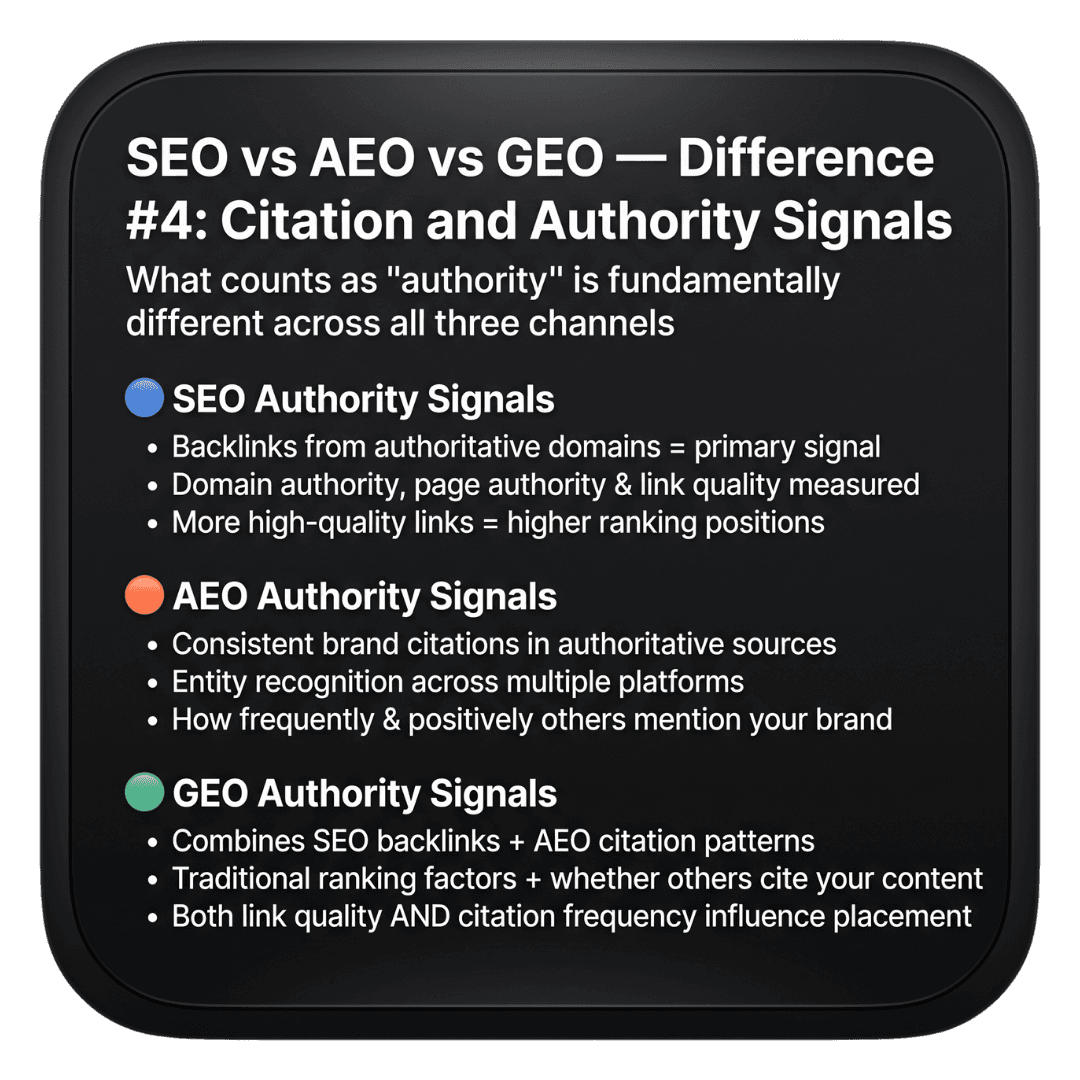
SEO emphasizes backlinks from authoritative domains as primary authority signals. Search engines measure domain authority, page authority, and link quality to determine ranking positions.
AEO requires consistent brand citations in authoritative sources, entity recognition across platforms, and establishment as trusted voices within specific domains. AI platforms evaluate how frequently and positively others mention your brand.
GEO combines SEO's backlink authority with AEO's citation patterns. Google AI Overviews weight both traditional search ranking factors and whether other authoritative sources cite your content.
Difference 5: Technical Implementation Priorities
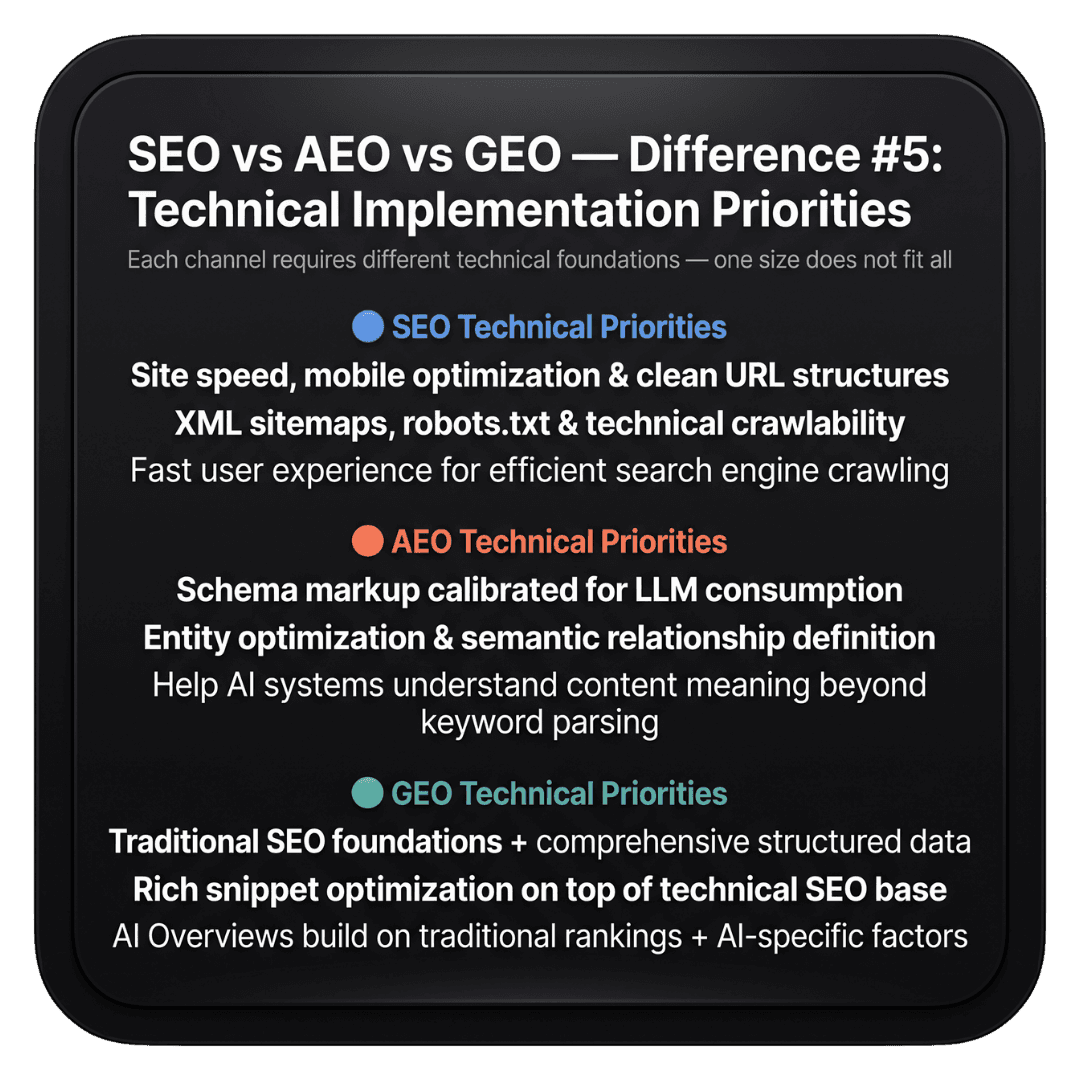
SEO prioritizes site speed, mobile optimization, clean URL structures, XML sitemaps, robots.txt configuration, and technical crawlability. Search engines need efficient crawling and fast user experience to rank content highly.
AEO requires schema markup calibrated for LLM consumption, entity optimization in structured data, semantic relationship definition, and specialized optimization helping AI systems understand content meaning beyond keyword parsing. Different schema requirements apply; our guide on how to optimize for AI search covers these technical steps.
GEO starts with strong traditional SEO technical foundations then adds comprehensive structured data implementation and rich snippet optimization. Google AI Overviews build on traditional search rankings enhanced by AI-specific factors.
Difference 6: Keyword Strategy Approach
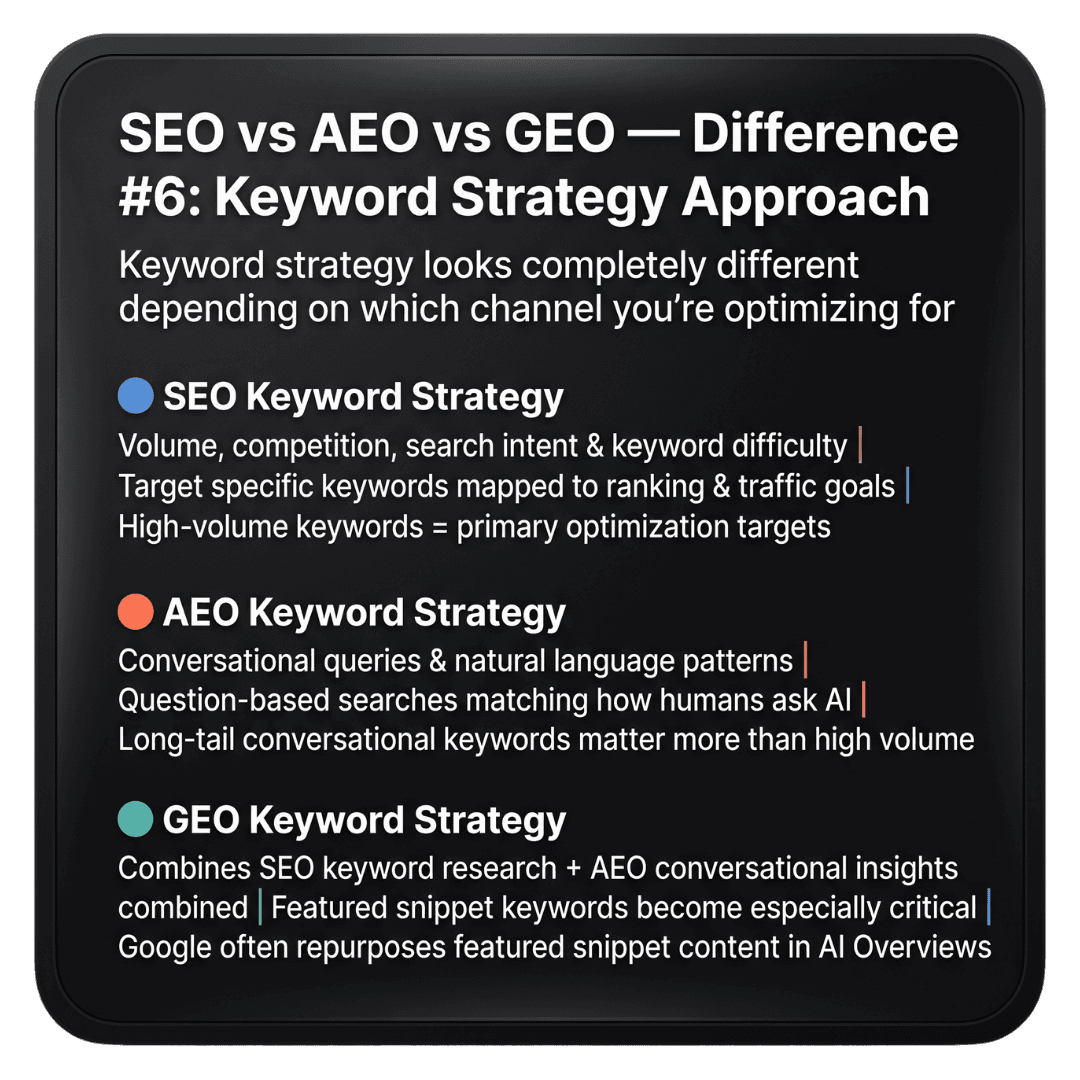
SEO focuses on keyword volume, competition, search intent, and keyword difficulty metrics. Optimization targets specific keywords with ranking and traffic goals mapped to each keyword.
AEO emphasizes conversational queries, natural language patterns, and question-based searches matching how humans ask ChatGPT and Perplexity questions. Long-tail conversational keywords matter more than high-volume keywords.
GEO uses SEO keyword research foundation but incorporates AEO insights understanding how people search AI platforms. Featured snippet keywords become especially important since Google often repurposes this content in AI Overviews.
Difference 7: Content Length Expectations
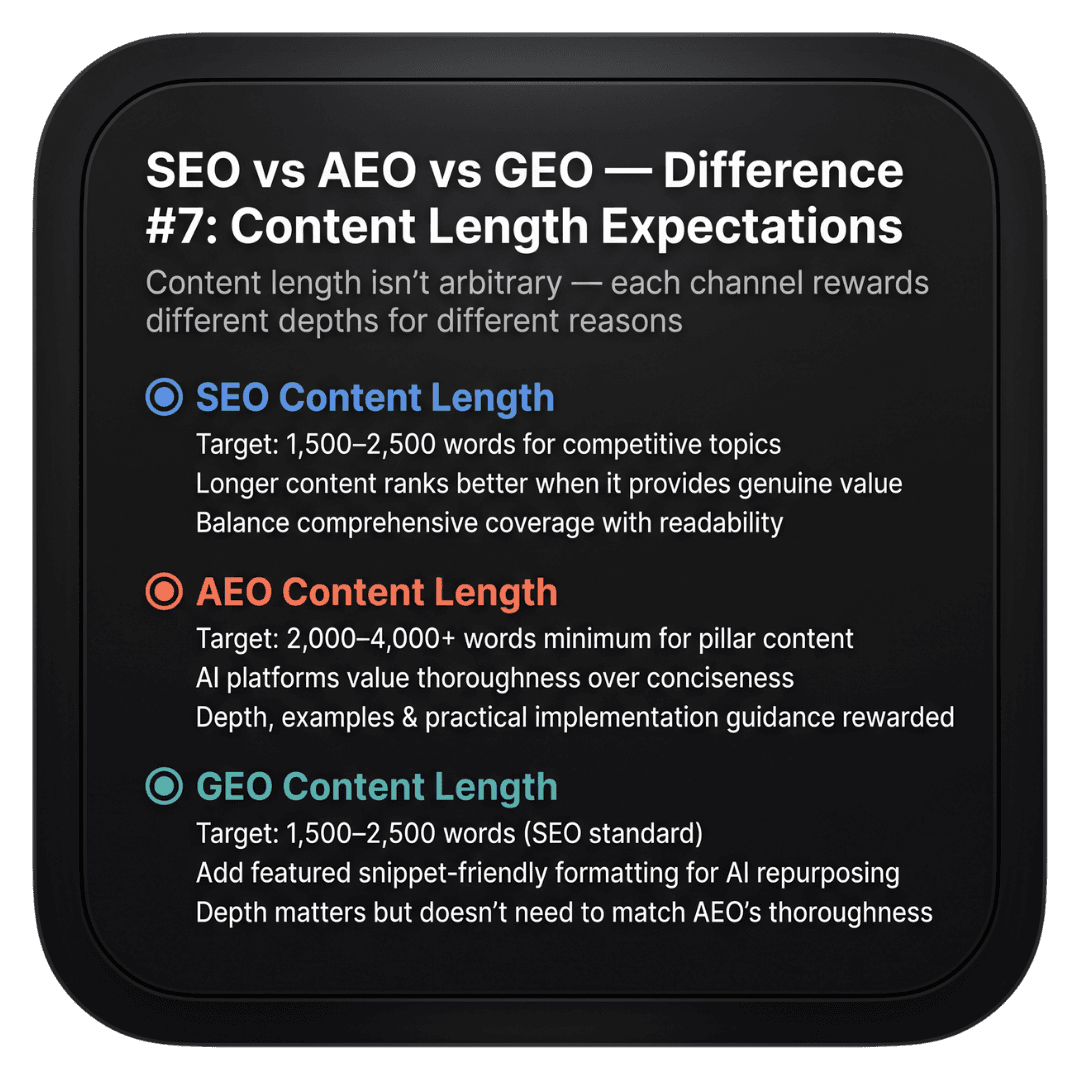
SEO typically targets 1500-2500 word articles balancing comprehensive coverage with readability. Longer content generally ranks better but must provide genuine value justifying length.
AEO favors comprehensive 2000-4000+ word content covering topics with extreme depth, extensive examples, and practical implementation guidance. AI platforms value thorough coverage more than conciseness.
GEO benefits from traditional SEO content lengths (1500-2500 words) with additional depth and featured snippet-friendly formatting that Google's AI can repurpose effectively.
Difference 8: Content Freshness Impact
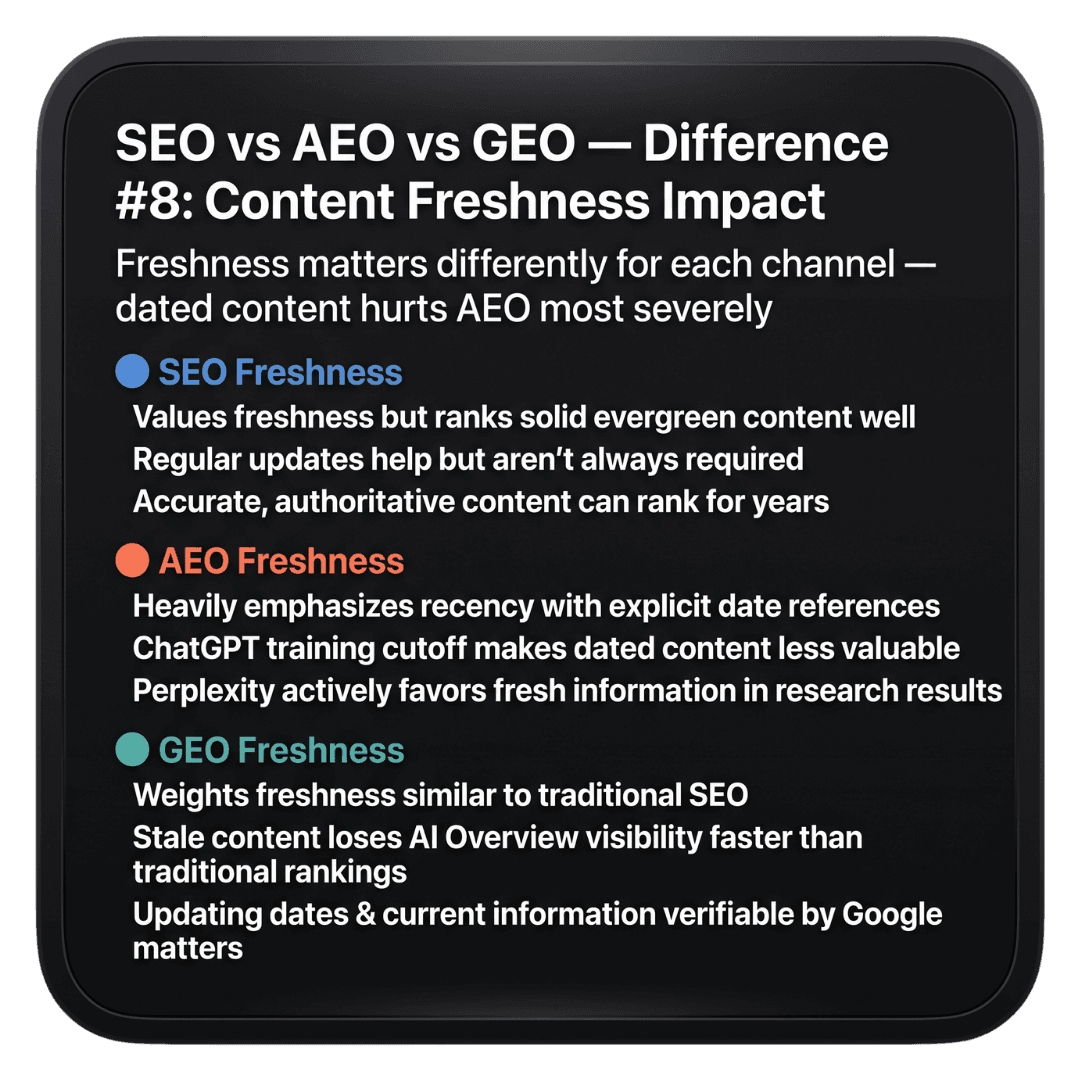
SEO values content freshness but ranks evergreen content well if technically sound and authoritative. Regular updates help but aren't always required if content remains accurate and valuable.
AEO heavily emphasizes content recency with explicit date references and current information. ChatGPT's training cutoff makes dated content less valuable, and Perplexity actively favors fresh information in research.
GEO weights content freshness similar to traditional SEO with additional emphasis on updating dates and current information that Google's AI can verify. Stale content loses AI Overview visibility faster than traditional search ranking.
Difference 9: Competitive Dynamics
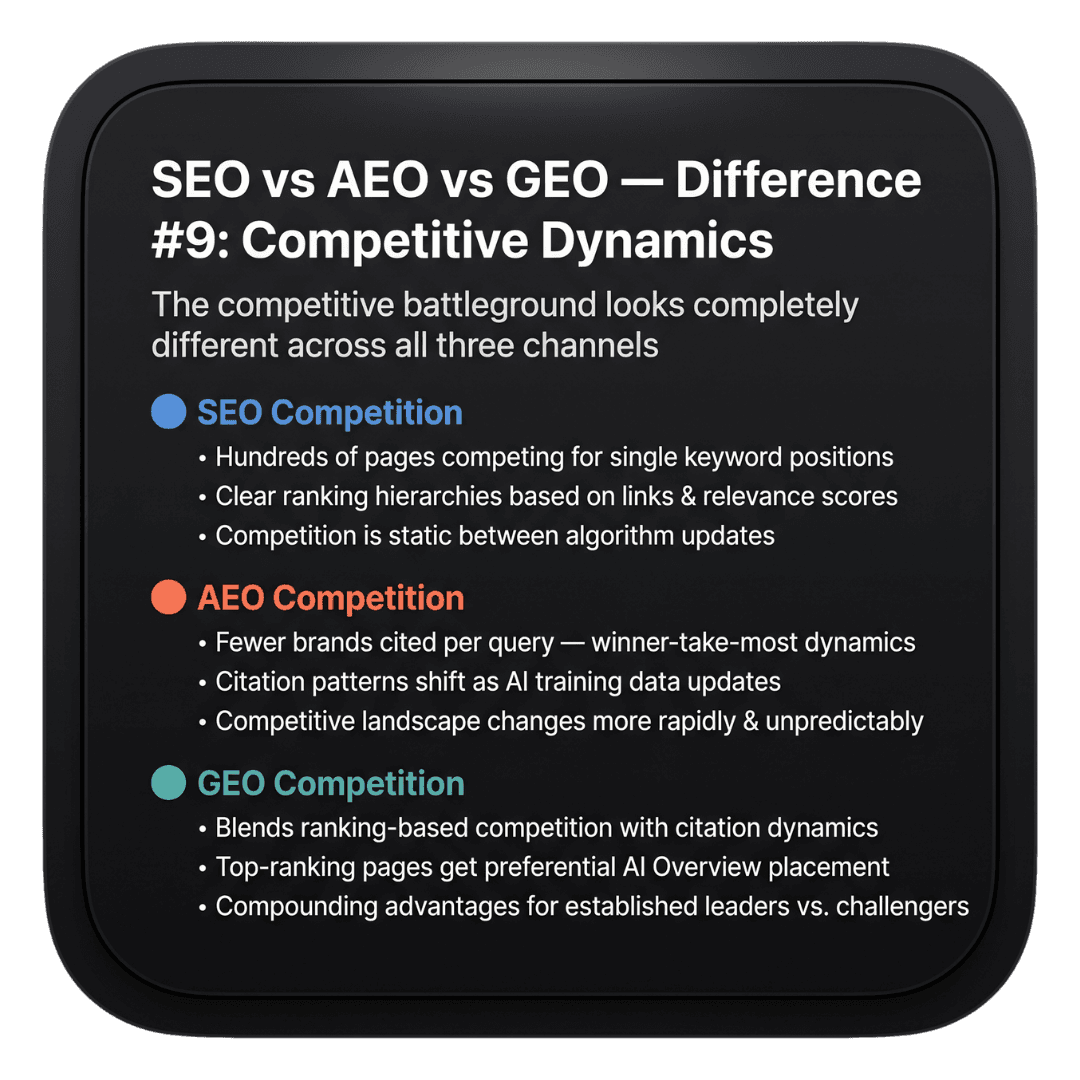
SEO competition centers on keyword rankings and link acquisition. Hundreds of pages may compete for single keyword positions with clear ranking hierarchies.
AEO competition focuses on citation frequency and quality. Fewer brands typically get cited for specific queries, but citation patterns shift as AI training data updates and platforms evolve algorithms.
GEO competition blends SEO's ranking-based competition with AEO's citation dynamics. Top-ranking pages get preferential placement in AI Overviews creating compounding advantages for established leaders.
Difference 10: Link Building Importance
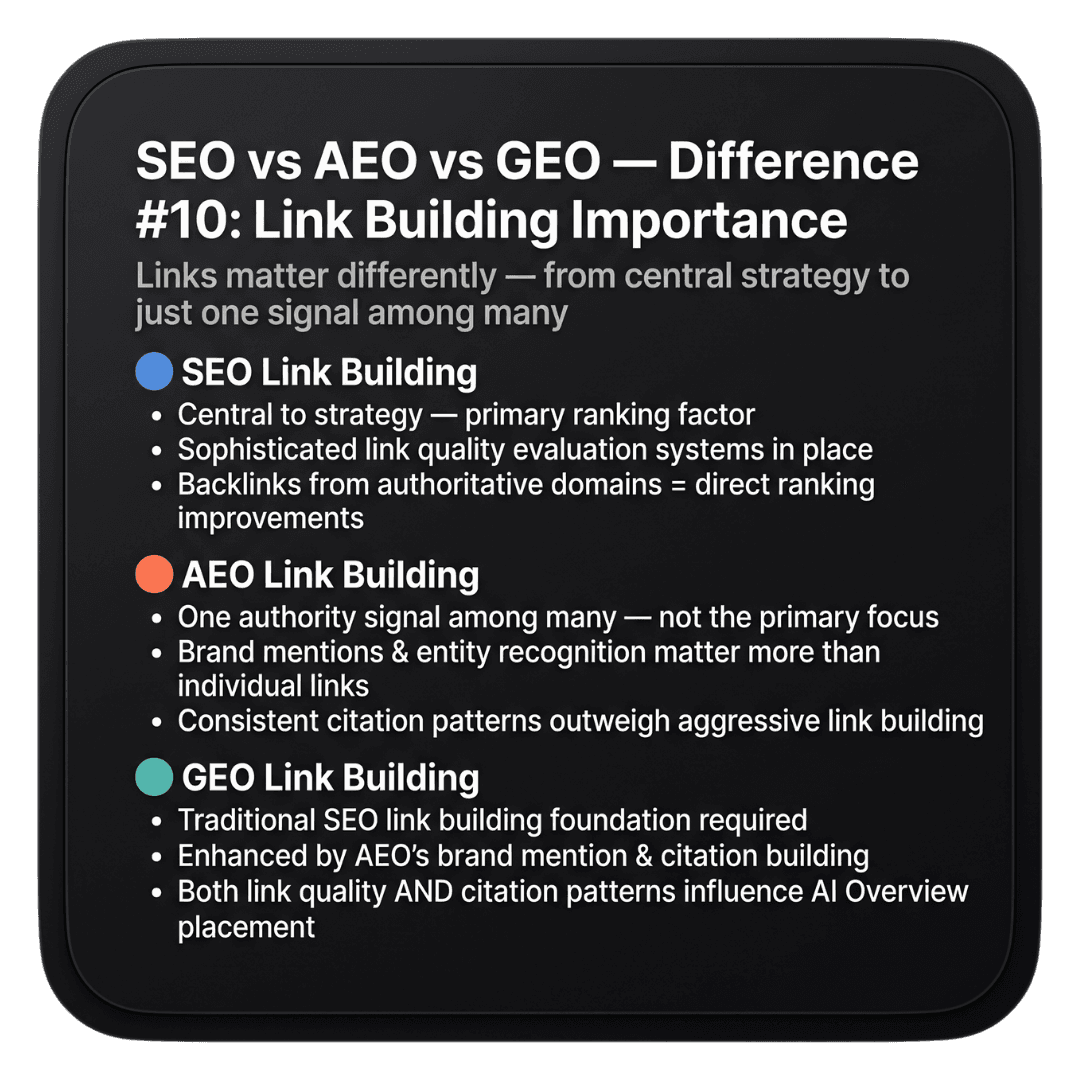
SEO makes link building central to strategy. Backlinks from authoritative domains remain primary ranking factors with sophisticated link quality evaluation systems.
AEO treats links as one authority signal among many but doesn't require aggressive link building. Consistent brand mentions and entity recognition matter more than individual backlinks to specific pages.
GEO requires traditional SEO link building foundation enhanced by AEO's brand mention and citation building. Both link quality and citation patterns influence AI Overview placement.
Difference 11: Measurement Metrics
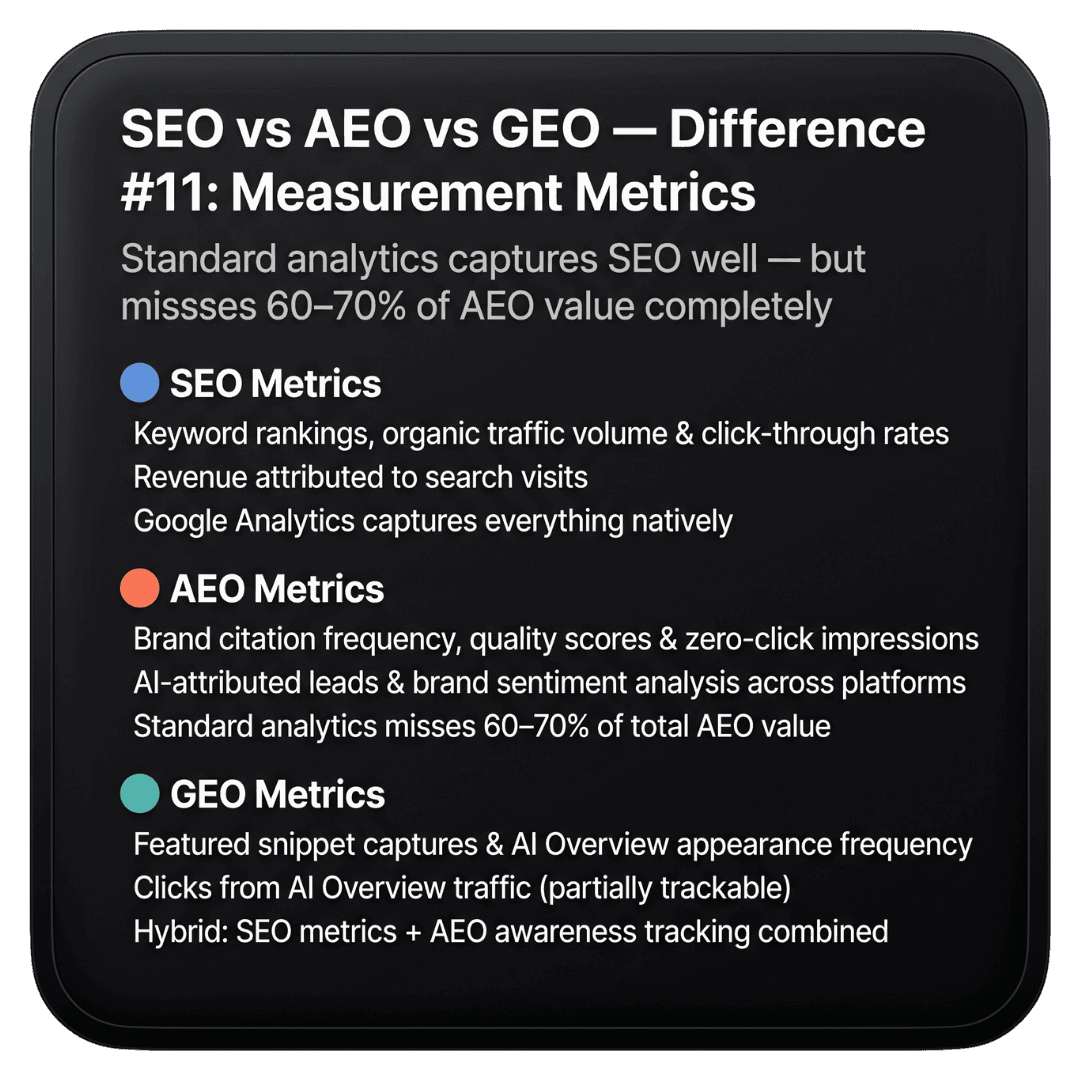
SEO measures success through: keyword rankings, organic traffic volume, click-through rates, and revenue attributed to search visits. Standard Google Analytics captures all metrics clearly.
AEO requires different metrics: brand citation frequency across platforms, citation quality and context, zero-click impressions, AI-attributed leads separate from website traffic, and sentiment analysis of how brands are portrayed. Standard analytics misses 60-70% of value.
GEO measures featured snippet captures, AI Overview appearance frequency, clicks from AI Overview traffic, and revenue influenced by AI search visibility. Hybrid measurement combines SEO metrics with AEO tracking.
Difference 12: Attribution Challenges
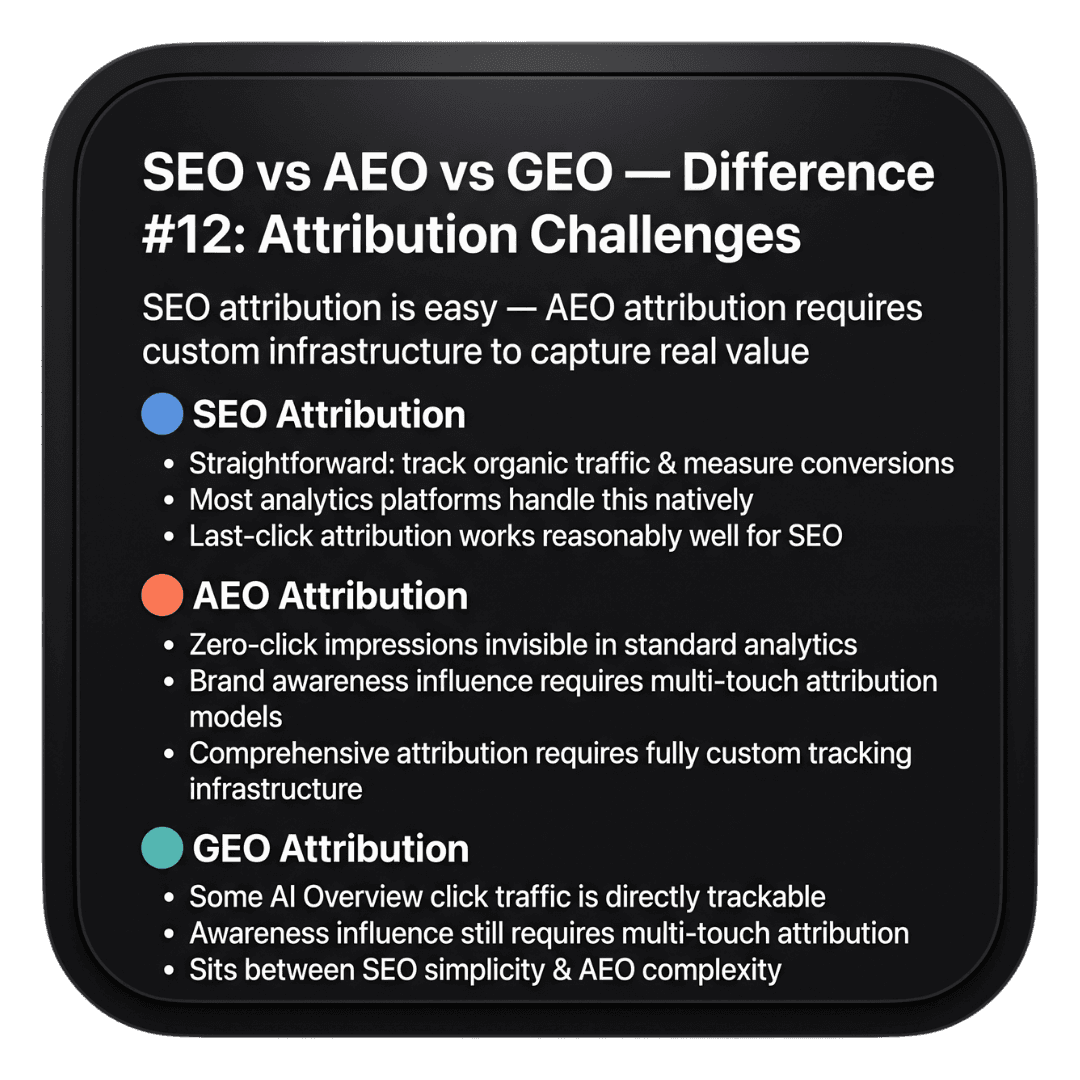
SEO attribution is straightforward: track organic traffic source and measure conversions from search visitors. Most analytics platforms handle this natively.
AEO attribution is complex: zero-click impressions never appear in standard analytics, brand awareness influence on later conversions requires multi-touch models, and many conversions happen through other channels after initial AEO discovery. Comprehensive attribution requires custom tracking.
GEO attribution sits between: some traffic comes directly from AI Overview clicks (trackable) but awareness influence requires multi-touch attribution similar to AEO's complexity.
Difference 13: Timeline to Results
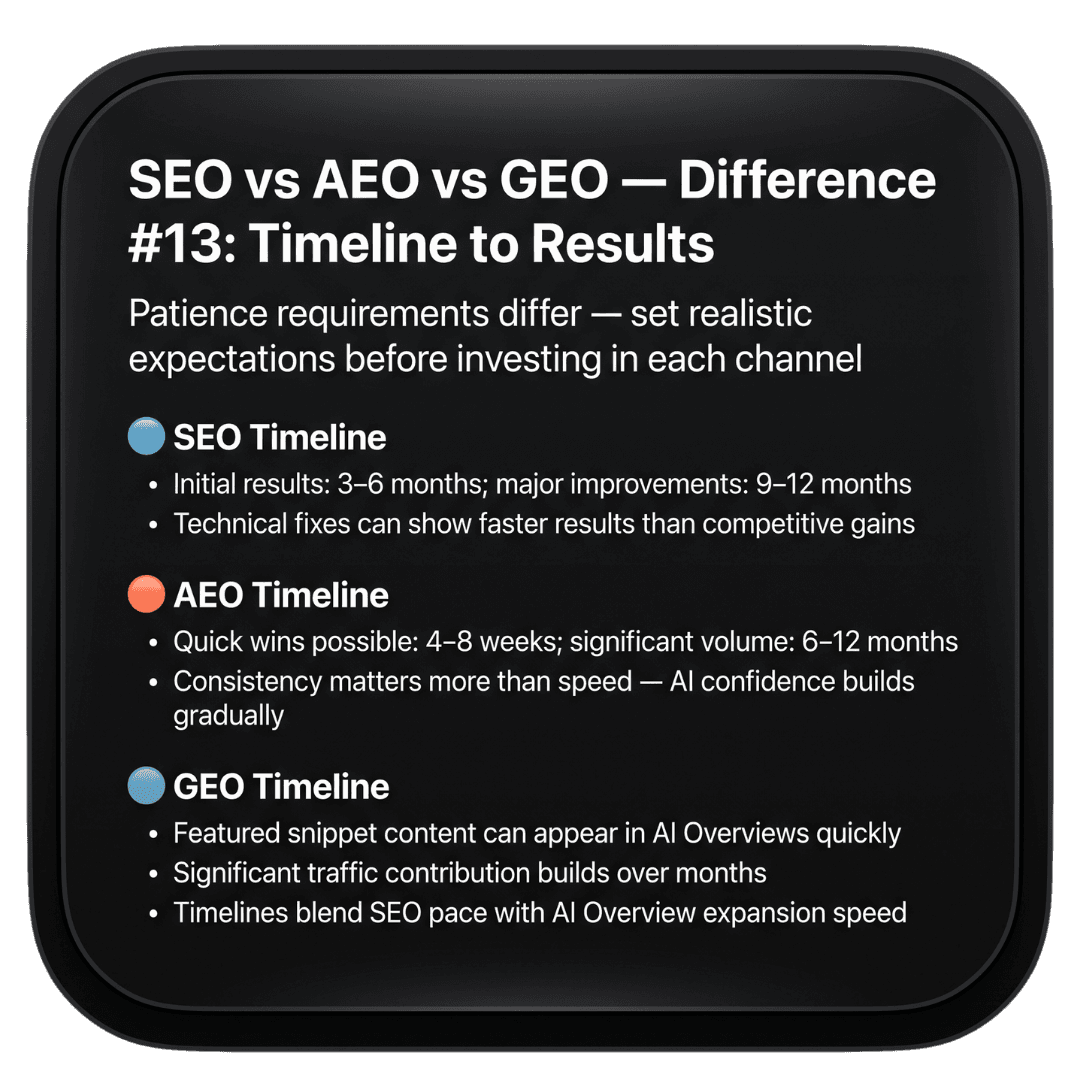
SEO typically shows initial results in 3-6 months with major improvements appearing by 9-12 months. Technical SEO improvements sometimes appear faster while competitive improvements take longer.
AEO shows potential quick wins in 4-8 weeks but major citation volume building takes 6-12 months. Consistency matters more than speed as AI platforms gradually increase confidence in your brand over time.
GEO blends timelines: Google AI Overview appearance can happen quickly for featured snippet-optimized content but significant traffic contribution builds over months as AI Overviews expand to more queries.
Difference 14: Organic Reach Limitations
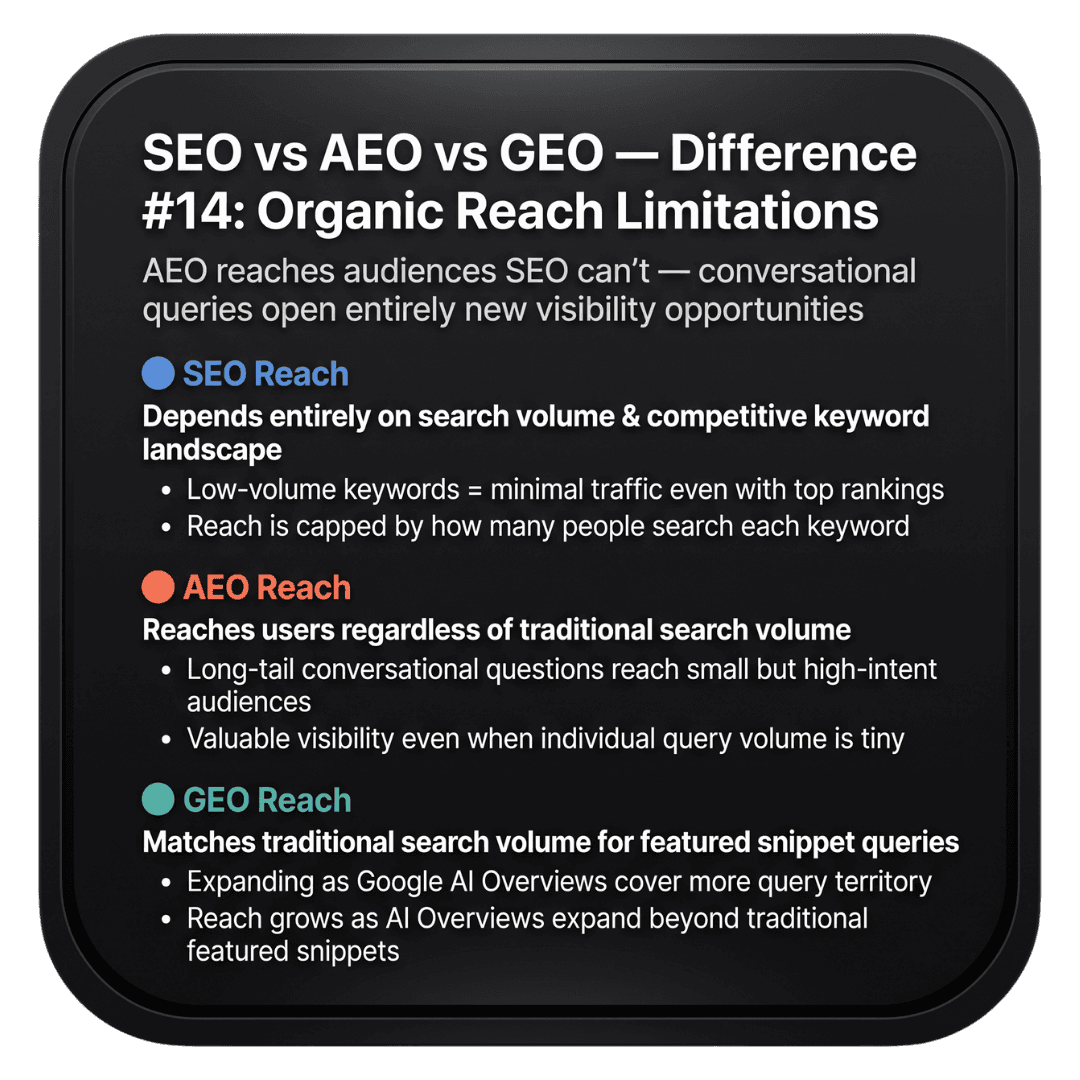
SEO organic reach depends on search volume and competitive keyword landscape. Low-search-volume keywords generate minimal traffic even with top rankings.
AEO reaches users regardless of search volume through conversational queries ChatGPT and Perplexity receive. Long-tail conversational questions reaching small audiences still provide valuable visibility and high-intent prospects.
GEO reach matches search volume for featured snippets but increasingly reaches more queries as Google AI Overviews expand to answers beyond traditional featured snippet territory.
Difference 15: Team Skill Requirements
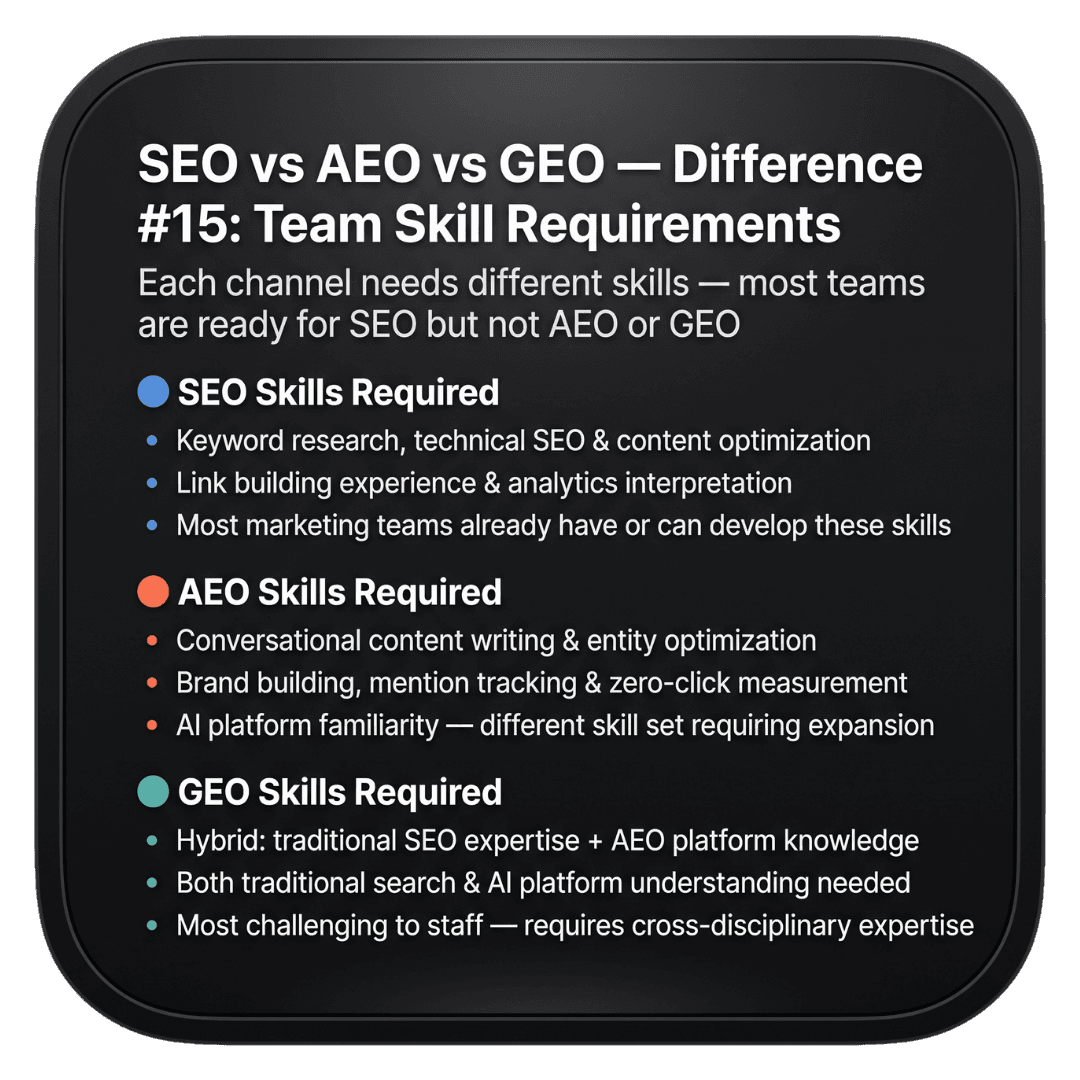
SEO requires: keyword research skills, technical SEO expertise, content optimization knowledge, link building experience, and traditional analytics interpretation. Most marketing teams already have or can develop these skills.
AEO requires: conversational content writing, entity optimization understanding, brand building and mention tracking, zero-click visibility measurement, and AI platform familiarity. Different skill set from traditional SEO requiring team expansion or retraining.
GEO requires: hybrid skills combining traditional SEO expertise with AEO knowledge. Teams need both traditional search and AI platform understanding making comprehensive implementation challenging.
Difference 16: Budget Allocation Models
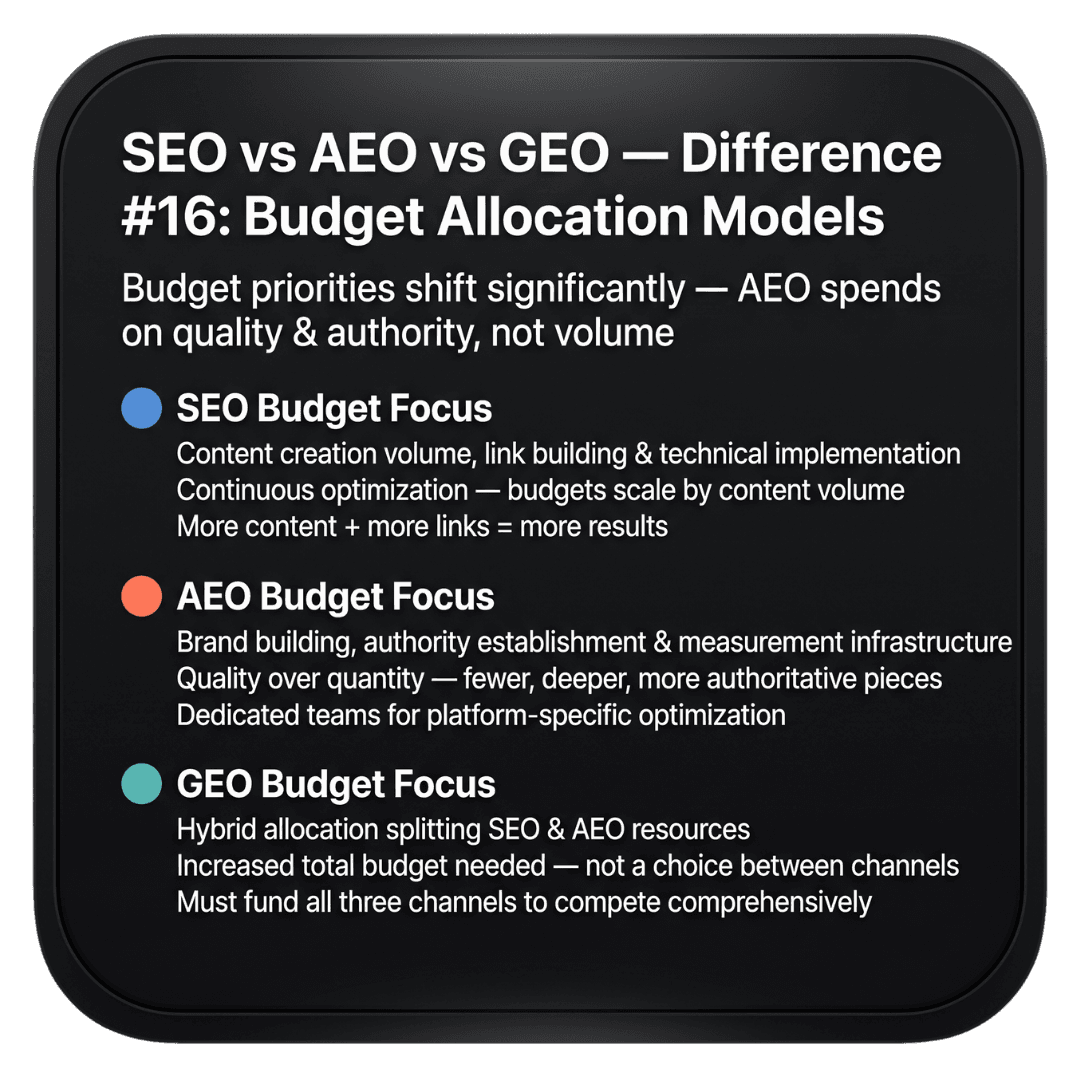
SEO budgets focus on: content creation, link building, technical implementation, and continuous optimization. Budgets scale with content volume and competitive intensity.
AEO requires different budget allocation: brand building and authority establishment, content depth rather than volume, specialized measurement infrastructure, and dedicated teams for platform-specific optimization. More budget goes to quality over quantity. Understanding what AEO services include helps set that budget realistically.
GEO budgets require hybrid allocation splitting resources between traditional SEO and AEO approaches. Organizations need increased total marketing budget to address all three channels effectively rather than choosing between them.
Difference 17: Strategic Integration Approaches
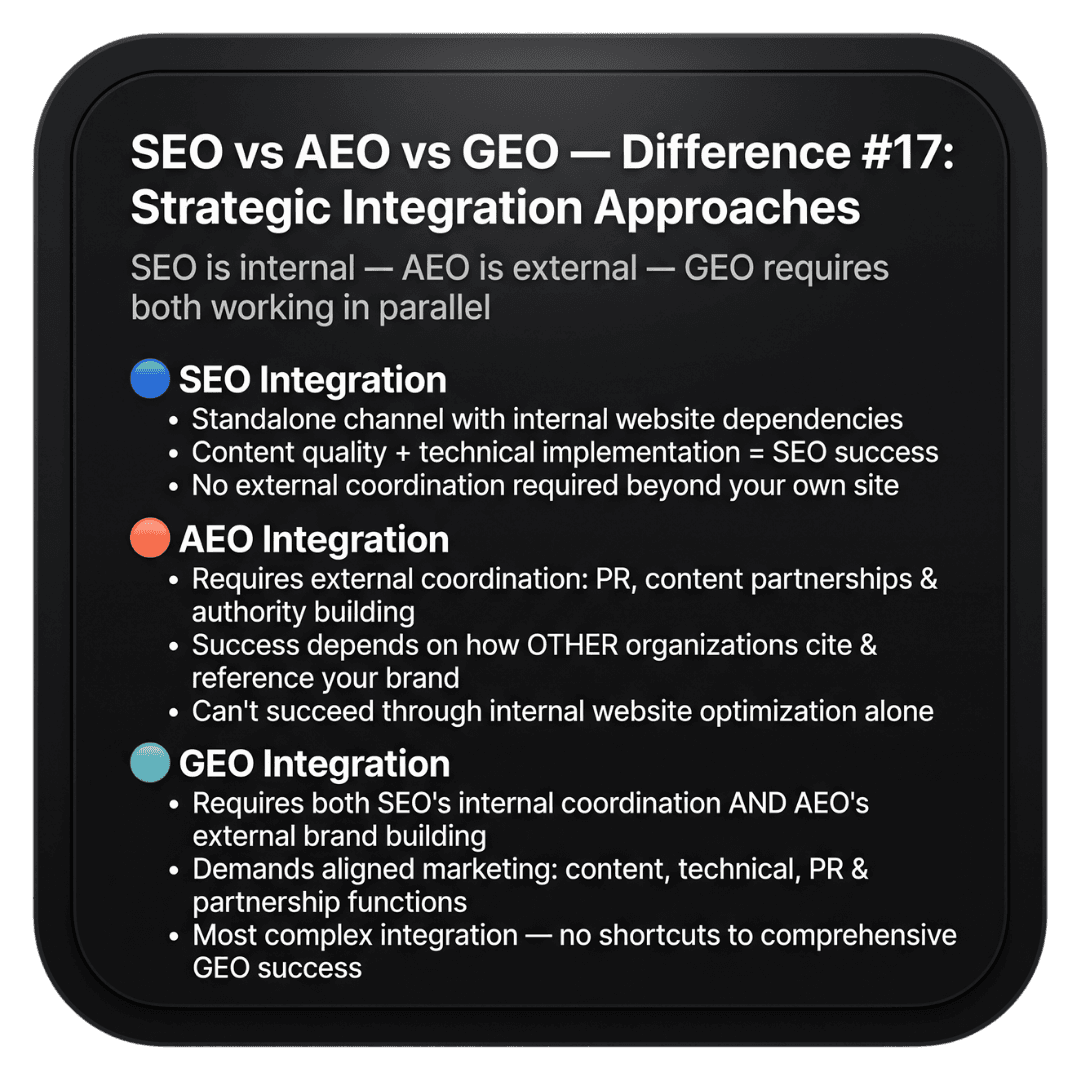
SEO operates as standalone channel with internal dependencies on content quality and technical implementation. SEO success doesn't require coordination beyond internal website optimization.
AEO requires external brand coordination including PR, content partnerships, and authority building beyond website optimization. Success depends on how other organizations cite and reference your brand.
GEO requires both SEO's internal coordination and AEO's external brand building. Comprehensive GEO success demands aligned marketing across content, technical, PR, and partnership functions.
Why Marketing Teams Struggle With These Distinctions
Most marketing terminology evolved from SEO, creating confusion when new disciplines emerge. The term "optimization" for all three approaches obscures fundamental differences in what's actually being optimized and how platforms evaluate success.
Historical SEO dominance means existing teams, processes, and budgets assume search engine optimization as primary channel. Introducing AEO and GEO requires organizational restructuring that teams resist without clear understanding of strategic necessity.
Tool ecosystems still emphasize SEO with limited AEO and GEO measurement infrastructure. Marketing teams can't easily see AEO and GEO performance because platforms don't provide visibility comparable to Google Analytics for traditional search.
How Organizations Should Allocate Resources Across All Three
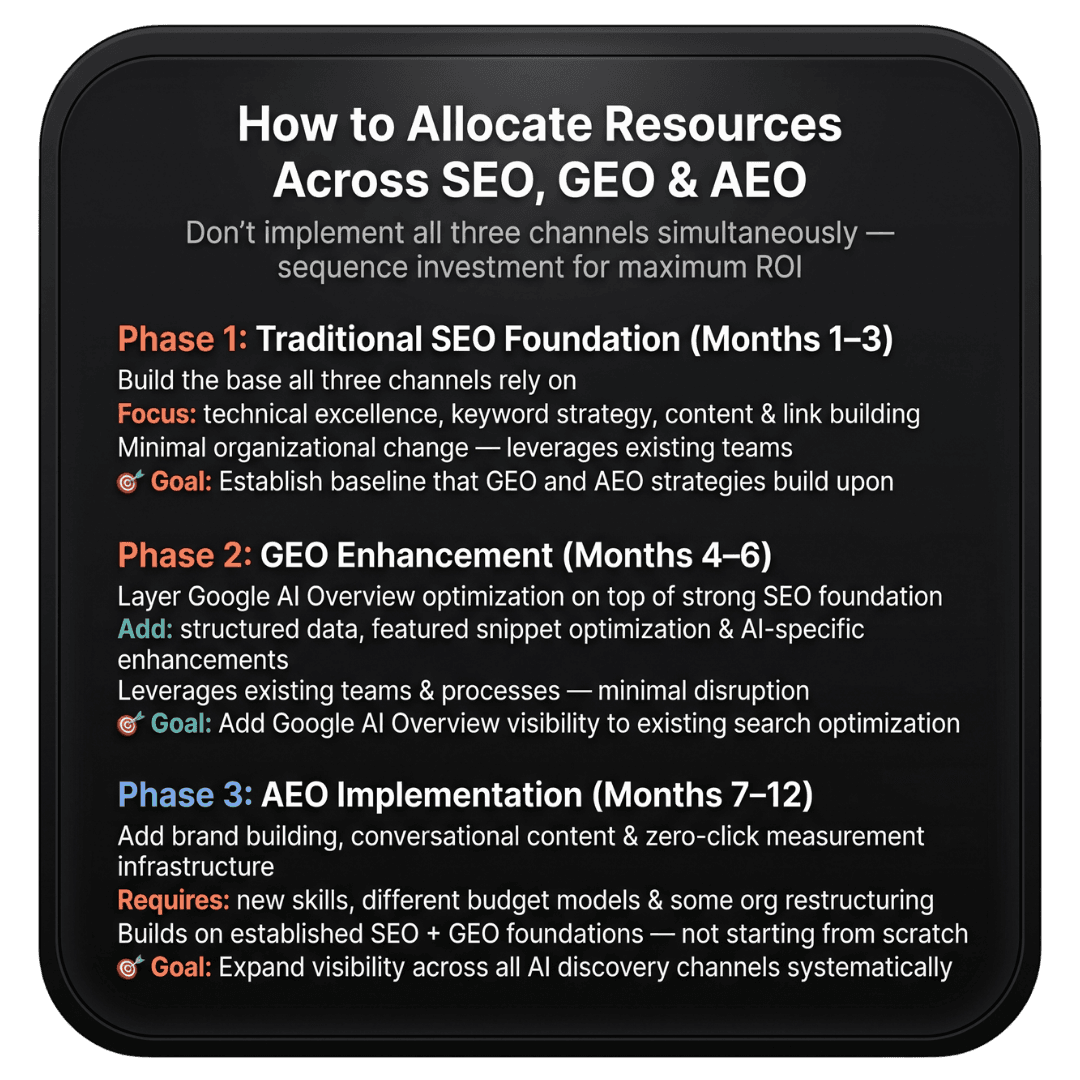
Phase 1: Traditional SEO Foundation (Months 1-3)
Start by ensuring solid traditional SEO fundamentals: technical excellence, keyword strategy, content optimization, and link building. All three channels benefit from strong SEO foundations making this investment essential regardless of AEO and GEO focus.
This phase requires minimal organizational change while establishing baseline that AEO and GEO strategies build upon.
Phase 2: GEO Enhancement (Months 4-6)
Layer GEO optimization on top of strong SEO foundation by implementing structured data, featured snippet optimization, and AI-specific enhancements. GEO builds most directly on traditional SEO work requiring less organizational disruption than AEO.
This phase leverages existing teams and processes while adding Google AI Overview visibility to existing search optimization efforts.
Phase 3: AEO Implementation (Months 7-12)
Add AEO strategies including brand building, conversational content optimization, and zero-click measurement infrastructure. AEO requires different skills and budget models requiring organizational restructuring but building on established SEO and GEO foundations.
This phased approach prevents organizational overwhelm while systematically expanding visibility across all discovery channels.
The Strategic Imperative for 2026
Traditional search will decline 25% by 2026 as AI platforms capture increasing share of discovery. Marketing teams continuing to treat SEO, AEO, and GEO as interchangeable approaches risk permanent competitive disadvantage as markets shift toward AI-driven discovery.
Organizations understanding these 17 differences and implementing platform-specific strategies will dominate their categories as AI search adoption accelerates. The competitive advantage window won't remain open indefinitely as more businesses recognize and implement these distinctions.
Building Your SEO, AEO, and GEO Strategy
Web of Picasso specializes in helping organizations understand these distinctions and implement coordinated SEO, AEO, and GEO strategies delivering visibility across all discovery channels. We've guided 150+ brands through transitions from traditional SEO-only approaches to comprehensive strategies addressing all three optimization disciplines.
Our methodology starts by assessing existing SEO strength, identifying AEO and GEO opportunities specific to your industry and competitive landscape, and building prioritized implementation roadmaps respecting organizational capacity while establishing visibility across all channels.
Contact Web of Picasso
Website: Visit Web of Picasso
Email: info@webofpicasso.net
Get Started: Book your SEO, AEO, and GEO strategy assessment